Trump Says He Does Not Want to Talk About North Korea's Denuclearization ... Is He Moving Toward Nuclear Arms Reduction Talks?
- Input
- 2026-08-20 16:08:48
- Updated
- 2026-08-20 16:08:48
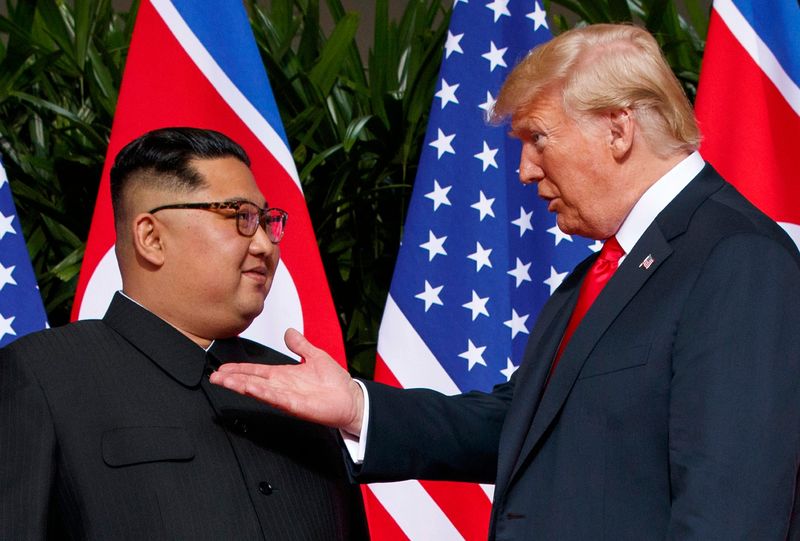
Speaking to reporters at The White House on the 19th local time, Trump said of North Korean leader Kim Jong Un, "He has 57 very powerful nuclear weapons." But when asked about North Korea's denuclearization, he sidestepped the question, saying, "I don't want to talk about that."
Diplomatic circles say Washington may be abandoning its long-held principle of "complete, verifiable and irreversible denuclearization (CVID)" and instead seeking a "pragmatic compromise" that would ease sanctions in return for a freeze on North Korea's nuclear program and limits on warhead numbers.
That is because Trump has been sending conciliatory signals toward North Korea, including ordering a reduction in ROK-US Combined Military Exercise, while Pyongyang has responded coolly.
Kim Yo Jong, the director-general of the Workers' Party of Korea (WPK), said in a statement the previous day that there was no need to even comment on the early end of Ulchi Freedom Shield. She also played a hard-to-get strategy on whether she had been in contact with Trump, saying it was "the only matter I do not know about." North Korea experts believe Pyongyang is demanding more than just a reduction in ROK-US military drills, namely recognition as a nuclear-armed state.
However, both South Korea and the United States are drawing a line against recognizing North Korea as a nuclear power. Instead, they are hoping for arms reduction talks to halt the annual increase of 10 to 20 North Korean nuclear weapons.
In a New Year's press conference on Jan. 21 last year, President Lee Jae-myung said, "Denuclearization is the most ideal outcome, but whether North Korea would give up its nuclear weapons is a stark reality," adding, "Reality and the desirable ideal are not easy to reconcile, and nuclear weapons continue to increase in the meantime."
Regarding a solution to North Korea's nuclear issue, Lee said, "We should first negotiate a halt to nuclear weapons development, then move on to arms reduction talks, and eventually proceed to denuclearization talks." He added, "I raise this every time I meet U.S. President Donald Trump and Chinese President Xi Jinping."
However, interpretations of Lee's remarks have long differed between South Korea's alliance camp and its autonomy camp. Foreign Minister Cho Hyun told the National Assembly that recognizing North Korea's nuclear status and entering arms reduction talks is "not the government's official position."
By contrast, Chung Dong-young, the Minister of Unification, said that stopping the acceleration of North Korea's nuclear program is the position of the Lee Jae-myung administration. Chung said, "North Korea's nuclear issue is ongoing. Its nuclear capability keeps growing," expressing concern. He explained, "What the president meant when he said whether North Korea would give up its nuclear weapons was to stop this [nuclear advancement]."
Meanwhile, confusion has also emerged between Seoul and Washington over the rapidly increasing number of North Korean nuclear weapons. Ahn Gyu-back, the Minister of National Defense, told the National Defense Committee of the National Assembly on the day that North Korea may possess as many as 80 to 120 nuclear weapons, more than double the 57 cited by Trump.
The discrepancy stems from the fact that Trump was referring to the number of finished nuclear warheads that can be mounted on missiles, while Ahn included nuclear material that could become nuclear weapons in the future.
By contrast, the international community often assesses the issue in the same way Trump did, focusing on the number of actual assembled warheads.
The Stockholm International Peace Research Institute (SIPRI), a world-renowned Swedish think tank, said in a report that North Korea may have secured enough fissile material to produce up to 90 nuclear warheads, but that the number of actually assembled warheads is estimated at around 60.
On warheads alone, the figure of 60 is similar to the 57 cited by Trump. But if nuclear material is included, the number rises to 150, approaching the maximum of 120 cited by Ahn.
The estimated number of nuclear weapons can also differ by more than 1.5 times depending on whether one assumes that 15 to 20 kilograms of highly enriched uranium are needed to make one weapon, or whether technological advances allow production with as little as 10 to 12 kilograms. The more highly North Korea's recently disclosed tactical nuclear warheads, such as the Hwasan-31 tactical nuclear warhead, are rated for miniaturization, the higher the estimated number of nuclear weapons becomes.
[email protected] Kim Kyung-soo Reporter