Lee Jae-myung's approval rating falls to 42.8%, the lowest since taking office... Seven in 10 people in their 30s say he is doing a poor job
- Input
- 2026-08-20 14:30:35
- Updated
- 2026-08-20 14:30:35
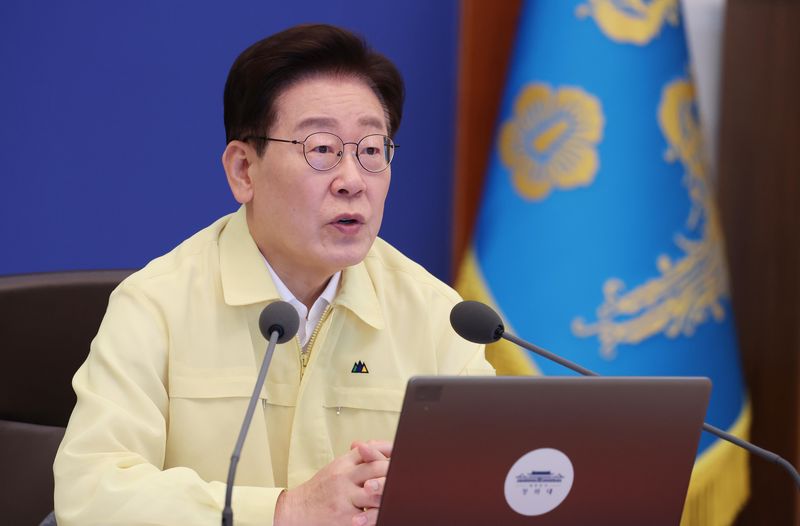
[Financial News] A poll released on the 20th showed that President Lee Jae-myung's approval rating for his administration had fallen to 42.8%, the lowest since he took office. His negative rating rose to 52.5%, moving above the majority mark and widening the gap with his approval rating beyond the margin of error. In particular, nearly seven in 10 people in their 30s viewed his administration negatively, and the negative rating in Seoul also exceeded 60%.
According to KSOI's regular poll of 1,001 adults nationwide aged 18 and older conducted on the 18th and 19th, Lee's approval rating for state affairs came in at 42.8%, down 5.0 percentage points from the previous survey. His negative rating, meanwhile, rose 5.7 points to 52.5%. Positive responses were split between 23.3% who said he was doing "very well" and 19.5% who said he was doing "somewhat well." Negative responses included 38.7% who said he was doing "very poorly" and 13.9% who said he was doing "somewhat poorly." KSOI said this was the lowest approval rating since it began its regular surveys.
The drop was especially pronounced among people in their 30s. In that age group, the negative rating reached 69.2%, far exceeding the 29.5% positive rating. Among people in their 20s, the negative rating was also 61.4%, well above the 29.8% positive rating. By contrast, approval ratings among people in their 40s and 60s were above 50%, at 52.2% and 50.5%, respectively. Compared with the previous survey, however, positive ratings among people in their 40s and 50s also plunged by 14.0 and 13.9 percentage points, respectively.
Public sentiment in Seoul was also poor. The negative rating in Seoul stood at 60.7%. In most other regions, negative ratings also topped 50%, including 59.1% in the Daejeon, Sejong and Chungcheong region, 55.0% in Daegu–Gyeongbuk, 54.4% in the Capital area, and 52.4% in the Busan–Ulsan–Gyeongnam region. By contrast, Jeonnam, Gwangju and Jeonbuk recorded a positive rating of 71.9%, the only region to exceed 70%.
By political leaning, the negative rating among moderates was 54.8%, higher than the 42.7% positive rating. Among progressives, the positive rating remained dominant at 67.1%, but it fell 10.1 percentage points from the previous survey. Positive ratings among moderates also dropped by 10.6 points. Among conservatives, the negative rating reached 76.5%.
"Economic recovery" was cited both as the area where the administration was performing best and the area where it was performing worst. The top areas for performance were economic recovery at 16.6%, diplomacy and security at 14.9%, and welfare and labor at 7.7%. The areas seen as weakest were economic recovery at 19.1%, eliminating anti-state forces at 16.1%, and national unity at 13.9%.
The outlook for the August 13 real estate measures also appears to be a burden. A negative view that the measures would have "no effect" on stabilizing the housing market came in at 51.8%, more than double the 25.4% who said they would be effective. In Seoul, in particular, the negative outlook reached 61.6%. KSOI cited concerns over the recent controversy surrounding real estate tax reform and the August 13 supply measures as factors behind the sharp drop in support in Seoul and among people in their 30s.
The survey was conducted using an automated response system with virtual mobile numbers provided by the three major mobile carriers. The margin of error was plus or minus 3.1 percentage points at the 95% confidence level, and the response rate was 5.8%. More details are available on the website of the Central Election Poll Deliberation Commission.
[email protected] Sung Seok-woo Reporter