[Exclusive] He was assaulted and even recognized as an industrial accident, but the labor office said it was not workplace harassment
- Input
- 2026-08-24 14:52:55
- Updated
- 2026-08-24 14:52:55
According to Financial News on the 24th, the Seoul Gangnam Branch of the Seoul Regional Office of the Ministry of Employment and Labor administratively closed a workplace harassment complaint filed in June by A, an unregistered executive at foreign software company E, as "no violation." The labor office concluded that it could not confirm any violation of the ban on workplace harassment or the duty to take action when such harassment occurs.
A joined E in December 2020 as Marketing Director. According to A's side, he raised concerns after being instructed to send promotional emails using customer personal data held by the company, saying the order could violate the Personal Information Protection Act. He was then dismissed in February 2021. After going through wrongful dismissal relief procedures and administrative litigation, the Supreme Court of Korea finalized in December 2024 its ruling that A's dismissal had been wrongful. After his reinstatement, however, the company transferred him to the Incheon Songdo office instead of his original Seoul Office. In March last year, the Seoul Regional Labor Relations Commission ruled that the transfer was improper and ordered his return to his original post.
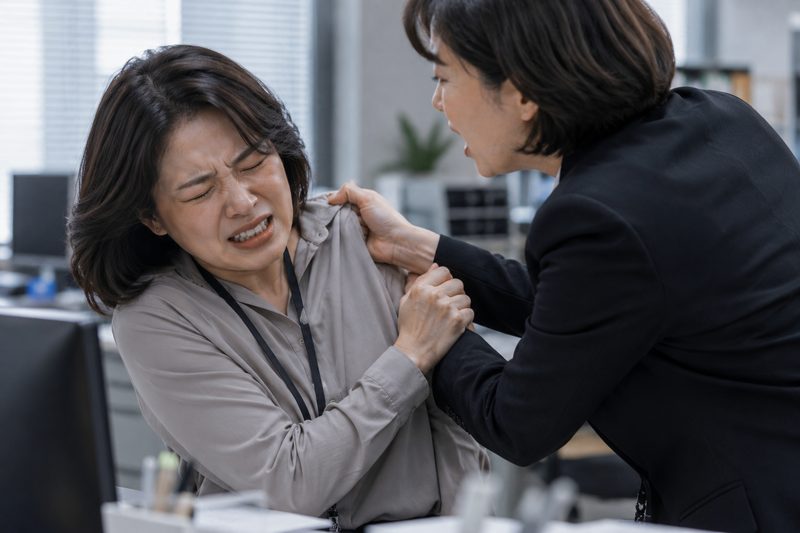
The assault occurred four days after the labor commission's ruling. According to the complaint, A visited the Seoul Office to discuss work-related matters and was speaking with B, a registered director, when B used physical force to drag A out of the conference room. A recording from the scene also captured B saying, after A said he would leave the room, "Then I'll hold you down and hit you again."
The Seoul Gangnam Police Station determined that B had assaulted A, including repeatedly pulling A's left wrist, and sent the case to the Seoul Central District Prosecutors' Office. Prosecutors later issued a summary indictment against B on assault charges. EAP approved the case as an occupational accident in May last year. The industrial accident approval documents listed a sprain and strain of the left wrist and injuries to the shoulder area as the diagnoses.
A also claimed that, beyond the assault, he was subjected to exclusion from work, defamation, and improper instructions. The complaint said B referred to A to another employee as "a strange person who came in through a lawsuit," excluded him from access to the work system and from meetings and training materials, and took no meaningful action even after A challenged the legitimacy of the transfer.
The Seoul Gangnam Branch of the Ministry of Employment and Labor reached a different conclusion. After reviewing the statements of the parties, witness testimony, and the recorded scene, the labor office said B's conduct "cannot be seen as ordinary assault in light of social norms." It also found no evidence of persistent or repeated verbal abuse or insulting remarks, and said the conduct could not be viewed as clearly exceeding the appropriate scope of work. It further concluded that the work exclusion could not be regarded as an intentional effort to leave A out of major projects.
The labor inspector in charge told Financial News by phone that "if there is an assault, it is often recognized as workplace harassment, but in this case, after listening to the full recording, it was difficult to see it as unilateral workplace harassment." Regarding the investigation by the outside labor law firm hired by the company, the inspector said, "The employer appointed an external investigator without B's involvement and conducted the inquiry objectively, and there was nothing clearly unreasonable in the conclusion." On the issue of the allegedly improper transfer, the labor office said there was no objective evidence showing that B had authority over personnel decisions.
The company also flatly denied A's claims. An E representative said, "Because B is a registered executive who has worked here for a long time, there could be concerns about the credibility of an internal investigation, so we excluded even our existing advisers and asked an outside labor law firm with no prior business relationship to handle it." The representative added that the firm was instructed to conduct an objective investigation based on statements from both sides and related materials. B explained, "I only grabbed his wrist to stop him from causing a disturbance and disrupting work, and suggested we move to another place to talk." B added, "It is impossible that I assaulted him in an office where everything inside could be seen clearly." He also argued that A was deliberately filing assault reports and industrial accident claims, saying, "Even the outside labor law firm's investigation and the labor office's review concluded that this was not workplace harassment."
Experts say the current system, which relies heavily on the judgment of individual labor inspectors in workplace harassment cases, needs to be improved. Moon Young-seop, a labor attorney at Labor Law Firm Ro&N, said, "Courts have precedents and labor commissions have published rulings, so standards are formed as cases accumulate. But workplace harassment cases handled by the labor office are not properly disclosed on an individual basis." He added, "The same case can be judged differently depending on the inspector, but because those differences cannot be verified, self-correction is difficult. We need to accumulate and disclose the labor office's judgment examples to establish objective standards."
[email protected] Kim Ye-ji Reporter