Trump Says Rates Should Be Cut When the Economy Is Strong, While the Fed Says They Should Be Raised
- Input
- 2026-08-20 09:19:47
- Updated
- 2026-08-20 09:19:47
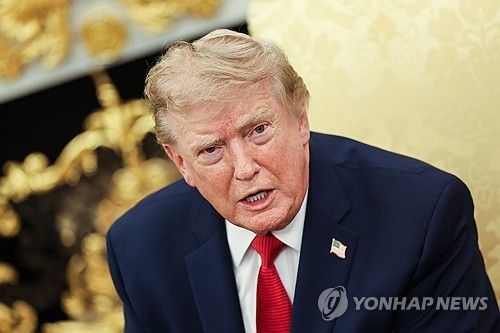
[Financial News] Donald Trump, President of the United States, has pressured the Federal Reserve System (Fed) to cut its benchmark rate, citing the strong economy. But inside the Fed, support for further rate hikes appears to be growing. Many Fed officials said rates should be raised further if inflation does not slow. With the U.S. national debt surpassing $40 trillion for the first time, rising Treasury yields and a heavier government interest burden are expected to intensify the power struggle between the Trump administration and the Fed.
Trump says rates should be cut... pressure for hikes grows at the Fed
At an event at The White House on the 19th with major figures from the virtual asset industry, Trump said, "Interest rates should not rise because of our country's success. They should be able to come down as success grows."
He argued that the United States economy is performing well, but the Fed is keeping rates high because it is overly wary of inflation. "When we release good numbers, they get too afraid of inflation and keep raising rates," Trump said. "There is no need for that. Rates should be allowed to fall instead."
However, the minutes from the Fed's July Federal Open Market Committee (FOMC), released the same day, said the opposite of Trump's claim. According to the minutes from the July 28-29 FOMC meeting, a majority of participants believed the benchmark rate should be raised further if inflation does not fall enough toward the Fed's 2% target.
Some officials also said price pressures are broadening and argued that tighter monetary policy is needed to achieve the Fed's goals of price stability and maximum employment. They warned that delaying action could force larger rate hikes later, increasing the cost to the economy.
In fact, at that FOMC meeting, the Fed left the benchmark rate unchanged at 3.50% to 3.75%, but three members dissented and called for a 0.25 percentage point increase. No one argued for a rate cut.
Earlier this year, markets widely expected the Fed to begin cutting rates before year-end as inflation eased. But concerns over inflation risks, driven by Middle East conflict and rising global oil prices, have shifted sentiment inside the Fed toward caution.
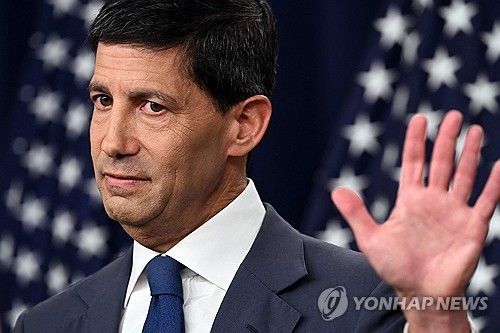
A $40 Trillion Debt Burden Also Pressures Rates
Behind Trump's push for lower rates is an economic policy centered on growth and investment expansion. At the event, he also highlighted virtual assets and artificial intelligence (AI) as the next engines of growth for the U.S. economy.
Trump urged Congress to pass the Clarity Act, which would establish the United States' regulatory framework for virtual assets. The bill aims to clearly define the regulatory authority of the United States Securities and Exchange Commission (SEC) and the Commodity Futures Trading Commission (CFTC) by classifying virtual assets as securities, commodities and other categories.
He said, "The United States is an unmatched leader not only in Bitcoin and virtual currencies, but also in a wide range of technologies such as AI," adding, "Now Congress needs to pass the bill and move to the next stage."
The United States' massive national debt is also cited as another reason Trump wants lower rates. According to the U.S. Department of the Treasury, total U.S. national debt stood at $40.047 trillion as of the 18th, surpassing $40 trillion for the first time. That is roughly $10 trillion more than in January 2022, when it first topped $30 trillion. As the debt burden grows, higher Treasury yields quickly increase the government's interest costs. With about two months left in fiscal 2026, the U.S. government's cumulative interest expense has reached $1.17 trillion, up 15% from a year earlier. It is the third-largest spending item in the federal budget. As national debt also nears the statutory ceiling of $41.1 trillion, the chances of renewed political battles over the debt limit are rising.
[email protected] Kim Kyung-min Reporter