"You made 3 billion won just because you bought a house, so of course you should pay taxes"... To make people say that, the government must win on the details [Tax War 6·Final]
- Input
- 2026-08-22 05:00:00
- Updated
- 2026-08-22 05:00:00
The 8·3 tax reform plan unveiled by the Lee Jae-myung administration[Tax War Triggered by Real Estate]has escalated into a full-blown conflict. Elderly homeowners who have become high-end property owners almost by chance after living in their homes for decades have been hit hardest, sparking unprecedented tax resistance. Financial News will examine the problems in the reform plan in six installments.
[Financial News] After the government announced its 2026 tax reform plan on the 3rd, market confusion and criticism intensified, especially in the real estate sector. The backlash grew after it became known that the plan would raise the tax burden on ultra-expensive homes and non-resident single-home owners, while restructuring comprehensive real estate holding tax and capital gains tax benefits around actual residence.The controversy has now moved to the National Assembly. Within the ruling party, calls are growing for "detail-level adjustments," while opposition lawmakers are introducing bills aimed at easing the burden on single-home owners.
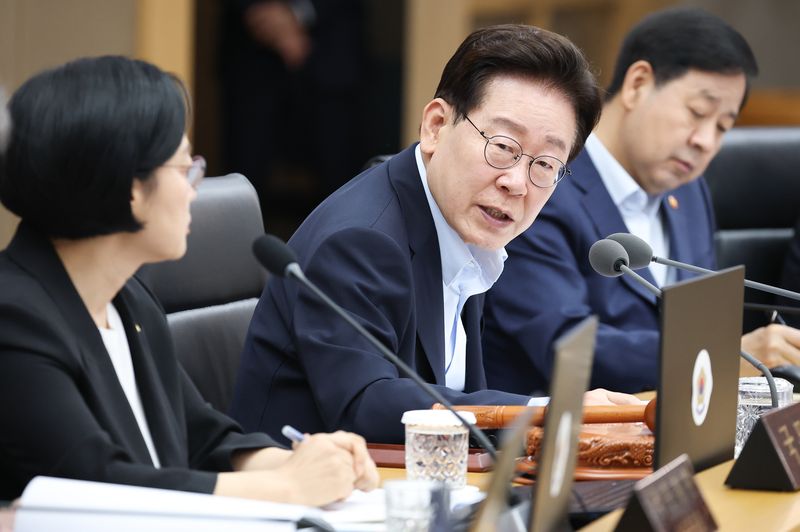
President Lee Jae Myung also said at the Cabinet meeting on the 11th at the Government Complex Sejong, "There is a difference between announcing a policy decision and announcing a proposal. When you present a proposal, you listen to opinions," adding, "A proposal can still be changed."
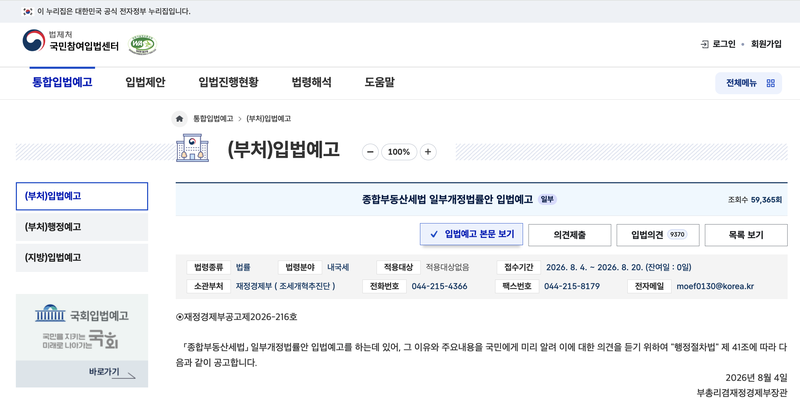
As of the 20th, the final day of the legislative notice period for the "Comprehensive Real Estate Holding Tax Act amendment," 9,370 public comments had been submitted to MOLEG's public participation legislative center.
"Is rising home prices a crime?", "What about tenants?", "What counts as a non-resident?"... A wide range of disputes
Along with public feedback, experts also pointed out areas that need revision. The first is the newly introduced cap on tax credits under the comprehensive real estate holding tax.
Under the current system, a single-home owner can receive up to an 80% tax credit by combining senior citizen and long-term ownership deductions, with no separate cap on the deduction itself. But the reform plan converts the long-term ownership deduction into a long-term residence deduction and limits the tax credit to a maximum of 8 million won in 2027 and 6 million won from 2028 onward.
Shin Bo-yeon, a professor in the Real Estate AI Convergence Department at Sejong University, said, "This is the first time a monetary cap has been introduced."
She added, "Even if it has nothing to do with speculation, sharply increasing taxes for elderly single-home owners who have lived in one house for a long time could create problems if home prices have risen. If they lack cash flow after retirement and cannot afford property taxes, it may ultimately be seen as telling them to sell or move, so the plan needs to be reconsidered."
There are also concerns that stronger tax burdens could prompt owners to move into their homes, rather than putting properties on the market as the government intended, which could reduce rental supply.
Kim Hak-ryeol, head of the SmartTube Real Estate Research Institute, said, "If homeowners who cannot afford property taxes sell their homes or move in themselves, rental housing supply could shrink and eventually push up rents." He added, "Unlike home sales, jeonse and monthly rentals are directly tied to housing, so measures that keep rental listings circulating in the market are just as important as new supply."
Another challenge for a residence-centered tax system is how far to recognize unavoidable non-residence. The government has decided to count certain periods of non-residence as residence periods under specific conditions, such as school enrollment, job changes or transfers, medical treatment, or living with parents aged 60 or older.
Yang Jae-mo, a professor in the Department of Law and Public Administration at Hanyang Cyber University, said, "It is hard to believe the market will respond exactly as the government intends. The moment people feel that 'that person qualifies, but why don't I?' the policy goal itself can be undermined."
"Different next year, different again the year after"... Tax offices also fear confusion
Tax experts are voicing concern that the system has become overly complicated.
Cheon Gyeong-wook, CEO of Songwoo Tax Firm, said, "The tax system has been revised quite a lot this year, and if you look closely, there are many transitional rules by year. The deductions related to long-term ownership also differ by year, making the system quite complex."
Because the deduction methods, limits, and tax rates for the comprehensive real estate holding tax and capital gains tax will change gradually across 2027, 2028, and 2029, taxpayers will find it difficult to predict their future tax burden.
Cheon said, "Even if this is part of a transition to a new system, if the revisions are not properly made, confusion could repeat every year for taxpayers and tax offices."
The Korean Association of Certified Public Tax Accountants also warned that as key systems such as the comprehensive real estate holding tax rate, the fair market value ratio, and the special long-term holding deduction are changed in stages rather than all at once, the risk of underreporting or errors, as well as compliance costs, could rise not only for ordinary taxpayers but also for tax professionals.
Kim Min-seok: "I agree with the broad direction, but the details need refinement"

Even within the ruling Democratic Party of Korea, voices are emerging that the details of the government plan need to be adjusted.
On the 13th, while regional primary contests for the party convention were underway, party leader Kim Min-seok wrote on social media, "On the premise that we agree with the broad direction of the real estate tax reform plan, we need to discuss refining the details."
Kim focused on non-resident single-home owners and the jeonse and monthly rental markets. He noted that because there are many middle-class single-home owners living outside their homes nationwide, changes in their taxes could have a ripple effect on the rental market.
As an alternative, he suggested keeping the current system for non-resident single-home owners under the comprehensive real estate holding tax, while raising only the basic deduction for resident single-home owners to 1.4 billion won.
He also said further discussion is needed on issues such as whether a single-home owner with joint spousal ownership is disadvantaged compared with sole ownership, and whether tax benefits should be offered to people aged 65 or older who move to non-capital regions.
The ruling party and the government are expected to discuss detailed revisions at a high-level consultative meeting on the 23rd.
Opposition pushes for 1.5 billion won tax exemption and expanded long-term holding deductions... even a prorated approach
The opposition, led by the People Power Party, is moving more aggressively. It is already seeking revisions through lawmakers' bills.
People Power Party lawmaker Seo Myeong-ok has introduced a revised Income Tax Act bill that would raise the capital gains tax exemption threshold for single-home owners from the current 1.2 billion won to 1.5 billion won and expand the long-term holding deduction rate. Fellow party lawmaker Kim Eun-hye has also proposed a revision that would recognize property tax and comprehensive real estate holding tax paid during the ownership period as necessary expenses, thereby reducing capital gains.
People Power Party lawmaker Park Soo-min has introduced a bill that would defer tax payment on part of the capital gains for single-home owners who have held and lived in a home for more than three years and then sell it to move to a smaller, cheaper house, until the new home is sold. This is a deferred taxation approach.
There is also likely to be debate over how far the new system should apply to people who have held homes for a long time even before the reform plan.
People Power Party lawmaker Na Kyung-won is pushing an Income Tax Act revision that would apply the current deduction rate only to the ownership period before the law takes effect and apply the new rules only to the period after implementation, a prorated-by-period approach.
How much will the original 8·3 plan change?... The National Assembly is the turning point
In the end, the regular session's tax bill review is expected to focus on finding common ground between the government's "residence-centered taxation" principle and the need to protect the tax burden and trust of existing single-home owners.
The government has not ruled out revisions either. It says it will review whether further adjustments are needed based on opinions raised during the legislative notice period and discussions in the National Assembly.
MOLEG Minister Woncheol Cho recently said in an interview with a media outlet, "Going forward, during the review of the amendment bill, we will work closely with MOEF from a legislative perspective so that the bill can be well prepared." MOEF also said, "We are listening as broadly as possible to a wide range of voices, and we will review reasonable supplementary measures so that the purpose of the reform can be fully reflected."
[email protected] Seo Yoon-kyung Kim Hee-sun Reporter