KOSPI plunges 5.8% on U.S. rate shock... Foreign investors 'panic sell' [fn closing market report]
- Input
- 2026-08-19 15:50:46
- Updated
- 2026-08-19 15:50:46
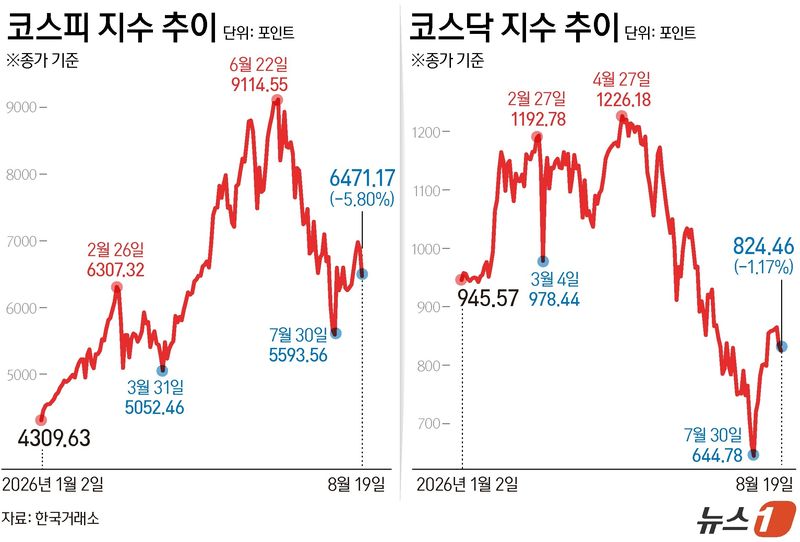
The KOSPI closed at 6,471.17, down 398.66 points, or 5.80%, from the previous trading day. It opened at 6,528.77, down 341.06 points, or 4.96%, and widened its losses as the session progressed.
A sell-side sidecar was triggered early in the session. Around 9:06 a.m., the KOSPI was down more than 6%, prompting a temporary suspension of program sell orders on the Korea Exchange Main Board.
Selling by both foreign investors and institutions pushed the index lower. Individual investors bought a net 4.6367 trillion won in the main board market, absorbing the supply, while foreigners and institutions sold a net 3.5035 trillion won and 1.3244 trillion won, respectively.
The shock to the market came from a sharp rise in global long-term interest rates. The 30-Year Treasury Rate in the United States surged as high as 5.337% intraday, its highest level since 2007, before giving back some of the gains.
Market watchers said the global bond selloff reflected growing concerns over fiscal soundness in major economies, combined with increased corporate bond issuance by AI companies to fund data center investments.
Joain, a researcher at Samsung Securities, said, "Concerns over increased Treasury issuance due to widening U.S. fiscal deficits and the expansion of corporate bond issuance by AI companies for data center investments are adding pressure on the supply side." She added, "On top of that, worries about weakening demand are rising as holdings of U.S. Treasuries by major overseas investors such as Japan, the United Kingdom and China decline, which is pushing long-term rates higher."
Rising oil prices from the Middle East were also cited as a factor adding to upward pressure on rates. Joain explained, "As the 60-day ceasefire agreement between the United States and Iran expired and tensions escalated, Brent Crude Oil climbed back above $91 per barrel." She added, "Prolonged high oil prices are fueling inflation concerns and dampening investor sentiment toward long-term bonds."
In particular, analysts said the latest rise in rates appears to stem more from bond supply-demand imbalances and inflation concerns than from a shift in the Federal Reserve System (Fed)'s monetary policy path. The U.S. 2-Year Treasury Rate, which is highly sensitive to policy rates, remained relatively stable, while long-term yields climbed sharply.
Joain said, "Higher long-term rates raise the discount rate for future earnings, putting pressure on AI growth stocks in particular." She added, "Because structural factors such as the U.S. fiscal deficit and the expansion of AI corporate bond supply are unlikely to be resolved quickly, it will be difficult for rates themselves to fall easily from current levels."
Among the 14 largest stocks by market capitalization, most closed lower except for Mobile Tactical Cannon program (2.71%), LG Energy Solution (1.85%), and Samsung Biologics (0.85%).
SK Square posted the steepest decline, plunging 11.54%. It was followed by Samsung Life Insurance (-11.11%), SK hynix (-9.75%), Samsung Electronics (-7.82%), Samsung C&T Corporation (-5.96%), and Hyundai Motor Company (-4.83%).
KOSDAQ also ended the day lower. The KOSDAQ Index closed at 824.46, down 9.74 points, or 1.17%, from the previous session. It opened at 810.08, down 24.12 points, or 2.89%, from the previous trading day.
[email protected] Kim Hyun-jung Reporter