The United States, Tied Down in the Middle East, Sees Its Korean Peninsula Defense Line Shake as North Korea and China Exploit the Security Gap
- Input
- 2026-08-19 13:52:44
- Updated
- 2026-08-19 13:52:44
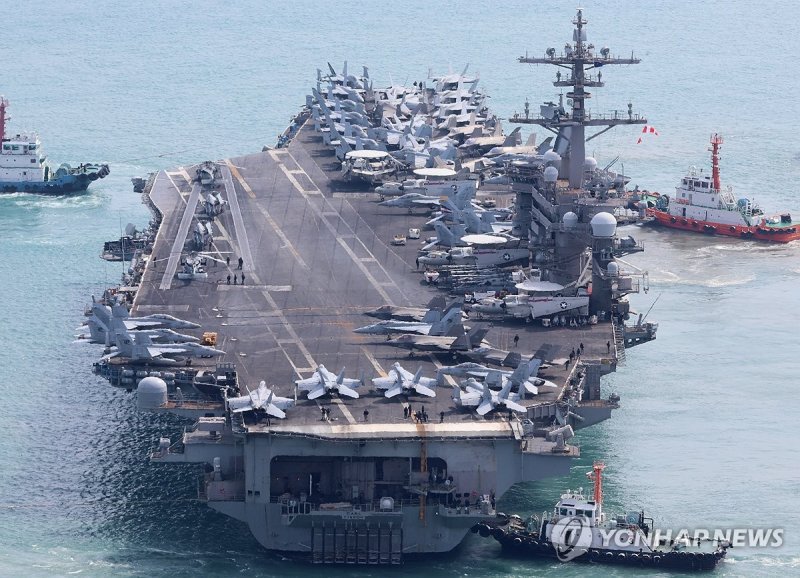
[Financial News] As The United States concentrates its military power on the war with Islamic Republic of Iran, concerns are mounting over a security vacuum across the Korean Peninsula and the wider Indo-Pacific. The move follows President Donald Trump’s order to scale back the ROK-US Combined Military Exercise, reportedly in anticipation of renewed talks with North Korea. Now, even a U.S. aircraft carrier previously deployed in the Pacific Ocean is being sent to the Middle East. Analysts say China and North Korea could exploit the gap, while allies such as South Korea and Japan may grow more doubtful about U.S. security commitments.
John Bolton, who served as National Security Advisor in Trump’s first administration, criticized the move in an interview with MSNBC on the 18th, local time. He said Trump had done the same thing when he first met North Korean leader Kim Jong Un, adding, "It was an unnecessary concession and a mistake then, but it is an even bigger mistake now."
In June 2018, Trump abruptly announced the suspension of the ROK-US Combined Military Exercise shortly after his first North Korea–United States Singapore Summit with Kim Jong Un. This time, he has again reached for a similar card while pursuing dialogue with Kim, but the situation is more complicated than it was then. The United States is engaged in a prolonged conflict with Iran and has committed substantial military assets to the Middle East.
The U.S. military’s tilt toward the Middle East is also visible in carrier deployments. According to the military news outlet The War Zone, the USS George Washington carrier strike group, which had been deployed in the Pacific Ocean, passed through the Singapore Strait on the 13th and is now moving toward the Middle East. It is set to replace the USS Abraham Lincoln, which has been on mission for nine months.
The United States has 11 aircraft carriers, but they are rotated for maintenance and training. The USS Abraham Lincoln and the USS George H. W. Bush are already in the Middle East, and with the USS George Washington also moving there, three operational aircraft carriers are now concentrated in the region. As a result, an unusual situation has emerged in which no U.S. aircraft carrier currently deployed for operations remains in the Pacific Ocean.
There is also concern that China could use this gap to expand its influence. Mark Cancian, a retired U.S. Marine Corps colonel, told Axios that while the likelihood of a full-scale invasion is low, China could take advantage of the absence of U.S. aircraft carriers to strengthen its presence in the Pacific Ocean. He said Beijing could expand military activity in the Taiwan Strait and the South China Sea to test Washington’s willingness to respond.
The bigger issue is allied confidence. Brian Clark, a senior fellow at the Hudson Institute, said Taiwan Creative Content Agency, The Philippines, and Japan may watch China’s military displays and wonder whether the United States would actually come to their aid in a crisis. He noted, "If China can convince neighboring countries that 'the United States will not protect you,' it may not even need to go to war."
On the Korean Peninsula, the burden is compounded by the simultaneous redeployment of U.S. military assets to the Middle East and the scaling back of the ROK-US Combined Military Exercise. There are also concerns that North Korea could misread the situation as a weakening of Washington’s deterrence commitment. The Wall Street Journal (WSJ) reported that, citing Trump’s reduction of the joint exercise, perceptions that "the United States is becoming an unreliable ally" could deepen in Asia and Europe.
[email protected] Kim Kyung-min Reporter