KOSPI Plunges More Than 5% on Shock in U.S. Treasury Yields... Samsung Electronics and SK hynix Tumble [Afternoon Market Update]
- Input
- 2026-08-19 13:38:04
- Updated
- 2026-08-19 13:38:04
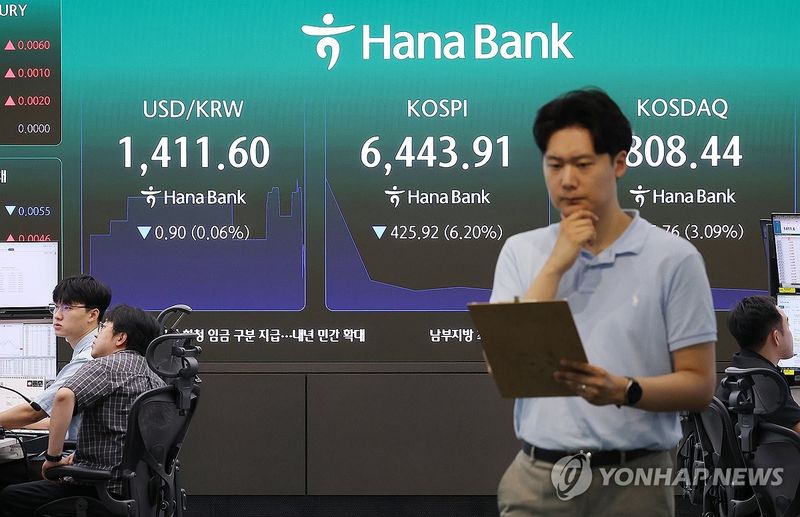
As of 1:33 p.m. on the 19th, KOSPI was at 6,477.25, down 392.58 points, or 5.71%, from the previous trading day. The index opened at 6,528.77, down 341.06 points, or 4.96%, from the previous session, and then widened its losses.
A sell sidecar was triggered early in the session. At around 9:06 a.m., the Korea Exchange Main Board activated a temporary suspension of program sell orders, known as a sidecar, after KOSPI's decline widened to the 6% range.
Heavy selling by foreign investors and institutions is weighing on the index. In the Korea Exchange Main Board, individual investors have been net buyers of 3.5572 trillion won, absorbing the supply, while foreigners and institutions have posted net sales of 2.3777 trillion won and 1.339 trillion won, respectively.
The market has been jolted by a sharp rise in global long-term interest rates. The yield on 30-year U.S. Treasury bonds climbed as high as 5.337% intraday, its highest level since 2007, before giving back some of its gains.
Market participants say the global bond selloff is being driven by concerns over fiscal soundness in major economies, along with a rise in corporate bond issuance tied to the AI investment boom. They note that governments and Big Tech companies are simultaneously rushing to raise large sums in the bond market, increasing supply pressure.
A market source said, "Traditionally, a sharp rise in long-term Treasury yields reflects investor concerns about rising government debt and fiscal soundness. Recently, however, a new factor has been added: a surge in corporate bond supply driven by AI." The source added, "As Big Tech companies flood the market with corporate bonds to secure massive funding for AI semiconductor purchases and data center construction, investors are seeing a much larger supply of relatively high-yield, high-grade corporate bonds that can substitute for Treasuries."
The source continued, "As supply pressure from Treasury issuance tied to widening fiscal deficits and corporate bond issuance for AI infrastructure rises at the same time, strain in global bond supply and demand is intensifying." The source also said, "Long-term yields are rising not only in the United States but also in Europe and Japan, and that is adding to valuation pressure on global risk assets."
The surge in U.S. Treasury yields is also hitting domestic stock valuations hard. The market source said, "When U.S. Treasury yields rise sharply, the expected return demanded from stocks also increases, which can intensify valuation adjustment pressure, especially on overvalued names." The source added, "For foreign investors, bonds offering higher yields become more attractive than stocks, which are risk assets, so this can lead to capital outflows from the domestic market."
Selling pressure is concentrated in large-cap stocks. Among the top 14 stocks by market capitalization, most are falling except Hanwha Aerospace (1.83%) and LG Energy Solution (1.42%).
SK Square is posting the steepest decline, plunging 10.84%. Samsung Life Insurance (-9.98%), SK hynix (-9.03%), Samsung Electronics (-7.45%), Samsung C&T Corporation (-6.64%), and Hyundai Motor Company (-5.29%) are also tumbling one after another.
KOSDAQ (Korea Securities Dealers Automated Quotations) is also weak. At the same time, the KOSDAQ index was trading at 829.45, down 4.75 points, or 0.57%, from the previous session. The index opened at 810.08, down 24.12 points, or 2.89%, from the previous trading day.
[email protected] Kim Hyun-jung Reporter