With a leadership vacuum at the Ministry of Justice becoming more apparent, will follow-up legislation for the revised Criminal Procedure Act be delayed further?
- Input
- 2026-08-19 14:22:10
- Updated
- 2026-08-19 14:22:10
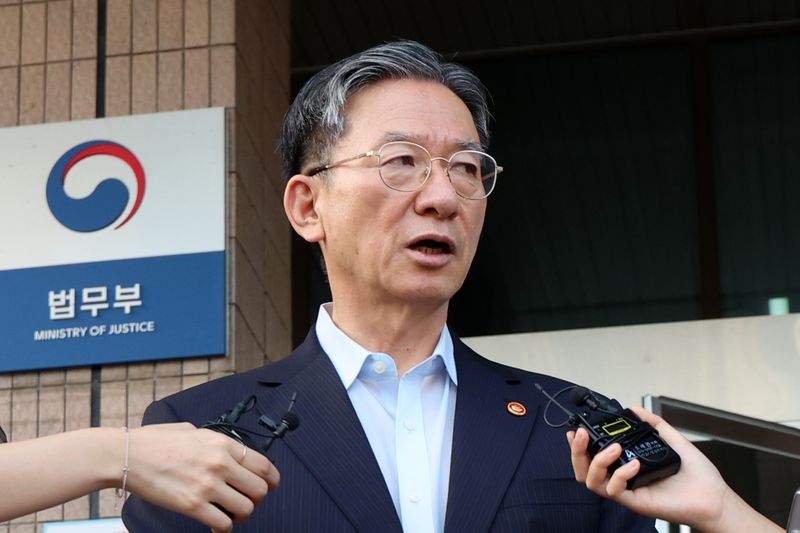
According to the National Assembly and the legal community on the 19th, Jeong submitted his resignation to Cheong Wa Dae and the Ministry of Personnel Management on the 18th. If his resignation is accepted, Vice Minister Lee Jin-su will serve as acting minister. Even before the revised Criminal Procedure Act passed the National Assembly, Jeong had pointed to a gap in victim protection caused by the complete abolition of prosecutors' supplementary investigative authority and had called for countermeasures.
The Ministry of Justice's most urgent task is to revise subordinate regulations. The ministry plans to update investigation rules governing the relationship between prosecutors and judicial police officers, as well as various enforcement decrees, before the law takes effect. However, the schedule is tight because the revisions must go through advance notice procedures. As the revised law changes prosecutors' oversight of judicial police officers from inspection to review, removing their direct authority to intervene, how to fill that gap is seen as the biggest issue in revising the investigation rules.
Follow-up legislation in the National Assembly is also likely to miss the October 2 effective date of the revised law. The Democratic Party of Korea (DPK) is pushing to introduce a system requiring all cases handled by first-line investigative agencies such as the police to be forwarded to prosecutors for seven major crimes, including child abuse, domestic violence, sexual crimes, child sexual abuse, stalking, abuse of persons with disabilities, and elder abuse. The party has set next month's regular session as the target for handling the matter, and Seo Young-kyo, chairperson of the Legislation and Judiciary Committee of the National Assembly, is reportedly aiming to complete the revisions before the October audit session. However, that timing comes after October 2, when the SPO will be abolished and the Public Prosecution Office and the Serious Crime Investigation Agency will launch.
The method of revising the law is also a hurdle. The all-case forwarding system cannot be implemented by amending only the Criminal Procedure Act; separate revisions are needed for multiple individual laws, including the child abuse law, domestic violence law, sexual crimes law, stalking law, the Act on Welfare of Persons with Disabilities, and the Welfare of Senior Citizens Act. In addition, there are reportedly more than 180 other legal provisions that assume prosecutors' investigative authority. Concerns are being raised that there is too little time to review them and avoid conflicts between laws.
Practical issues also remain unresolved. The Joint Investigation Headquarters of Prosecutors and Police, which is operating at nine sites including narcotics, voice phishing, and financial securities cases, would have difficulty maintaining its current structure if prosecutors lose investigative authority. A legal community source noted, "If a prosecutor without investigative authority becomes involved in an investigation and creates evidence, disputes over the admissibility of that evidence are inevitable during trial," pointing to possible side effects in courtroom practice.
In this situation, Jeong's resignation has left a leadership vacuum for final approval of internal revisions and coordination with the National Assembly. If the appointment of a successor takes time, the ministry may have to meet the effective date under an acting vice minister system.
After the inauguration ceremony for new prosecutors on the 3rd, Jeong said, "It was designed with good intentions, but no one can predict what side effects may arise or how it will work on the ground," adding, "I expect swift supplementation and revision."
[email protected] Kim Dong-gyu Reporter