Assad's Hidden 'Nuclear Legacy' Revealed... IAEA Confirms First Discovery of Several Tons of Nuclear Material
- Input
- 2026-08-19 08:44:52
- Updated
- 2026-08-19 08:44:52
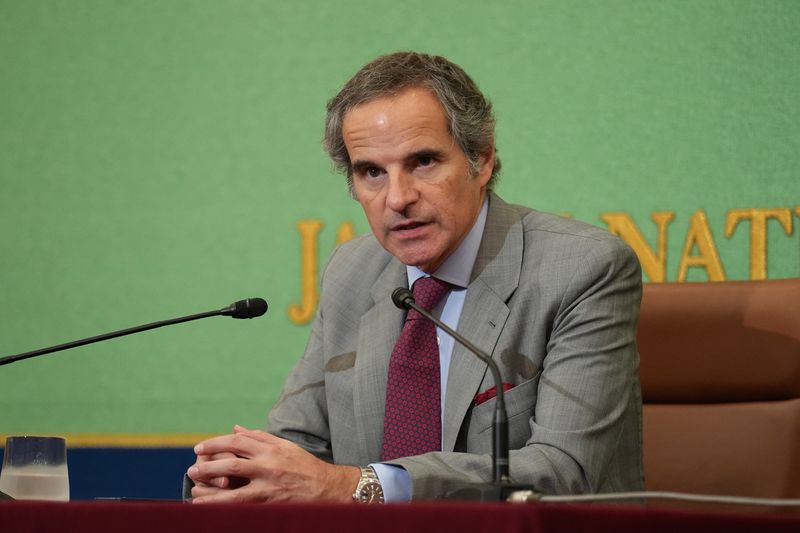
[Financial News] The International Atomic Energy Agency (IAEA) has officially confirmed that several tons of nuclear material were hidden in a secret facility by the ousted regime of former Syrian President Bashar al-Assad. The material is believed to have come from a secret reactor that was built with North Korean assistance and later destroyed in an Israeli airstrike. Syria's new government says it will keep the material under IAEA monitoring and use it for civilian and peaceful purposes.
According to AFP on the 18th local time, IAEA Director General Rafael Mariano Grossi held a joint press conference in Damascus with Syrian Foreign Minister Asaad al-Shaibani and said the agency had found "several tons of nuclear material" hidden by the former Assad regime.
Grossi said, "Thanks to the new Syrian government's disclosure that there was another location where nuclear material was stored, we were able to access the site and investigate." He added, "We are talking about several tons of nuclear material that could have been misused."
On the 17th of last month, Syria's transitional government sent an official letter to the IAEA and voluntarily reported that nuclear material existed at undeclared facilities left behind by the Assad regime. As the IAEA then launched an on-site investigation, the existence and scale of the long-concealed material were confirmed.
The material found is believed to include yellowcake, a uranium concentrate. Yellowcake is produced by refining uranium ore and must undergo further conversion and enrichment before it can be used as nuclear weapons material. By itself, it cannot be used to make a nuclear bomb. However, it still requires strict control because it could be misused in a dirty bomb, which disperses radioactive material with conventional explosives.
The newly discovered material is also linked to past suspicions of nuclear cooperation between the Assad regime and North Korea. The Assad regime is known to have built a secret reactor in Al Kibar, Deir ez-Zor, in eastern Syria with North Korean support. The facility was destroyed in an Israeli airstrike before it could begin operations in 2007. The IAEA has since assessed that the Al Kibar site was highly likely to have been a reactor.
After the airstrike, the Assad regime appears to have moved the remaining related materials and research and development equipment to a secret facility known as Site 99 and hidden them there. In a report last year, the IAEA also said it had found uranium particles at the site during an inspection in 2024.
During this visit to Syria, Grossi also went to the Deir ez-Zor site, which had been effectively off-limits for 18 years. He said, "A very comprehensive excavation and survey is now under way." He added that this was highly significant because it confirmed the IAEA's long-standing assessment that a nuclear facility had been built in secret.
Syria's new government says it will not transfer the discovered nuclear material abroad and will instead manage it directly. Al-Shaibani said, "Syria has the right to use this material for civilian and peaceful purposes." He added, "Technical assessments show that these materials do not pose a risk." He also explained that they would be placed under the IAEA safeguards system while remaining under Syria's national control.
So far, however, there is no evidence that Syria has obtained nuclear material that could be used immediately to manufacture nuclear weapons.
After the Assad regime collapsed in late 2024 following a rebel offensive, Syria's transitional government has been seeking to rejoin the international community and has been actively disclosing the former regime's nuclear activities.
[email protected] Kim Kyung-min Reporter