"You want me to sell my house so my dual-income daughter can ask me to watch the kids for three years?" Frustrated grandparents in their golden years [Tax War 5]
- Input
- 2026-08-21 05:00:00
- Updated
- 2026-08-21 05:00:00
The Lee Jae-myung administration's August 3 tax reform plan[Tax war sparked by real estate]has escalated. Older people who became high-value homeowners almost by accident after living in the same home for decades have taken the hardest hit, triggering an unprecedented backlash against taxation. In response, Financial News will examine the problems in the reform plan in an emergency six-part series.
[Financial News]"If the government is serious about solving caregiving and low birthrate problems, which are national priorities, please recognize moving to care for grandchildren as a valid non-resident exception, just like work transfers, illness, or school enrollment."That was one complaint filed after the government unveiled its 2026 tax reform plan on the 3rd, in connection with the non-resident single-homeowner rule.
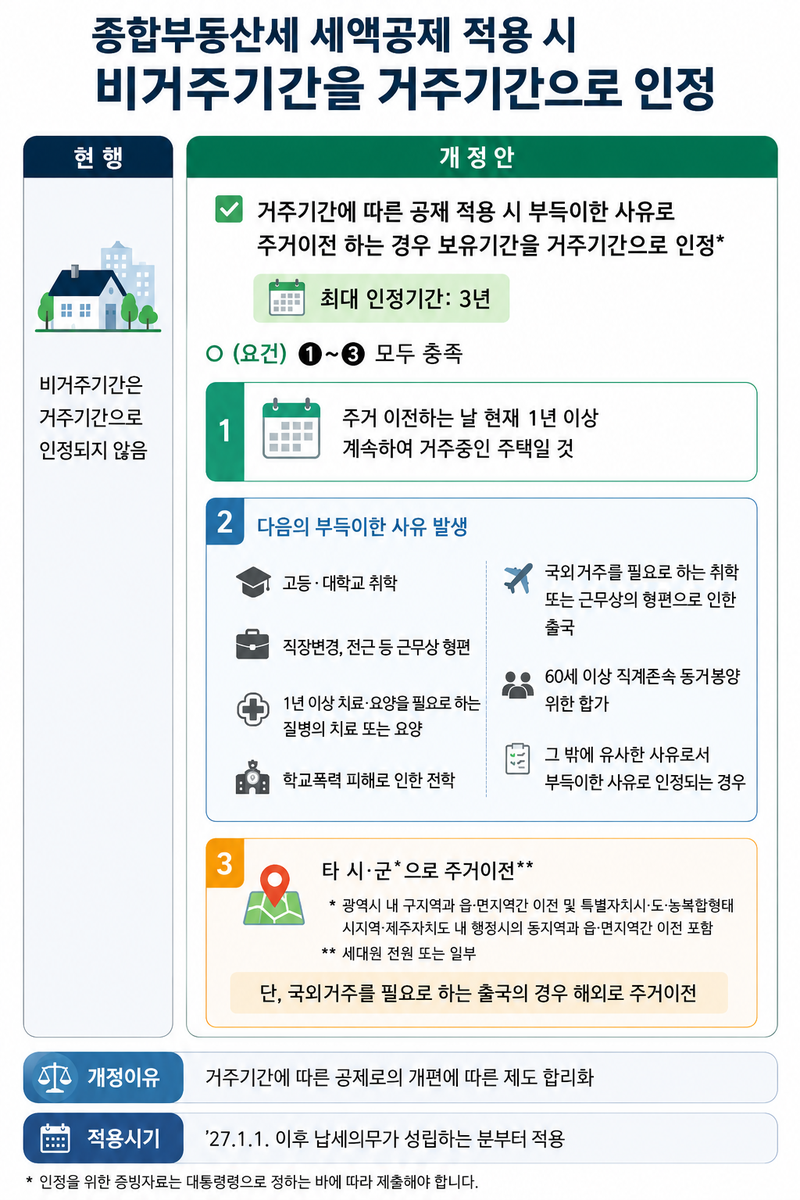
In the latest overhaul, the government shifted the long-term ownership benefits in the Comprehensive Real Estate Holding Tax and Capital Gains Tax toward actual residence. However, it decided to make exceptions for unavoidable non-residence, such as school enrollment, job changes, medical treatment, and supporting elderly parents.
The problem, along with the tax issue itself, was that the reasons single-homeowners end up living elsewhere are far more varied than the exceptions the government listed.
A typical example is an older person who moved near a child's home to help raise grandchildren. Another case that drew attention involved a homeowner who gave up their house to elderly parents and a disabled sibling and then faced a tax shock while trying to care for them nearby.
Critics say the government is acting inconsistently: on one hand, it is expanding tax support to improve child-rearing conditions and help people with disabilities live in familiar communities; on the other, it is classifying homeowners who leave their own homes for caregiving reasons as non-residents and burdening them with higher taxes.
"My dual-income son called for help" ... Grandfather leaves Seoul at 76 and moves to Yongin to care for grandchildren
After the government announced the tax reform plan, 76-year-old Bae submitted a complaint to the draft revision of the Comprehensive Real Estate Holding Tax Act, explaining his situation and pleading, "Please consider grandchild care as a reason for recognizing actual residence."
Bae has owned one home in Seoul for more than 20 years. His life changed after he received a "child-rearing SOS" from his dual-income son and daughter-in-law. He moved to Yongin in Gyeonggi Province, where his son lives. At first, he lived with the couple and cared for two grandchildren. He now lives about 500 meters from his son's home and continues to provide childcare, he said.
There was also a case in which a person rented out their apartment and moved to the building next to their son's apartment to care for a two-year-old grandchild and another grandchild soon to be born. The complainant asked for changes to the reform plan, saying, "Should elderly parents who do grandparenting without pay have to bear taxes?"
There is a reason these appeals cannot be dismissed as isolated family matters.
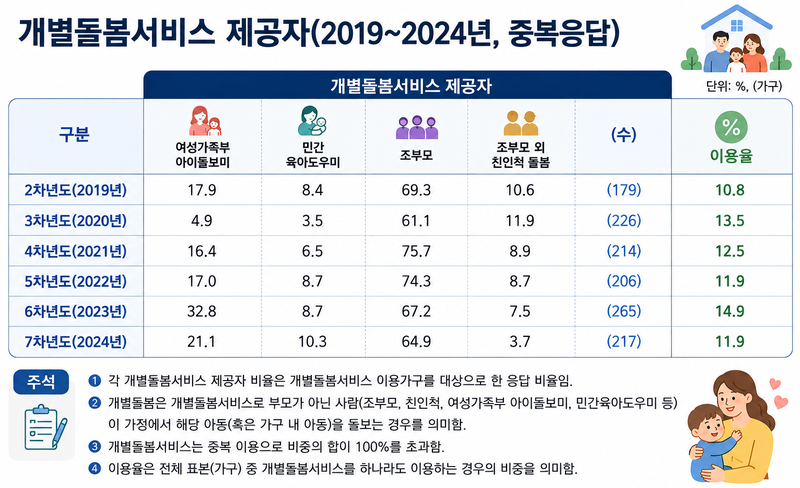
According to the 2025 KICCE Spending Survey published by the Korea Institute of Child Care and Education, 11.9% of infants and toddlers in 2024 used at least one individualized care service. Among temporary individual caregivers, grandparents accounted for the largest share, staying above 60% throughout the survey period.
Reflecting this reality, local governments across the country are expanding cash-style support for grandparent childcare. The Seoul Metropolitan Government pays 300,000 won per month for one child if grandparents or other relatives within the fourth degree of kinship care an infant for at least 40 hours a month. Gyeonggi Province has expanded the program this year to 26 cities and counties, offering the same level of support not only to relatives but also to neighbors who provide care.
That is why critics say the latest reform plan failed to properly reflect the reality of grandparents moving nearby to care for grandchildren, even though they effectively serve as informal caregivers for dual-income families.
I gave my home to my elderly father and disabled brother ... "If I don't live there, I lose out"
The clash with the tax system also appears in families with disabled members.
Lee said he had given his home to his father, who is over 70, and his younger brother, who has a physical disability, while he himself lives in a nearby rental home and cares for the family. He explained that it was important for his disabled brother to remain in a familiar community with welfare centers and treatment facilities, and that repeatedly moving his elderly father between rental homes would also be burdensome.
He stressed, "This is fundamentally different from not living in a house for investment or tax evasion purposes. It is a case where the homeowner gave up his own residence to ensure housing stability for elderly parents and a disabled family member."
The government's non-resident exception includes "cohabitation for the support of a lineal ascendant aged 60 or older," but Lee's case does not fit neatly. He did not move into the same home as his parents, and his brother is not a lineal ascendant.
Conflicting policy directions within the same tax reform plan
The gap between policies is also visible within the same tax reform plan. In this overhaul, the government expanded the income tax exemption period for childbirth support payments from "within two years after a child's birth" to from the date of pregnancy through two years after birth.
The stated reason for the revision was to "ease the burden of childbirth and child-rearing."
That is why critics say the government is offering tax support in the reform plan to ease childbirth and child-rearing burdens, while grandparents who moved to care for grandchildren are still excluded from the explicit non-resident exceptions in the real estate tax system.
The same applies to support for people with disabilities. The government raised the cap on assets excluded from the gift tax base when property inherited by people with disabilities is placed in trust from 500 million won to 1 billion won, citing the need to expand support for vulnerable groups, including people with disabilities.
By contrast, the real estate tax rules do not clearly include cases in which family members give up their own homes so that a disabled relative can remain in a familiar living area. Critics say welfare policy and real estate taxation are moving in different directions within the same reform package.
Even if grandchild care or care for disabled family members is added to the exceptions, another problem remains. The period that can be recognized as a residence is limited to a maximum of three years. That may not match reality, since the end point of grandchild care or caregiving for elderly parents and disabled relatives is hard to predict.
How far should the exceptions go?
As criticism of the non-resident single-homeowner rule grows, along with calls to include more exceptions, the government faces a deeper dilemma.
Cheon Kyung-wook, CEO of tax firm Songwoo, said, "Even if there are special provisions for non-residence caused by unavoidable personal circumstances rather than speculation, there is a limit to how many individual cases can be written into the rules."
Yang, Jae-Mo, a professor in the Department of Law and Public Administration at Hanyang Cyber University, noted, "If the government keeps accepting requests for exceptions, the policy's effect of taxing non-residents will eventually disappear. If there are too many exceptions, there is no reason to have the policy in the first place." He explained this as the "conduit effect."
The conduit effect refers to a situation in which rising home prices in one region create a channel through which the burden flows to other regions. If exceptions are broadly allowed, the policy goal of cutting off that channel is weakened.
[email protected] Seo Yoon-kyung Kim Hee-sun Reporter