[Editorial] AI-Driven Youth Unemployment Calls for Urgent, Unconventional Measures
- Input
- 2026-08-18 19:38:40
- Updated
- 2026-08-18 19:38:40
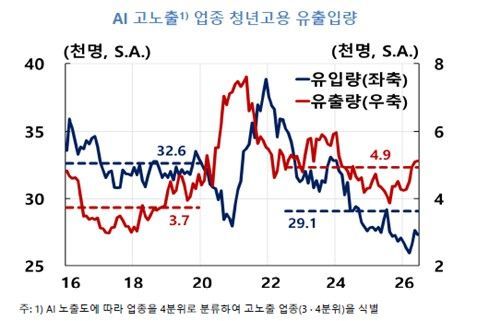
The emergence of Artificial Intelligence (AI) is being cited as a key driver of youth unemployment. The shock AI is delivering to young workers is severe. Yet because AI is still in its early stage, there is concern that its impact on jobs is being underestimated. In a survey by FKI of 1,000 job seekers and employed young people, 53.9% of respondents said their desired jobs were likely to be replaced or reduced by AI within five years. Another 65.6% said AI would reduce opportunities to gain experience and grow into skilled workers, since it is taking over entry-level tasks. The anxiety felt by young people has clearly gone beyond vague fear. AI is still at an early stage, but its ripple effects are spreading so quickly that social newcomers can feel them even before taking their first step into the labor market.
These concerns are already being confirmed by the numbers. According to a BOK report, 94.0% of the 285,000 youth jobs lost over the past four years were in industries with high AI exposure. The sectors that actually shed jobs included information services, publishing, and computer programming, where tasks such as data organization, document writing, and basic analysis are concentrated. It is only natural that young people feel the impact of AI more strongly than older workers do.
The rise in unemployment linked to AI is different in nature from a typical business-cycle downturn. The labor market is undergoing a structural upheaval as AI interacts with existing changes such as more hiring of experienced workers and the spread of remote work. In this turbulence, access to society through employment is being blocked. For new entrants to the workforce, the chance to learn and grow on the job is also narrowing. If a generation never gets to experience that first step in a career, the pool of mid-level workers that will support industry in a few years will inevitably become thinner.
We worry about youth jobs because they will become a major source of instability for society in the years ahead. In particular, the gap in social and economic status could widen sharply depending on who can use AI effectively. In the end, job policies in response to AI must be tailored in stages.
Ideally, the first priority would be to create as many new jobs as possible, but that is a difficult goal to achieve in reality. Beyond new job creation, entry-level workers should be given opportunities to build job experience using AI. Internship programs are a good example, but they need to be designed so that participants can gain practical project experience with AI.
Measures that focus only on increasing the number of jobs risk producing low-quality temporary positions and delaying a structural solution to youth unemployment. The government and companies alike must recognize that AI affects each generation, industry, and job category differently. Only customized responses, not one-size-fits-all measures, will prove effective.