Even in the Wind, Stay Confident: Hairline Design That Preserves Everyday Angles [Kim Jin-oh's Hair Loss Escape]
- Input
- 2026-08-20 10:00:00
- Updated
- 2026-08-20 10:00:00
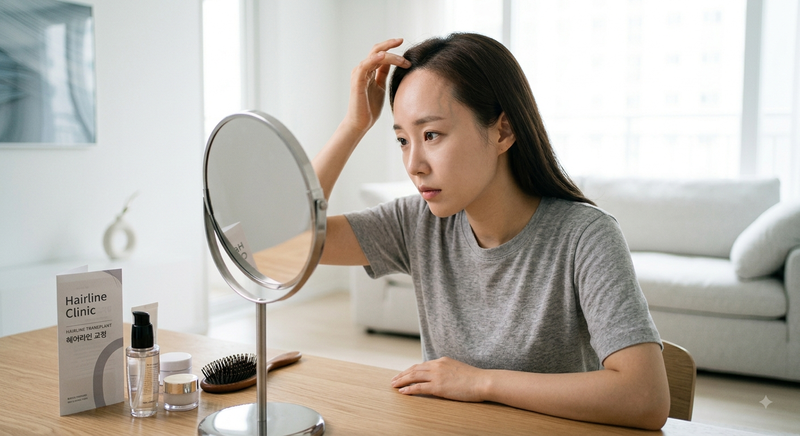
[Financial News] "Please lower my forehead as much as possible." That is a common request from women who seek hairline transplantation to cover a broad forehead. After years of trying to hide their forehead every time the wind blows, it is only natural to hope for dramatic surgical results.
But lowering the hairline as much as possible is not always the answer. If the hairline is too low, the face can look cramped. Depending on the face shape, it may also appear wider and flatter. In female hairline transplantation, what matters is not simply the height of the hairline, but a customized design that takes into account the width and length of the face, the cheekbones and jawline, and the curve of the forehead.
Some patients ask for a hairline that is smooth, soft, and perfectly symmetrical. But faces are not as even as people think. The contours and heights on both sides differ slightly. Hair also grows in different directions, with strands on one side lying flat while those on the other side point upward. A naturally attractive face is more asymmetrical than many expect. If the hairline is designed to be too round and too smooth in an effort to create a feminine shape, it can look unnatural.
The focus should not be only on the height of the center of the hairline. After surgery, lowering the center may create a dramatic change when viewed from the front. But when the hair is swept back or tied up, the M-shaped recession on both sides and the temple area become more visible. If only the center is lowered while the sides are left unchanged, the middle may look as if it drops abruptly. On the other hand, closing the sides too aggressively can make the upper face look heavy and cramped. The same design cannot be applied to someone whose forehead looks long and someone whose forehead looks wide.
Gradation is especially important in female hairlines. At the very front, relatively fine single-hair grafts are placed irregularly. Behind them, slightly thicker single-hair grafts are mixed in. As the design moves inward, the proportion and density of two-hair follicles are gradually increased. It is also better to preserve any existing fine hairs, as long as they do not clash with the new design. They help create a smooth transition between the transplanted hair and the original hairline. Surgery adds hair, but choosing not to remove the few strands that remain can make the final result look more natural.
Direction and angle matter just as much as the number of hairs. Women’s bangs usually grow low against the scalp, and the flow at the center differs from that on the sides. The angle becomes even lower near the temples. If this difference is ignored, transplanted hairs may stand stiffly or grow in a direction that does not match the existing hair. A small difference in angle on the day of surgery can affect how the bangs are worn, parted, or swept back for a long time afterward.
More grafts do not automatically mean better results. If the goal is to lower the hairline dramatically and increase density as well, more follicles must be taken from the back of the head. In the end, ambition at the front has to be paid for with hair from the back.
The harvesting method should also be chosen according to the condition of the donor area. The non-incisional method can be burdensome when a large amount of hair needs to be taken from someone whose donor density is low or whose hair is fine. If too much is harvested, the density at the back of the head may drop and the scalp may show through. The incisional method can secure a relatively large number of follicles, but if the scalp lacks flexibility, it may be difficult to harvest a wide enough area safely or close the incision without strain. More important than the name of the procedure is whether your own occipital area can handle it.
Facial proportions can be measured with a ruler, but everyday appearance cannot be explained by numbers alone. When designing a hairline, it is important to consider not only the front and side views, but also the hairstyles a person usually wears. The design should change depending on whether the person always wears bangs, parts the hair to one side, tucks it behind the ears, or ties it up often. Surgery is not done for a single front-facing photo. It is done to look natural in the many looks repeated every day.
In the end, if you are preparing for female hairline transplantation, the question to ask the clinic is not, "How much can it be lowered?" It is, "How far and in what way should it be lowered so that it looks natural on my face?" A good design respects facial proportions and considers the front, 45-degree, and side views, while preserving the strengths of the face.

/Kim Jin-oh, Chief of Medical Clinic at New Hair Hair Transplant Clinic
[email protected] Kim Hyun-sun Reporter