"Is it over once higher deposits cut trading?" NARS calls for added safeguards for leveraged ETFs
- Input
- 2026-08-19 09:58:53
- Updated
- 2026-08-19 09:58:53

[Financial News] The National Assembly Research Service said that although trading volume fell sharply after the minimum deposit requirement for single-stock leveraged exchange-traded funds (ETFs) was raised, it is difficult to immediately conclude that the move improved investor protection. The government raised the minimum deposit requirement from 10 million won to 30 million won on July 31.
It also said that, beyond restricting market entry by raising deposits, there is a need for mechanisms that can manage market shocks, such as adjusting leverage levels based on product size and the liquidity of underlying stocks.
In a report released on the 18th titled "What Should Be Improved After the Introduction of Single-Stock Leveraged ETFs?" NARS analyzed market conditions and regulatory systems at home and abroad after the products were introduced, and proposed the following improvements.
More than 1 trillion won on the first day of listing... 27% of ETF trading concentrated
Since single-stock leveraged ETFs were first listed in South Korea in May, trading has been concentrated among investors in a short period of time.
On the day of listing alone, combined trading value for single-stock leveraged ETFs reached about 1.04 trillion won, accounting for roughly 27% of total ETF trading value. For some products, daily turnover exceeded 100% several times in the early days after listing.
During the same period, share-price volatility for Samsung Electronics and SK hynix also widened. Volatility across the broader Korean stock market rose sharply as well, with daily KOSPI return volatility jumping from 1.4% in 2025 to 3.6% in the first half of this year.
NARS cautioned against concluding that single-stock leveraged ETFs were the direct cause. It said multiple factors were at work at the same time, including heightened volatility in the global semiconductor industry, external uncertainties, and clashes in investor demand by type.
It added that, based on the data available so far, it is premature to identify single-stock leveraged ETFs as the sole driver of increased stock market volatility. Given Korea's market structure, where a small number of large-cap stocks account for a significant share of the market, the impact of rebalancing trades triggered by larger leveraged products on underlying stock prices should be monitored continuously.
Trading value plunged 89% after the deposit requirement was raised to 30 million won
The higher minimum deposit requirement had an immediate effect on trading volume in single-stock leveraged ETFs.
According to NARS analysis citing Korea Exchange data, the combined average daily trading value of 16 single-stock leveraged and inverse ETFs reached about 1.17 trillion won from May 27 to July 30.
The situation changed sharply after the deposit requirement was raised on July 31. From July 31 to August 10, the average daily trading value of these products fell to about 130 billion won. That marked a decline of roughly 89% from the period before the rule took effect.
This shows that the higher deposit requirement had a significant impact on limiting investor participation in trading. In particular, on July 31, the first day of the rule, trading value in related single-stock leveraged ETFs fell sharply even though Samsung Electronics and SK hynix surged.
However, NARS drew a line at interpreting the drop in trading as an immediate success in investor protection. Its point was that a decline in trading itself is a separate issue from whether investors fully understand the risks of the products and reduce their losses.
Accordingly, it recommended that the effectiveness of entry restrictions such as the minimum deposit requirement be reviewed continuously, while pre-investment education should be improved in both content and format so that investors can genuinely understand the core risks of leveraged ETFs. It also said information disclosure methods should be reviewed so that the products' unique risks can be communicated effectively to long-term investors.
The U.S. limits leverage to 2x, while Hong Kong uses variable leverage
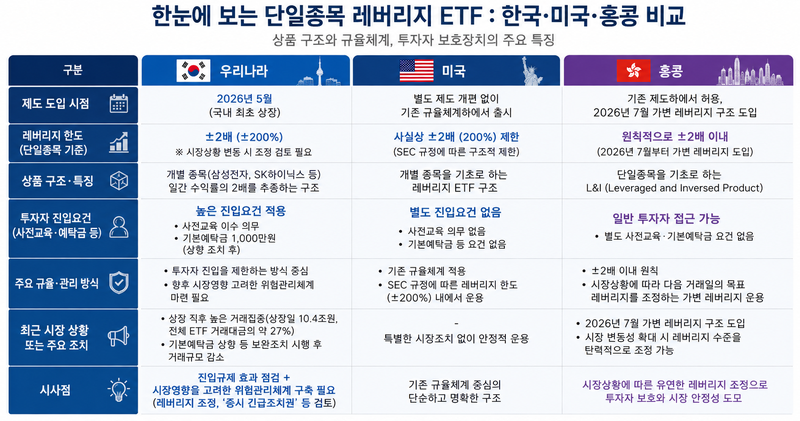
The report also pointed to areas where South Korea should improve by comparing its system with those overseas. Single-stock leveraged products are traded in markets such as the United States and Hong Kong, but the regulatory approaches differ.
In the United States, single-stock leveraged products were launched under the existing regulatory framework without a separate system overhaul. Under SEC rules, leverage is effectively capped at 200%, and there are no separate investor entry requirements such as pre-investment education or a minimum deposit requirement.
Hong Kong generally limits the leverage ratio for L&I products based on single stocks to within plus or minus 2x.
In July, it introduced a "Variable Leverage" structure that allows the target leverage for the next trading day to be adjusted within the maximum leverage limit depending on market conditions. Rather than restricting investors' trading itself, the system adjusts the product's risk level in line with market conditions.
When markets shake, cut leverage... review risk-management tools
NARS said South Korea should also establish a management system that can continuously monitor and respond to risks tied to market conditions, such as product size and underlying stock liquidity, separate from measures that restrict investor participation in trading.
It also suggested adjusting leverage levels according to market conditions as one possible tool.
If the so-called emergency action authority for the stock market, which has recently been under discussion, is institutionalized, detailed system design will also be necessary, it said. That would include reviewing the conditions for invoking the authority, the scope and duration of measures, how it would relate to procedures under the Financial Investment Services and Capital Markets Act, and how information should be provided to existing investors.
NARS stressed that, in addition to the risk of investor losses from single-stock leveraged ETFs, the impact of rebalancing trades on underlying stocks should be monitored continuously as product size grows.
[email protected] Reporter Seo Yoon-kyung Reporter