Free Childcare, Health Insurance, and Other Social Transfers Total 9.26 Million Won a Year; People in Their 40s Benefit the Most
- Input
- 2026-08-18 12:00:00
- Updated
- 2026-08-18 12:00:00
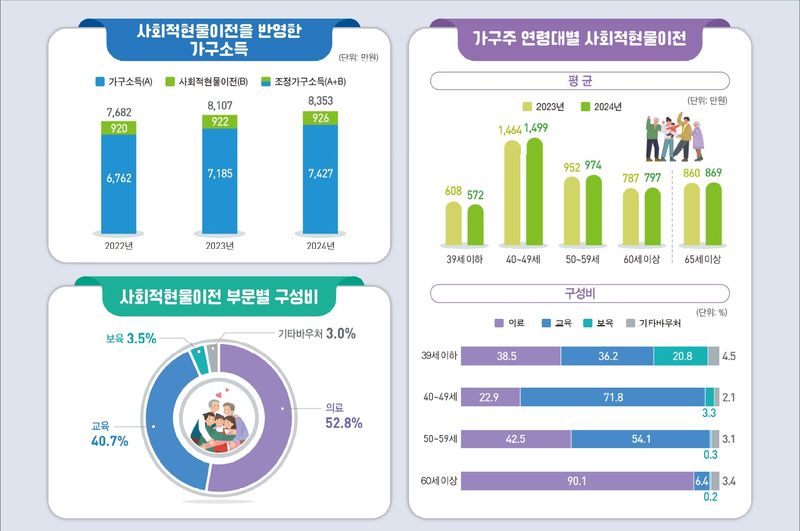
[Financial News] The average annual income from social transfers in kind, which refers to medical cost support and free childcare and education provided by the government, came to 9.26 million won. That accounted for 12.5% of household income.
On the 18th, the Ministry of Data and Statistics released the results of its 2024 income statistics reflecting social transfers in kind.
Social transfers in kind refer to free education and childcare, medical cost support through National Health Insurance, and vouchers, all of which are goods and services provided to households and individuals using government budget. They make it possible to assess the impact on welfare spending, household income, and distribution indicators.
In 2024, income from social transfers in kind averaged 9.26 million won, up 0.4% from 9.22 million won a year earlier. That was equal to 12.5% of the average household income of 74.27 million won. In other words, the government paid that amount in the form of goods and services using public finances.
Adjusted household income, which adds social transfers in kind to household income, rose 3.0% from a year earlier to 83.53 million won.
First, the data showed clear differences in in-kind transfers by income level.
In 2024, average income from social transfers in kind was 7.27 million won for the first income quintile, or the bottom 20%, and 12.53 million won for the fifth quintile, or the top 20%.
Lower-income households relied more heavily on social transfers in kind. The ratio of social transfers in kind to household income was 46.8% in the first quintile, compared with 7.2% in the fifth quintile, showing that the share falls as income rises.
By sector, the medical component accounted for 88.0% and 67.1% of transfers for the first and second income quintiles, respectively.
The education component was relatively high among the more affluent fourth and fifth quintiles, at 51.3% and 57.0%, respectively.
Differences also appeared by the age of the household head.
People in their 40s, who are typically working while raising children, received the most social transfers in kind at 14.99 million won. The figure was 9.74 million won for those in their 50s and 7.97 million won for those aged 60 and older. It was lowest for those in their 30s or younger, many of whom are unmarried, at 5.72 million won.
The larger the household, the greater the income from in-kind transfers.
The social transfers in kind received by a four-person household, at 19.14 million won, were more than five times those of a one-person household, at 3.54 million won.
Social transfers in kind also helped reduce income inequality.
In 2024, the Gini coefficient based on equivalized adjusted disposable income reflecting social transfers in kind stood at 0.281, down 0.044 from the disposable-income measure. The Gini coefficient was lowest for children at 0.230, followed by the working-age population at 0.271 and the retired-age population at 0.300.
The higher the Gini coefficient, the greater the income inequality.
The quintile ratio based on equivalized adjusted disposable income, after reflecting social transfers in kind, was 4.33 times, down by 1.45 percentage points. On the same basis, the relative poverty rate fell to 10.5%, an improvement of 4.8 percentage points.
Ryu Chang-jin, Director of the Welfare Statistics Division at the Ministry of Data and Statistics, said, "The improvement in relative poverty rates by age group was greatest among the retired-age population, at 12.0 percentage points." He added, "In particular, the Gini coefficient improvement in the medical sector, at 0.295 for adjusted disposable income, was greater than in childcare, at 0.323, education, at 0.312, and voucher programs, at 0.324."
[email protected] Jung Sang-gyun Reporter