Retaliation for Not Helping in Iran? U.S. Lawmakers and Foreign Media Say, "Only North Korea, China, and Russia Benefit from Scaling Back ROK-U.S. Drills"
- Input
- 2026-08-18 10:07:49
- Updated
- 2026-08-18 10:07:49
On the 17th local time, Republican Senator Thom Tillis said, "South Korea, with its exceptional military capabilities, has been a steadfast military ally of the United States for more than 70 years." He added, "Scaling back joint exercises with South Korea would only allow thousands of North Korean troops to support Vladimir Putin's systematic kidnapping, torture, rape, and murder of innocent Ukrainian civilians." His remarks appeared to suggest that easing the burden on North Korean troops through reduced ROK-U.S. drills could give them more room to support Putin's war in Ukraine.
Jack Reed, the Democratic ranking member of the Senate Armed Services Committee, also criticized the move as "another reckless decision by President Trump." Reed explained, "If President Trump scales back joint exercises to flatter a dictator, or punishes South Korea for not joining a war he started, both our allies and our adversaries will conclude that America's commitments are negotiable." He warned, "Kim Jong Un has won a propaganda victory, and South Korea, one of our strongest allies, has been punished for no reason other than President Trump's ego. China and Russia are watching how easily President Trump abandons allies, and they will remember that when they test us."
Democratic members of the House Foreign Affairs Committee also criticized the move, saying, "President Trump's war in Iran is failing disastrously." They added, "He is scaling back joint exercises with South Korea, a 70-year ally, because it will not help an illegal war." They said, "The alliance with South Korea makes America safer, but President Trump is weakening it."
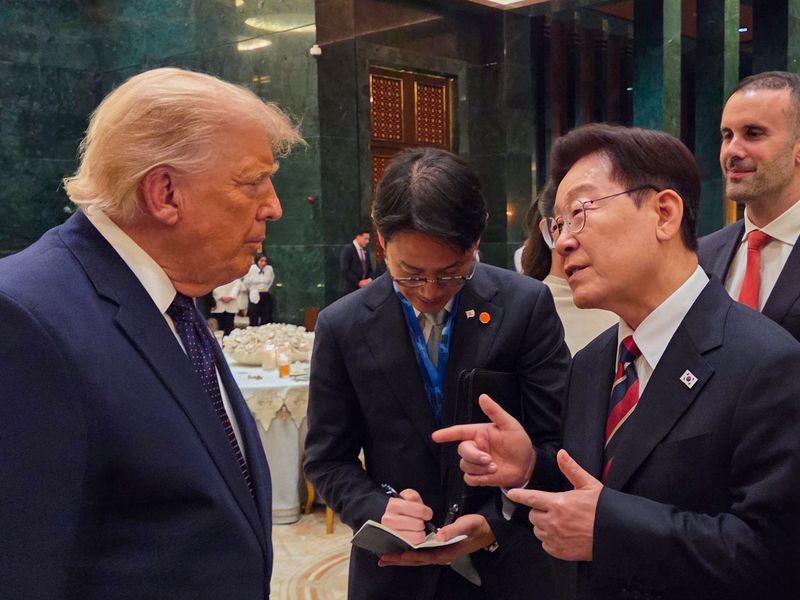
The Financial Times also reported that "Trump recently asked President Lee Jae-myung to take part in the denuclearization of the Islamic Republic of Iran, but the South Korean leader refused to provide support." It added that "Trump suggested the situation was partly related to his decision to scale back joint military exercises." The paper said, "The decision will further worsen tensions with South Korea."
Reports also raised concerns about the impact of Trump's move on relations with allies. The Associated Press described it as "the latest example of a president appearing to turn his back on friendly nations." It added that "Trump and his appointees in the U.S. government have also been criticizing NATO allies for not providing enough support for the war against Iran, even as they confront a more aggressive Russia in the Baltic Sea region."
The New York Times, a liberal U.S. newspaper, also criticized the announcement, saying it could deepen Asian allies' concerns about "what the United States is willing to do to contain China" at a time when America is already facing massive disruption and resource drain from the war with Iran.
Even The Wall Street Journal, a conservative U.S. newspaper, said in an op-ed that "Trump's unilateral order to cut back the drills will materially weaken the response capabilities of friendly countries in and around the Korean Peninsula, including Japan, in the event of an emergency."
[email protected] Hong Chaewan Reporter