Will Samsung Electronics and SK hynix rise again? Brokerage says foreigners bought a net 780 billion won in KOSPI stocks
- Input
- 2026-08-18 07:02:05
- Updated
- 2026-08-18 07:02:05
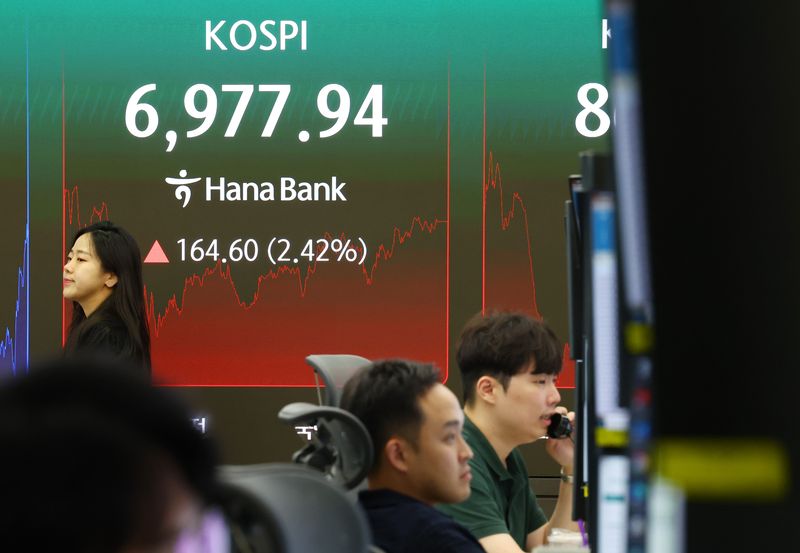
[Financial News] As large-cap KOSPI stocks, including Samsung Electronics and SK hynix, showed strength, brokerage analysts said investors should reduce exposure to KOSDAQ (Korea Securities Dealers Automated Quotations). They argued that with semiconductors rising alongside autos and shipbuilding, a strategy centered on large-cap stocks is becoming more important.
On the 16th, Yuanta Securities Korea said in a report that both the KOSPI and KOSDAQ had risen for five straight trading days, but KOSPI large caps were relatively stronger. The report said, "The KOSPI and KOSDAQ rose 2.4% and 0.4%, respectively, and both markets have climbed for five consecutive sessions," adding that the gains were driven by easing concerns over U.S. inflation and interest rates, as well as strength in the memory sector. On the KOSDAQ, it noted, "By contrast, the KOSDAQ showed a relatively limited move as profit-taking after the recent sharp rebound and weakness in some large-cap biotech stocks overlapped."
Earlier, on the 14th, the KOSPI closed at 6,977.94, up 2.42% from the previous session. Samsung Electronics ended at 274,500 won, up 2.43%, while SK hynix finished at 1,645,000 won, up 3.26%. On the same day, the KOSDAQ closed at 864.65, up 0.38% from the previous day. Alteogen Inc., one of the KOSDAQ's largest companies by market capitalization, fell 1.1% to 314,000 won.
Foreign buying was cited as a factor supporting the strength of KOSPI large caps. Yuanta Securities Korea said, "Whenever uncertainty eases, foreigners lead the index higher with net buying of large-cap semiconductors," adding that large caps in autos and shipbuilding also showed broad strength. On the auto and shipbuilding sectors, it explained, "Autos are benefiting from existing finished-car earnings, with added expectations for robots and physical AI businesses. Shipbuilding is reflecting hopes for a revival in U.S. shipbuilding, and it is important that Hanwha Group is pursuing the acquisition of Austal's U.S. business, which builds U.S. Navy vessels, while the U.S. government also views local investment by foreign companies, including Philly Shipyard, as one pillar of supply chain expansion."
Some also said it would be appropriate to increase exposure to the KOSPI rather than the KOSDAQ if strength in semiconductors and major large caps continues and foreign net buying remains supportive. Yuanta Securities Korea said, "Ultimately, for the KOSPI's uptrend to continue, a return to trend-like net buying by foreigners is crucial," adding, "This week alone, foreigners have bought a cumulative 7.8 trillion won net, confirming meaningful inflows."
Its view on individual investors' buying power was more cautious. Yuanta Securities Korea said, "With customer deposits recently declining and margin loans rising again, individual investors are unlikely to show the same buying leadership as in the first half of the year. On strong up days, foreigners bought net while individuals sold net," it said. "On down days, the opposite pattern repeated. Easing interest-rate pressure as inflation stabilizes, along with the recent decline in the KOSPI 200 Volatility Index (VKOSPI), creates a favorable environment for foreigners to return," it added.
Yuanta Securities Korea suggested placing more weight on semiconductors and KOSPI large caps than on the KOSDAQ. The brokerage said, "It is necessary to reduce KOSDAQ exposure and prepare to expand holdings centered on semiconductors and large caps," emphasizing that two upside catalysts remain: further oil price declines from easing geopolitical tensions and announcements of strong shareholder-return policies.
[email protected] Han Seung-gon Reporter