Japan on Edge Over Trump's Courtship of Kim Jong Un, Fearing Strains on the Alliance
- Input
- 2026-08-18 06:00:00
- Updated
- 2026-08-18 06:00:00
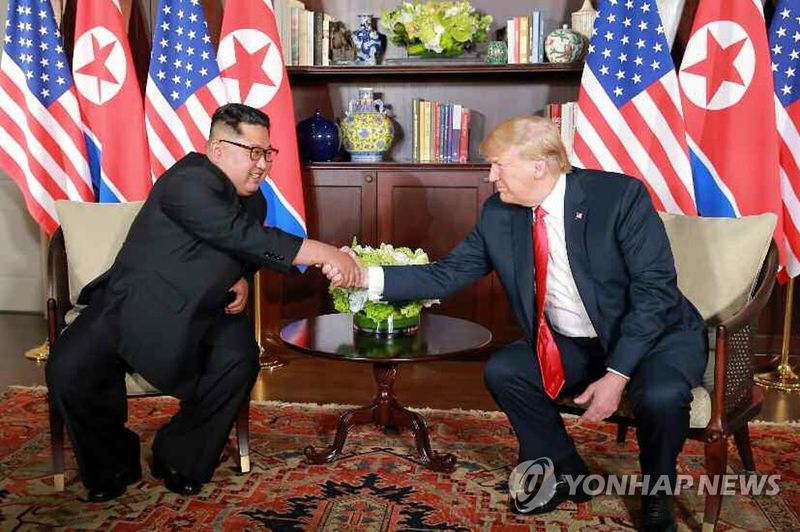
[Financial News, Tokyo = Seo Hye-jin Correspondent] Japanese media interpreted U.S. President Donald Trump's order on the 16th to sharply scale back Republic of Korea–United States joint military exercises as a form of preemptive courtship aimed at reviving summit diplomacy with Kim Jong Un, the North Korean leader. They also raised concerns that if Trump puts his personal ties with Kim ahead of coordination with allies and diplomatic results, the ROK-U.S. combined defense posture could weaken.
According to reports on the 18th from the Nihon Keizai Shimbun, or The Nikkei, and The Asahi Shimbun, Trump said on social networking service (SNS) on the 16th that "Kim Jong Un and I have a very good relationship," and claimed that the joint exercises sent "inappropriate and hostile signals" to North Korea. He also complained that the United States bears a large share of the enormous training costs. He then said it was "too late to cancel" and instructed Defense Secretary Pete Hegseth to drastically reduce the scale of the drills.
The remarks came just before the start of the Ulchi Freedom Shield (UFS) joint exercises. Even before Trump's comments, field maneuver drills had already been reduced from 22 last year to 14 battalion-level exercises this year. With about 18,000 South Korean troops taking part, the drills began as scheduled.
Japanese media therefore placed more weight on the view that the remarks were a political message aimed at restarting North Korea–United States dialogue, rather than a direct order to further scale back the exercises. The Asahi Shimbun, citing a South Korean military expert, described them as "a political act that gives meaning to something that has already happened." The analysis is that Trump was trying to present the existing reduction in drills as his own decision and signal his willingness to talk to Kim.
Attention also focused on Trump's push to attend the Asia-Pacific Economic Cooperation (APEC) summit in Shenzhen, China, in November. The Nikkei said there were signs that he wants to draw Kim into dialogue ahead of an autumn visit to Asia, and raised the possibility that he may try to revive the denuclearization talks that collapsed during his first presidency as a new "deal."
A former senior U.S. official who handled North Korea issues during the first presidency of Donald Trump told The Asahi Shimbun that "President Trump is clearly interested in visiting Pyongyang" and that "there is no one in the White House now who can oppose him." Trump had also announced a plan to suspend large-scale ROK-U.S. exercises during the 2018 Singapore North Korea–United States summit without sufficient coordination inside the U.S. government.
This time, however, North Korea's bargaining power is stronger than it was then. Pyongyang has deepened military cooperation with Russia through its troop deployment in the Russia-Ukraine War and has also restored ties with China. On that basis, it is now demanding recognition as a nuclear-armed state rather than a return to denuclearization talks.
Japanese media were especially wary of Trump's repeated references to North Korea as a "nuclear power" after returning to office for a second term.
The Nikkei noted that this could be interpreted as lowering the priority of the U.S. goal of North Korea's denuclearization. Even if North Korea–United States summit diplomacy resumes, there are concerns that talks on arms reduction or improved relations could take place while effectively accepting North Korea's nuclear status.
The Asahi Shimbun pointed out that if field maneuver drills are reduced while North Korea gains modern warfare experience, including drone warfare, through its deployment to Russia, the operational capabilities of the ROK-U.S. combined forces could weaken. The Nikkei also said that "North Korea may be able to exploit President Trump, who values immediate gains over alliances," adding that "if the rift between South Korea and the United States widens, China, Russia, and North Korea around Japan could become even more militarily assertive."
[email protected] Seo Hye-jin Reporter