Hyundai Motor to Train Atlas on 10,000 Hours of Data Before Factory Deployment
- Input
- 2026-08-17 18:23:33
- Updated
- 2026-08-17 18:23:33
■ First confirmation of the '10,000-hour' target
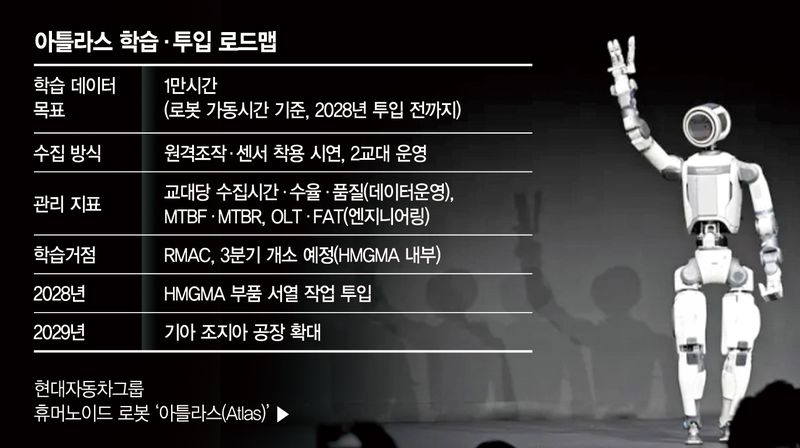
According to industry sources on the 17th, Boston Dynamics, Hyundai Motor Group’s robotics affiliate, has recently begun recruiting staff for RMAC in Savannah, Georgia. A posting for the head of applied engineering said the job would ensure that all generated data meets quality assurance standards aligned with the 10,000-hour collection target. This is the first time a specific target for Atlas training data has been confirmed.
RMAC is a facility where Atlas will accumulate work data and undergo performance verification before being introduced to actual production lines. It is a key base in Hyundai Motor Group’s robotics strategy unveiled at CES 2026 in January. When robots learn movements such as lifting and rotating at the center, the results are combined with real operating data from the Georgia plant to improve performance. The core idea is a cycle in which robots trained and tested at RMAC are deployed in the field, and the data collected on site is fed back into training. A Hyundai Motor Group official explained, "The 10,000 hours refer to actual operating time when the robot is moving, and the goal is to reach that level before deployment in 2028."
RMAC will be located inside the Hyundai Motor Group Metaplant America site. A Hyundai Glovis official said, "RMAC will use part of the space in the area where Hyundai Glovis handles logistics inside HMGMA."
RMAC will operate more like an automobile plant than a research facility. The applied engineering posting said the team must be able to support multiple shifts, including 6 a.m. to 2 p.m. and 2 p.m. to 10 p.m., if needed. For robot reliability, it will track mean time between failures (MTBF) and mean time to repair (MTBR), while applying operational level testing (OLT) and Factory Acceptance Testing (FAT) to robot behavior policies. In other words, the center will be managed as a production system designed to deliver consistent output within a set timeframe, rather than simply testing performance in a lab.
■ People are the ones creating the data
The data at this factory-like facility is created by people. The data operations team trains the robot’s 'brain' by remotely controlling Atlas or by having workers wear sensors and demonstrate tasks themselves. The posting refers to the operators as 'robot pilots' and calls for a separate manager to coach their control techniques and correct low-quality patterns. The supervisor’s key performance indicators are also set by the amount of data collected per shift, as well as yield and quality. In the end, the 10,000-hour target will be filled through human shift work.
The data generated by people will not remain with a single robot. At CES, Hyundai Motor Group formed a strategic partnership with Google DeepMind and agreed to jointly advance Gemini Robotics, a robot AI foundation model based on Gemini. The idea is to share what individual robots learn in the field through DeepMind and then further refine it. A Hyundai Motor Group official said, "DeepMind acts as a single brain, while each robot becomes a body."
Because the data accumulated at RMAC will feed back into the performance of robots across the group, the opening date is expected to influence the broader commercialization timeline. Hyundai Motor Group said in its first-quarter earnings release that RMAC would open in the third quarter, but it did not disclose a specific date or the initial number of Atlas units to be deployed. After training is complete, Atlas will first be used for parts sequencing work at HMGMA in 2028, and later expand to the Hyundai factory in Alabama and the Kia factory in Georgia in 2029.
Once the training phase is over, the next challenge will be scaling production. Hyundai Motor Group plans to build annual production capacity for 30,000 robots by 2028.
[email protected] Kim Dong-chan Reporter