Margin Trading Surges Again as Semiconductor Stocks Rebound... Credit Loans Rise by 3 Trillion Won This Month
- Input
- 2026-08-17 18:22:27
- Updated
- 2026-08-17 18:22:27
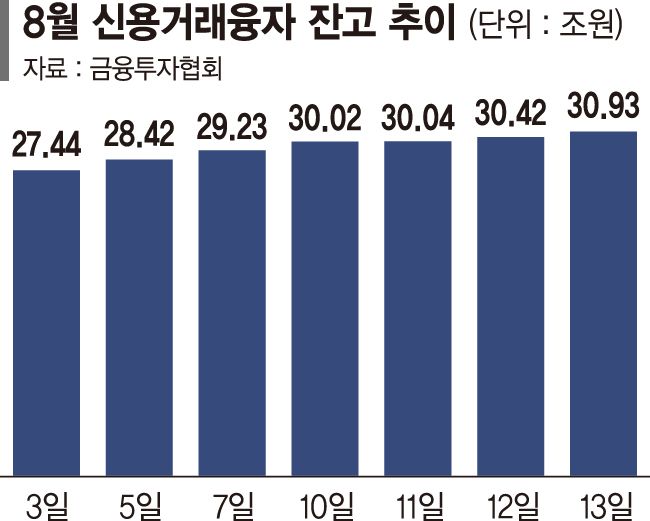
According to the Korea Financial Investment Association on the 17th, domestic stock market margin loan balances stood at 30.9263 trillion won as of the 13th. That was up 3.4824 trillion won, or 12.7%, from 27.4439 trillion won on the 3rd, the first trading day of the month, in just eight trading days. The recent increase has been led by KOSPI (Korea Composite Stock Price Index). Margin loan balances on the Korea Exchange Main Board rose by 2.9208 trillion won, or 13.5%, from 21.6141 trillion won on the 3rd to 24.5349 trillion won on the 13th. Over the same period, KOSDAQ (Korea Securities Dealers Automated Quotations) balances increased by 56.16 billion won, or 9.6%, from 5.8298 trillion won to 6.3914 trillion won. In other words, 83.9% of the total increase came from KOSPI.
In particular, leveraged funds are flowing into large semiconductor stocks such as Samsung Electronics and SK hynix. As of the 14th, margin balances for Samsung Electronics and SK hynix stood at 4.8821 trillion won and 4.8121 trillion won, respectively, up 9.4% and 20.9% from the end of last month. Combined, the two stocks account for 9.6942 trillion won in margin balances.
The recent rebound in semiconductor stocks appears to have prompted individual investors to join the buying through margin trading. Samsung Electronics and SK hynix rose for four straight trading days from the 11th to the 14th. On the 14th, Samsung Electronics closed at 274,500 won, while SK hynix finished at 1,645,000 won.
Stock market waiting funds are moving in the opposite direction. Investor deposits, which stood at 102.8256 trillion won on the 3rd, fell by 2.7572 trillion won, or 2.7%, to 100.0683 trillion won on the 13th. That contrasts with the 12.7% increase in margin loan balances over the same period. In short, the pool of idle money entering the market has shrunk, while demand to borrow money and buy stocks has increased.
Brokerage firms also see the renewed optimism over the semiconductor industry and stock prices as a factor behind the rise in margin balances. Kim Dong-won, Head of Research at KB Securities, said, "Samsung Electronics and SK hynix are currently trading at 4.5 times and 3.7 times forward 12-month price-to-earnings ratios, respectively, amid concerns over U.S. rate hikes, the sustainability of AI investment, the Iran situation, and a potential semiconductor peak-out." He added, "We believe the market is now entering a phase in which those concerns are fading, and a full-scale revaluation is expected to begin in the third and fourth quarters."
However, because margin balances have risen rapidly in a short period, investors could face greater pressure if market volatility expands. Margin trading can amplify gains in a rising market, but if stock prices fall sharply, it can trigger forced selling as collateral ratios decline. Kim Dae-joon, a research analyst at Korea Investment & Securities Co., Ltd., said, "The decline in customer deposits and the increase in forced selling are keeping supply-demand conditions unstable." He added, "Individual investors have played a major role in the KOSPI's rise so far, so weakening demand will likely limit the pace of index gains."
[email protected] Choi Du-seon Reporter