Geoje Hit by 900 mm of Rain in Three Days, Flooding Follows Just as Drought Worries Ease
- Input
- 2026-08-17 18:10:39
- Updated
- 2026-08-17 18:10:39
■'Extreme rain' hits the holiday period, with the highest hourly intensity on record
According to the Korea Meteorological Administration (KMA) on the 17th, cumulative rainfall in Geoje from the 15th through 4 p.m. that day reached 907 mm. Tongyeong also recorded 745 mm.
The KMA had downgraded the heavy rain warning for Geoje from a heavy rain advisory at 4 p.m. that day, but the city still received 633.2 mm, the highest daily rainfall since observations began in 1972.
Among the 97 national weather observation stations that the KMA uses to track rainfall rankings, it was the third-highest amount ever recorded.
Only two events brought more rain: 870.5 mm in Gangneung and 712.5 mm at Daegwallyeong Pass during Typhoon Rusa on Aug. 31, 2002.
The intensity of the rain over a short period was also unprecedented. Geoje's highest hourly rainfall reached 124.5 mm, far exceeding the previous record of 96.5 mm set on July 5, 2001. Tongyeong also broke its previous mark, with 97.4 mm compared with 86.5 mm on July 30, 1999.
The KMA analyzed that, based on the annual maximum hourly rainfall, this storm corresponded to a '200-year event' in Geoje and a '100-year event' in Tongyeong. It explained that the rainfall intensity was statistically the kind that could occur once every 200 years and 100 years, respectively. The average summer rainfall from 1991 to 2020 was 935.1 mm in Geoje and 728.8 mm in Tongyeong. During the holiday period, about 91% of Geoje's average summer rainfall and about 97% of Tongyeong's fell in less than three days.
The record-breaking rain was driven by a low-pressure system that formed after Typhoon Dolphin weakened. As the system moved northeast from the southwest of the Korean Peninsula, hot and humid air flowed strongly into the southern coast. When that air met the terrain of the southern coast and Jeju Province, rain clouds developed rapidly. The continued supply of moisture from the warm waters of the southern sea also helped increase rainfall.
■Four dead or injured in landslides, with flooding reported in roads and homes
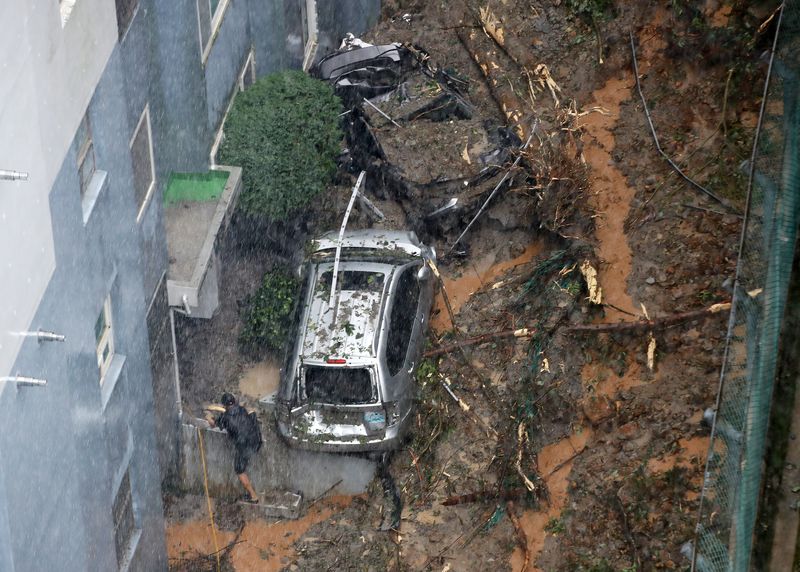
The record rainfall led to landslides and flooding. In Geoje, one person was killed and four others were injured after landslide debris buried the lower floors of an apartment building.
In Gollido, Sanyang-eup, Tongyeong, a landslide buried one house in soil and trapped one resident, who was later rescued. Across South Gyeongsang Province, including Geoje and Tongyeong, roads were washed away or flooded, and homes and shops were inundated. In some areas, city and intercity bus services were also disrupted.
The Ministry of the Interior and Safety activated Level 1 of the Central Disaster and Safety Countermeasures Headquarters at 6 a.m. after heavy rain intensified around Busan, South Gyeongsang Province, and Jeju Province, with flooding and isolation damage continuing to spread.
The National Fire Agency (NFA) issued a national firefighting mobilization order for Geoje and Tongyeong and concentrated firefighting resources there. A total of 1,947 reports related to the heavy rain were received, and 136 people were rescued through 20 life-saving operations. A total of 387 personnel, including 361 from the Gyeongsangnam-do Fire Department and 26 support personnel under the national mobilization order, were deployed along with 84 pieces of equipment. The National 119 Rescue Headquarters also sent 47 personnel and 13 pieces of equipment. After rescue operations were completed, crews continued drainage work, debris removal, recovery efforts, and additional safety measures.
To support recovery efforts, the government decided to urgently provide 3 billion won in special disaster and safety management grants to Jeollanam-do, Busan, and South Gyeongsang Province. It will also allocate 40 million won in disaster relief funds to support evacuated residents.
Meanwhile, the rain has eased much of South Gyeongsang Province's long-running drought in agricultural water supplies. As of 2 p.m. on the 17th, the average reservoir level for agricultural water across 18 cities and counties in South Gyeongsang Province stood at 43.1%, or 61.7% of the normal level of 69.8%. Six southern coastal cities and counties, including Changwon, Geoje, Tongyeong, Sacheon, Goseong County, Gangwon Province, and Namhae, have exited drought conditions. Miryang, however, remains at the 'severe' drought stage.
[email protected] Lee Bo-mi Reporter