Plastic That Was Hard to Recycle Came Back to Life as Raw Material in Just 90 Minutes [Unboxing Lab]
- Input
- 2026-08-18 05:56:00
- Updated
- 2026-08-18 05:56:00
Do you remember the excitement of opening a delivery box? Even now, university labs are producing remarkable discoveries that could change our lives. They are simply wrapped in the thick packaging of academic papers. In "Unboxing Lab," we will skip the complex equations and theories and focus on the essentials you want to know. So, shall we open the box? Today’s featured study is this one.
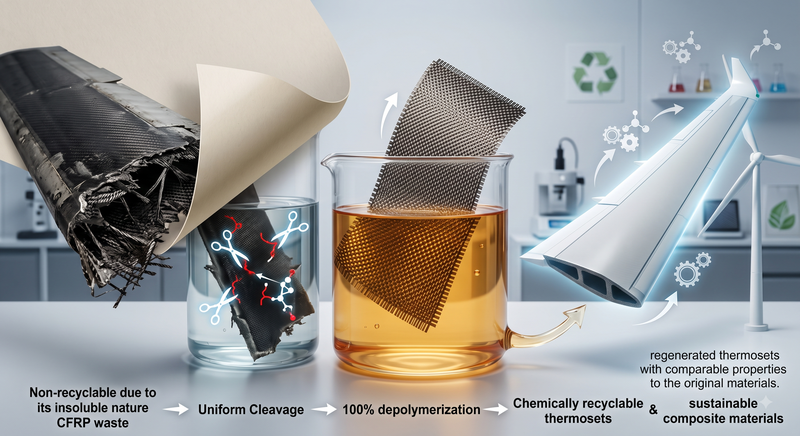
■ From aircraft wings to wind turbines... advanced materials once thrown away can be reused
Epoxy is a representative high-performance plastic that is heat-resistant and durable, so it is used across advanced industries, including aircraft, automobiles, wind turbine blades, and electronic device substrates. It is especially important when making carbon-fiber reinforced plastics (CFRP), where it firmly binds the carbon fiber together.
But epoxy is a thermosetting plastic, which means that once it hardens, it does not melt again even when heat is applied. When products reached the end of their life, most had to be landfilled or incinerated, and expensive materials were inevitably thrown away as well.
The research team’s technology overcomes that limitation. It breaks down used epoxy, recovers the key raw materials, and makes them into new plastic again. It can also recover expensive carbon fiber in fabric form, which is expected to reduce composite waste from aircraft, wind turbines, and eco-friendly mobility applications while also lowering material costs.
■ A "breakable link" inside the molecule... decomposed in 90 minutes at 50°C
The key lies in redesigning the plastic’s molecular structure. The team used Eugenol, a natural compound derived from plants, to insert a link inside the plastic that breaks only when needed. Under normal conditions, it retains the toughness of conventional epoxy, but during recycling, only that link is selectively broken.
In practice, when the material was placed in an alkaline solution at 50°C, the link broke quickly and the plastic completely decomposed into the solution in just 90 minutes. A structure with two such links decomposed about 420 times faster than one with a single link. Compared with existing technologies that required temperatures of 120°C to 220°C or separate catalysts, this method also has the advantage of enabling recycling at much lower temperatures.
■ 94% of key raw materials recovered... carbon fiber preserved in its original form
The team recovered up to 94% of the plastic’s key raw materials from the decomposed solution. Epoxy made from those recovered materials retained nearly the same strength and elasticity as the original product. Its water absorption rate was 0.76% over 30 days, and even after two months, or 60 days, there was little change, showing stable properties after recycling.
The results were also confirmed in experiments with carbon fiber reinforced plastic (CFRP). When the material was soaked in a 50°C solution for one hour, only the epoxy decomposed, and the carbon fiber fabric was recovered 100% without any damage to its shape. The recovered fabric showed a distortion angle of less than 5 degrees, meaning its original structure was almost completely preserved.
In the past, recycling carbon fiber composites usually meant shredding the fibers, which greatly reduced quality. This technology stands out because it allows expensive carbon fiber to be reused in its original form. It is expected to be widely applied in the future to recover carbon fiber and epoxy together from end-of-life aircraft, wind turbine blades, and discarded electric vehicle parts, and then turn them back into high-performance products.
Konkuk University is currently pursuing technology transfer and commercialization of the method, and its university spin-off Repork is preparing for production and commercialization. The study was selected as a cover paper in the international polymer journal Macromolecules.
[email protected] Kim Man-ki Reporter