LDP leadership visits Yasukuni Shrine en masse; prime minister offers ritual prayer from several hundred meters away
- Input
- 2026-08-16 13:17:40
- Updated
- 2026-08-16 13:17:40
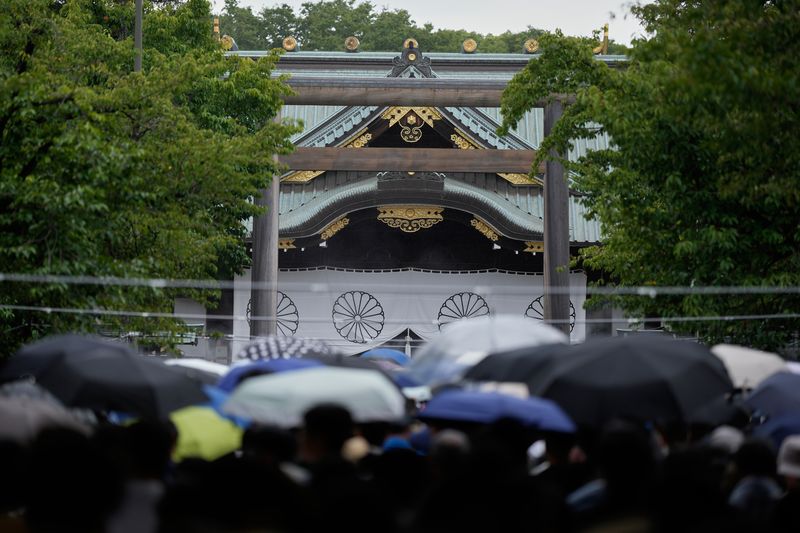
[Financial News, Tokyo = Reporter Seo Hye-jin] Takayuki Kobayashi, the last member of the LDP leadership to join the group visit to Yasukuni Shrine on Japan's surrender day, visited the shrine on the 16th. Including the three officials who paid their respects the previous day, such as Secretary-General Suzuki Shunichi, all four top party leaders of the LDP visited Yasukuni Shrine in person.
Prime Minister Sanae Takaichi chose ritual prayer from several hundred meters away instead of visiting in person the previous day, mindful of South Korea and China. But the party leadership all went to the shrine, sending a clear message to conservative supporters. With Takaichi having removed the word "reflection" from her memorial address and the party's top four officials completing their visits, observers said the new administration's first surrender-day actions showed an even stronger conservative tilt.■ All four top LDP officials visit, with Kobayashi joining a day laterAccording to The Asahi Shimbun and NHK, Policy Research Council Chair Takayuki Kobayashi visited the main hall of Yasukuni Shrine in Tokyo's Chiyoda City at around 6:30 a.m. that day. He paid a tamagushiryo offering with his own money and signed the guest book as "House of Representatives member Takayuki Kobayashi."
After the visit, Kobayashi said he had prayed quietly "as one of the bereaved family members." He added that he had "offered my deepest condolences to the spirits who made noble sacrifices, while thinking of my beloved family and hometown." He also said he had renewed his determination to "protect the lives and livelihoods of the country and its people to the very end." Kobayashi's grandfather is said to have died in the war.
Kobayashi had originally planned to visit the shrine on the previous day, Japan's surrender day, together with Secretary-General Suzuki, General Council Chair Haruko Arimura, and Election Strategy Committee Chair Yasutoshi Nishimura. He postponed the schedule by one day to respond to flood damage in his constituency in Chiba Prefecture.
With Kobayashi's visit, all four top LDP officials — the secretary-general, general council chair, policy chief, and election strategy chief — have now visited Yasukuni Shrine. The Asahi Shimbun noted that the timing meant all four leaders visited on the surrender day. The previous day, four sitting cabinet ministers, including Defense Minister Shinjirō Koizumi, and more than 80 lawmakers from a bipartisan parliamentary group also paid visits.
That stood in contrast to Takaichi's decision to forgo a direct visit and instead offer ritual prayer at Nippon Budokan's parking lot nearby, facing Yasukuni Shrine and following the Shinto-style practice of "two bows, two claps, and one final bow." Takaichi also offered a tamagushiryo donation in the name of the LDP president through Suzuki.
Asked about Takaichi's ritual prayer, Kobayashi said it was "a matter for the prime minister to judge appropriately at the time." On protests from South Korea and China over the cabinet ministers' visits, he said he understood them as "a matter of each person's inner feelings."■ Appeasing conservatives vs. the strongest possible expression while considering diplomacyJapanese major media interpreted Takaichi's ritual prayer as a desperate compromise designed to avoid diplomatic friction while preventing the loss of core conservative supporters.
JIJI PRESS analyzed that, as approval ratings for the Takaichi Cabinet were falling, abandoning a Yasukuni visit could have driven away the hardline conservative base known as the "bedrock supporters," and that concern lay behind the ritual prayer.
A close aide to Takaichi told JIJI PRESS, "Ritual prayer was a method even former Prime Minister Shinzō Abe considered," adding, "We did everything we could. It was a quarter-step forward toward an actual visit."
The Yomiuri Shimbun interpreted Takaichi's decision as a move to avoid a direct visit while taking relations with neighboring countries, including South Korea and China, into account. Although Takaichi has built a good relationship with President Lee Jae Myung, a direct visit to Yasukuni Shrine would have made a worsening of Japan-South Korea ties unavoidable. It also said she had to avoid further deterioration in Japan-China relations, which were already strained by her remarks on a possible Taiwan contingency.
A lawmaker close to Takaichi told the Yomiuri that she had expressed her desire to visit "in the strongest form possible at this time."
Within the LDP, voices also continued to call for a sitting prime minister to visit the shrine directly. Former Prime Minister's aide Akihisa Nagashima argued that "working to restore a normal situation in which the prime minister can visit is also an important task for politicians."
As a cabinet minister, Takaichi almost never missed Yasukuni Shrine visits on surrender day and during the spring and autumn festivals. During the LDP leadership race in 2024, she said she would continue visiting even after becoming prime minister, but since taking office in October last year, she has held off on direct visits out of consideration for diplomatic ties with neighboring countries.■ Did the phrase "I will not let it happen again" erase the perpetrator?Controversy also spread over Takaichi's ritual prayer and her memorial address at the National Memorial Service for War Dead. She again deleted the word "reflection," which former Prime Minister Shigeru Ishiba had restored for the first time in 13 years last year, and did not mention "a vow against war" or "the lessons of history."
In particular, attention was drawn to her change of the phrase used by previous prime ministers, from "I will not repeat the horrors of war" to "I will not let the horrors of war be repeated."
The Mainichi Shimbun analyzed this as a "one-character change" that reveals Takaichi's view of history.
YAMADA Akira, a professor at Meiji University and an expert on modern and contemporary Japanese history, told the Mainichi that the causative form in "I will not let it happen again" reflects the view that Japan was not a subject that waged war on its own, but rather a victim caught up in war.
Hiroko Okuda, a professor at Kanto Gakuin University and an expert in political communication, also said, "It appears to be intended to focus more on the future than the past, obscure the historical facts of aggression, and avoid turning historical awareness into a point of contention."
Takaichi's remark in the memorial address that Japan "can become a trusted nation as a shining beacon in the Indo-Pacific" was also interpreted as a message that she is inheriting former Prime Minister Abe's vision of a "Free and Open Indo-Pacific." JIJI PRESS said Takaichi had made Abe's influence clear in both her ritual prayer and her memorial address, highlighting the continuation of a conservative line.
[email protected] Seo Hye-jin Reporter