"Lost money, and people drifted away" ... Daily life collapsed before the empty account did [Young People Caught in the All-or-Nothing Dream 5]
- Input
- 2026-08-19 06:00:00
- Updated
- 2026-08-19 06:00:00

Photo = ChatGPT The fallout from failed investments does not stop at the account. Losses are hidden from family and partners, borrowers are pressured by loan repayments, and some even drift away from the people around them. The final installment of "Young People Caught in the All-or-Nothing Dream" looks at the problems that remain in young people's daily lives after their accounts are wiped out.
[Financial News] A salaried worker in his 30s, identified as A, could not tell his family about his investment losses. At first, he had only put in part of his paycheck, but he later used loans in an attempt to recover the losses. After his account balance shrank, he cut back on plans with friends and did not explain to his partner why his credit card bill had gone up.
Photo = ChatGPT The fallout from failed investments does not stop at the account. Losses are hidden from family and partners, borrowers are pressured by loan repayments, and some even drift away from the people around them. The final installment of "Young People Caught in the All-or-Nothing Dream" looks at the problems that remain in young people's daily lives after their accounts are wiped out.He deleted and reinstalled his securities app. Checking the losses was painful, but not looking made him even more anxious. After work, he read message boards about stocks, and on weekends he searched for signs of a rebound the following week.The failed investment did not end inside the account. A said, "What hurt more than losing money was having no one to talk to. " He could not tell his family because he did not want to worry them, and he could not tell his friends because he felt ashamed.When the topic of wedding preparations came up with his partner, he hid the size of his losses. Stress from account losses . a vicious cycle that makes it hard to confide in others Investment failures among young people cannot be explained by loss rates alone.
What lasts longer than the loss of principal is debt-backed losses, losses hidden from family, and repayment burdens that remain even after relationships have broken down. When investment failures repeat, money problems can spill into daily life and mental health. A worker in his 20s, identified as B, avoided family gatherings after losing money in cryptocurrencies and overseas stocks.
Photo = ChatGPT The fallout from failed investments does not stop at the account. Losses are hidden from family and partners, borrowers are pressured by loan repayments, and some even drift away from the people around them. The final installment of "Young People Caught in the All-or-Nothing Dream" looks at the problems that remain in young people's daily lives after their accounts are wiped out.
Whenever his parents brought up wedding savings, he delayed his answer. He feared that if he told them about the losses, they would ask, "Why did you make such an investment?" He said, "I was more afraid of having to explain it than of the money problem itself. " The time spent hiding losses changes daily life.
Photo = ChatGPT The fallout from failed investments does not stop at the account. Losses are hidden from family and partners, borrowers are pressured by loan repayments, and some even drift away from the people around them. The final installment of "Young People Caught in the All-or-Nothing Dream" looks at the problems that remain in young people's daily lives after their accounts are wiped out.People cut back on plans, delay credit card payments, and calculate repayment amounts first on payday. When stocks rise, they feel relieved; when they fall, the whole day feels heavy. Outwardly, they continue working, but in reality their days are organized around account balances and loan repayment dates.
A salaried worker in his 30s, identified as C, slept less after his losses. At night, he checked U. S.stock prices, and in the morning he followed news on the domestic market. He said, "Nothing gets solved by not sleeping, but if I don't look, I get even more anxious. " The time spent trying to recover losses pushed aside time for recovery.Debt and burnout left behind after investment losses Young people are already carrying both debt and living expenses. 37 million won. 2% of young people had experienced burnout in the past year.
1%. 6%. 2% among men.
It would be too simplistic to say that investment losses directly lead to mental health problems. But when debt, losses, and isolation pile up together, the burden grows. In particular, when people cannot tell family or those around them about the losses, solutions are delayed.
Photo = ChatGPT The fallout from failed investments does not stop at the account. Losses are hidden from family and partners, borrowers are pressured by loan repayments, and some even drift away from the people around them. The final installment of "Young People Caught in the All-or-Nothing Dream" looks at the problems that remain in young people's daily lives after their accounts are wiped out.
Investment failures begin as numbers, but over time they can shake relationships and daily routines as well. After his losses, B started a weekend part-time job to cover loan interest. He told his friends he was "saving money.
Photo = ChatGPT The fallout from failed investments does not stop at the account. Losses are hidden from family and partners, borrowers are pressured by loan repayments, and some even drift away from the people around them. The final installment of "Young People Caught in the All-or-Nothing Dream" looks at the problems that remain in young people's daily lives after their accounts are wiped out." In reality, he was using the time to make up for investment losses. He earned extra income on weekends, but he had less time to rest. Pain that leads to credit loans and overdraft accounts Investment losses do not end inside the account.
When an investment that started with spare cash turns into credit loans, card loans, or overdraft accounts, repayment dates remain after the losses. Even if stocks are sold, loan interest keeps draining money, and the longer losses are hidden, the larger the amount that must be explained to family or a partner becomes.
A also first saw his losses as nothing more than a failed investment. He thought the problem would be solved if stock prices rose again.
But while he held on to losing stocks, the account for daily living expenses ran dry first. As the credit card payment date approached, he had to decide whether to sell his holdings or take out a short-term loan.
Photo = ChatGPT The fallout from failed investments does not stop at the account. Losses are hidden from family and partners, borrowers are pressured by loan repayments, and some even drift away from the people around them. The final installment of "Young People Caught in the All-or-Nothing Dream" looks at the problems that remain in young people's daily lives after their accounts are wiped out.
More and more often, he checked interest payment dates before checking returns. The debt burden on young people is also confirmed by government data.
Photo = ChatGPT The fallout from failed investments does not stop at the account. Losses are hidden from family and partners, borrowers are pressured by loan repayments, and some even drift away from the people around them. The final installment of "Young People Caught in the All-or-Nothing Dream" looks at the problems that remain in young people's daily lives after their accounts are wiped out.12 million won. 13 million won.
A large share of the debt was tied to housing. 37 million won in personal debt among young people.
7% of respondents. 7%.
These figures do not separately count debt created by investment losses, but the debt burden on young people is already heavy under pressure from housing and living costs. When investment losses and loan interest are added on top, account losses can turn into a shortage of money for daily life.
In the process of putting in more money to recover losses, the nature of the debt also changes. At first, it was money to grow assets.Later, it became money to endure the losses AI-generated infographic Mental health indicators are no lighter. 8%.2% had experienced burnout. 6%.
Photo = ChatGPT The fallout from failed investments does not stop at the account. Losses are hidden from family and partners, borrowers are pressured by loan repayments, and some even drift away from the people around them. The final installment of "Young People Caught in the All-or-Nothing Dream" looks at the problems that remain in young people's daily lives after their accounts are wiped out.
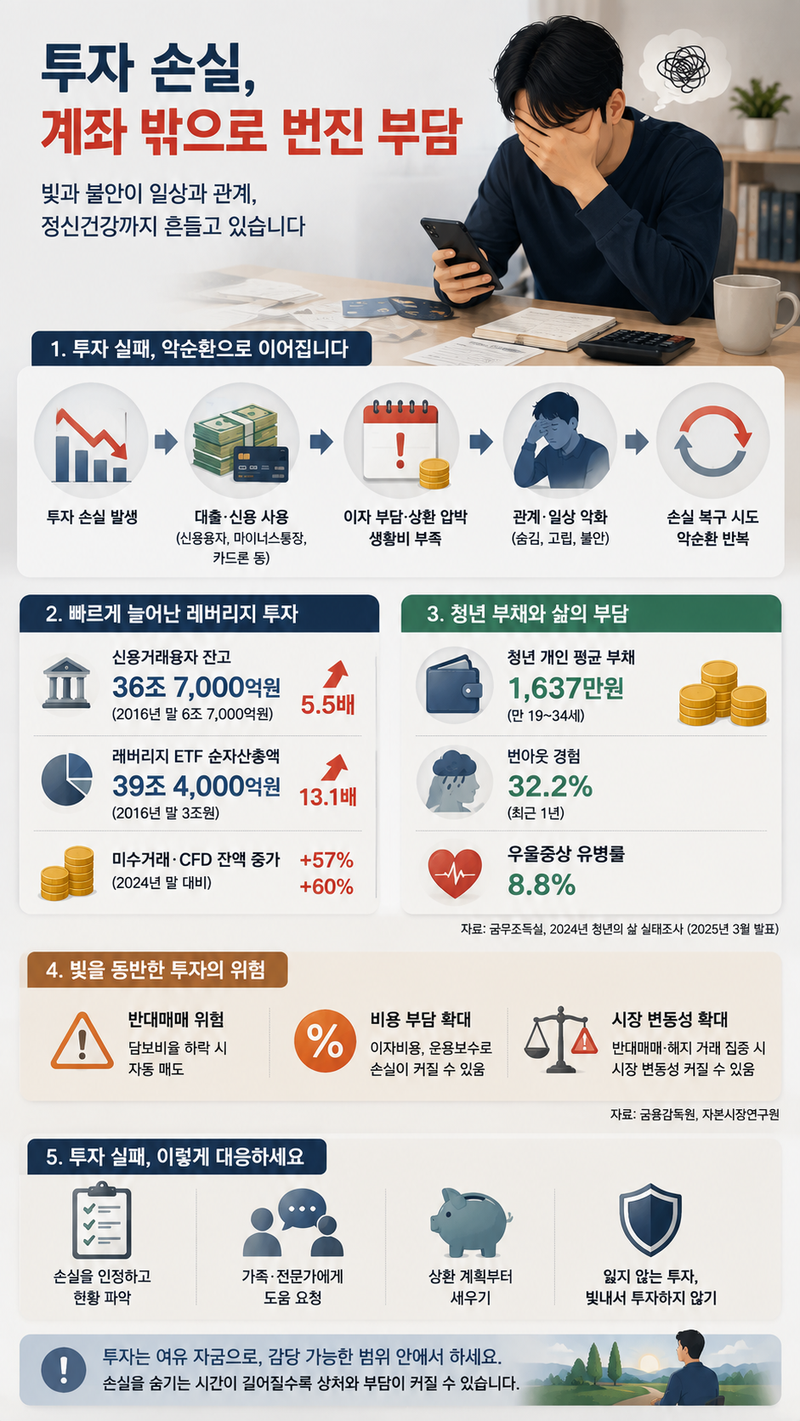
The number of new long-term delinquent borrowers rose from around 180,000 in 2021 to around 300,000 in 2025. There is also a section related to young people.
9% in 2025. High-risk households are those with a heavy repayment burden and difficulty repaying debt even after selling assets.
The report explained that after COVID-19, debt for home purchases and stock investments increased among people in their 20s and 30s, who generally have lower income and asset accumulation. The burden also appeared in special cases under the Credit Counseling and Recovery Service (CCRS) Individual workout program.
As of 2025, the number of beneficiaries under the special provision for unemployed young people and college or graduate students reached 11,723, the largest among all special categories. 5% of the reasons for applying a repayment period of less than three years in 2024.
Meanwhile, A recently sold off some of his losing stocks. He has not recovered all of his principal, but he decided not to increase his debt just to keep going.He also told part of the story to his family. He said, "Deleting a stock app does not make the credit card bill disappear," and added, "Even if I invest again, I do not want to keep going by borrowing money." He said.
[email protected] Han Seung-gon Reporter