"A 20 Million Won Margin Loan, and If Only SKHY Recovers, It Can Be Paid Back Quickly" — Averaging Down Turns Into 'Debt-Rolling' Debt Investing [Young People Caught in a One-Shot Life 4]
- Input
- 2026-08-18 05:00:00
- Updated
- 2026-08-18 05:00:00

After suffering losses, some young investors think of buying more before they think of selling. At first, they invest spare cash, but to make up for losses, some even turn to margin loans, overdrafts, and card loans. As the desire to recover lost money in one shot grows stronger, the phrase "one-shot life" comes to feel less like a hope for gains and more like a burden of debt. This installment looks at how the line between investment money and borrowed money becomes blurred.
[Financial News]#. A salaried worker in his 20s, identified as A, first put 3 million won into stocks. As gains from large-cap stocks rose into double digits this year, he invested every bit of spare cash he had after living expenses. Until the market crash, the steadily rising returns were the joy of his daily life. In July, when his account first turned red, he panicked. He opened a 20 million won overdraft line and rushed into averaging down. That was the start of his debt investing.His average purchase price fell, but the principal loss kept snowballing. Recovering the original investment has now become a distant dream.He made his first additional purchases with his salary. The following month, after paying his credit card bill and rent, he did not have enough money left. A opened an overdraft account. He said, "I thought I could just borrow for a short time and pay it back once the stock price went up."
But stock prices kept falling. His account losses did not shrink, and interest kept being deducted every month. What had started as an investment with spare cash gradually lost its distinction from living expenses. Recovering losses became the purpose of investing.
Selling means 'locking in losses'... avoiding pain by 'buying more'
For young investors, losses are not just numbers. For early-career workers with modest salaries, a loss of 1 million won can equal several months of savings. Once losses are locked in, it takes time to build the money back up. That is why some investors choose to buy more rather than sell.
A said, "It felt like the failure would be over if I sold." Buying more made it seem as if recovery was still possible. If the stock price rose a little, he waited longer. If it fell again, he considered buying more. At some point, recovering principal came before investment judgment.
A salaried worker in his 30s, identified as B, faced a similar situation. He initially bought only major domestic stocks, but after his losses grew, he turned to leveraged products. He said, "I thought recovery would be too slow with ordinary stocks," and added, "I thought a 2x product could help me recover faster." But in a falling market, his losses also grew much faster.
After losses, buying more may feel psychologically like an attempt to recover. But once the source of money changes, the problem changes too. When investing with part of a salary turns into margin loans, overdrafts, and card loans, account losses are shifted into repayment burdens the following month.
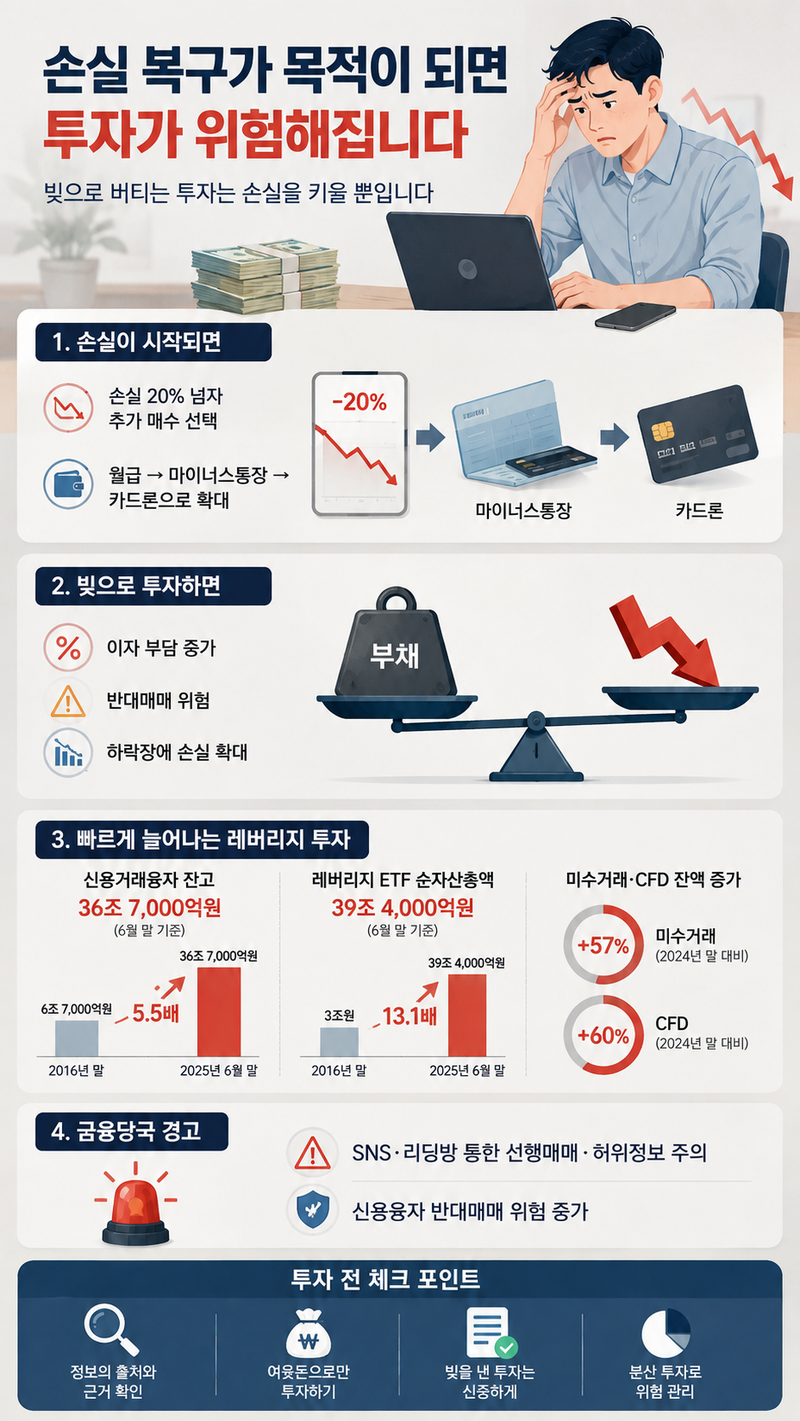
Margin loans reach 36.7 trillion won... up 5.5 times in 10 years
Leveraged investing by individual investors has grown rapidly. In a report titled "Current Status and Implications of Leveraged Investing by Individual Investors," senior researcher Lee Hyo-seop at the Korea Capital Market Institute analyzed that as of the end of June, margin loan balances in the domestic stock market stood at 36.7 trillion won, up 5.5 times from 6.7 trillion won at the end of 2016. The average annual growth rate was 19.6%.
The leveraged ETF market has also expanded. According to the same report, the total net assets of domestic leveraged ETFs reached 39.4 trillion won at the end of June, up 13.1 times from 3 trillion won at the end of 2016. Balances in unsettled trades and CFD transactions also rose 57% and 60%, respectively, from the end of 2024.
Leverage can amplify returns in a rising market. On the other hand, if the investment goes the wrong way, losses also grow larger. Margin loans carry interest costs, and if collateral ratios fall below the required level, forced selling can occur. Because of management fees and compounding effects, leveraged ETFs may not deliver long-term performance that simply tracks the multiple of the underlying asset's return.
The Financial Supervisory Service has also warned investors to be careful about disputes related to forced selling. In March, the agency outlined major dispute cases involving forced selling on margin loans and investor precautions, saying that recent sharp swings in the domestic stock market have increased the risk of forced selling for investors using margin loans, and that related complaints continue to be filed.
If the line between investment money and living expenses is not maintained, daily life can collapse too
Investing with borrowed money may seem to shorten the time needed for recovery. But if losses drag on, investors must bear not only returns but also interest rates. While waiting to recover principal, loan interest is deducted first, and credit scores and additional borrowing capacity can also be affected.
A salaried worker in his 20s, identified as C, used card loans after stock prices fell. He said, "I thought of it as investment money, not living expenses." But when the credit card payment date approached, his thinking changed. The investment money was in the securities account, while the money he had to repay appeared on the card statement.
C did not tell his friends about his investment losses. He cut back on plans because he did not have enough money, but it was hard to explain why. He said, "At first, I thought I could pay it back in a few months," and added, "But as stock prices kept falling, the repayment schedule got messed up too."
The debt burden on young people is already significant. According to the "2024 Survey on the Lives of Young People" released by the Office for Government Policy Coordination in March 2025, the average personal debt of people aged 19 to 34 was 16.37 million won. When investment losses are added to housing and living expenses, the room for recovery shrinks even further.
Severe volatility, forced selling... and the negative compounding effect
The expert warned that greater leverage can affect not only individual losses but also market volatility. In the report, senior researcher Lee said, "Individual investors who invest in leveraged products can suffer massive losses if the underlying asset moves against their investment direction, and losses can widen due to high interest costs, management fees, and negative compounding effects."
Lee also analyzed that when forced selling and ETF hedging trades move together, the burden can spread to the broader market. He said, "If forced selling is triggered in succession in margin loans and unsettled trades, or if hedging volumes for leveraged ETFs become concentrated near the market close, there is a strong possibility that volatility across the stock market will increase."
Meanwhile, A has recently stopped making new purchases. He has not liquidated his account, but he has decided not to increase borrowing any further. He said, "I started out trying to make money, but later all I cared about was getting back what I had lost," and added, "From that point on, it was no longer investing. It was just trying to survive the debt."
[email protected] Han Seung-gon Reporter