Chey Tae-won files appeal over 944 billion won property division with Noh So-young... Supreme Court to review the case again
- Input
- 2026-08-15 00:37:26
- Updated
- 2026-08-15 00:37:26
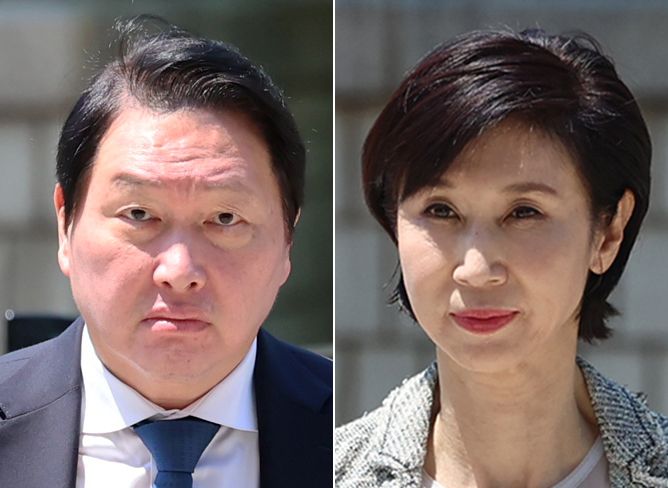
[Financial News] Chey Tae-won, chairman of SK Group, has filed another appeal and will now face a ruling from the Supreme Court of Korea after challenging a court decision ordering him to divide 944.4 billion won in assets with Noh So-young, director of Art Center Nabi.
According to the legal community on the 15th, Chey's side said it submitted the appeal the previous day to the Seoul High Court Family Division 1, which handled the remanded property division case with Noh.
In a notice, Chey's legal team said, "After careful consideration of various circumstances, Chey decided to file the appeal." It added, "We will proceed with the next steps with the goal of minimizing any negative impact on shareholders and group management."
Earlier, on the 24th of last month, the court ruled in the remanded property division case filed by Noh against Chey, saying, "Chey must pay Noh 944.4 billion won."
The main issue in the case was whether Chey's shares in SK and other companies should be treated as assets subject to division. The court found that those shares were included in the marital property subject to division. It said the shares were acquired in Chey's name during the marriage, and that both Chey and Noh contributed to the acquisition, preservation, and increase in value of the shares.
The court also set the valuation date for the SK shares and other stocks as the date when arguments closed in the appeals trial before the remand, rather than after the remand, when share prices had surged. It applied a 2000 Supreme Court precedent stating that even if a property division claim is filed after a divorce is finalized, the divided assets and amount should be determined based on the date when arguments closed in the trial on the merits. Although the value of SK shares and other stocks has risen sharply since the closing date before the remand, the court said that increase was the result of Chey's management efforts and therefore could not be treated as divisible property.
However, the court reflected the sharp fluctuation in share value in setting the property division ratio. Chey will receive one-third of the shares he holds, while Noh will receive two-thirds of the shares held by Chey. Because stock values can fluctuate significantly, the court said the total value of the couple's joint property could change greatly depending on when the post-remand closing date is set. It added that even if the valuation date is set as the closing date before the remand, any increase in value during that period must be shared by both spouses.
It has been suggested that Chey's decision to appeal again was driven by the heavy burden of raising 944.4 billion won. If the remanded ruling had been finalized, Chey would have had to pay 5% annual late-payment interest from the day after the judgment became final until the full amount was paid. That would amount to 47.2 billion won a year, or about 130 million won a day.
If Chey were to sell his stake in SK Inc. directly, it could affect the group's control structure. As a result, he may seek to raise funds through a combination of selling shares in SK Siltron, receiving dividends, and taking stock-backed loans. Since the matter could affect Chey's ownership stake in SK Group and, in turn, management control, his side is believed to have filed the appeal in hopes of securing another Supreme Court review. Some analysts also say the appeal is intended to buy time to raise the 944.4 billion won owed to Noh and avoid late-payment interest.
In the end, the property division lawsuit that began in 2017 will once again be reviewed by the Supreme Court of Korea. Chey's side is expected to challenge the remanded court's finding that SK shares are divisible property, as well as the method used to calculate the division ratio. The Supreme Court is also expected to examine whether it was appropriate to exclude the gains from the rise in share prices from the property division. Legal experts said they do not expect a major change in the outcome, as the remanded court appears to have followed the procedures pointed out by the Supreme Court.
[email protected] Jung Kyung-soo, Jung Won-il Reporter