President Lee Jae-myung: Constitutional Revision for a Four-Year, Two-Term or Consecutive-Term Presidency Has Been My Consistent Position... Willing to Accept Shortened Term
- Input
- 2026-08-14 19:14:06
- Updated
- 2026-08-14 19:14:06
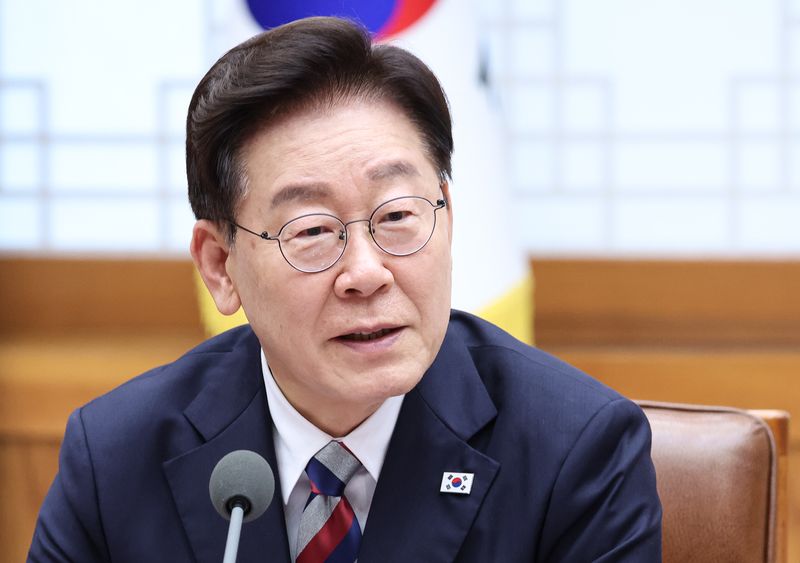
[Financial News] President Lee Jae-myung said on the 14th, "My pledge and my consistent position has been to revise the Constitution so that the presidential term is changed to a four-year, two-term or consecutive-term system, allowing responsible politics through a midterm review, while strengthening local autonomy and the people's basic rights." He added that a dual executive system or a parliamentary system would not be desirable.
Through X (formerly Twitter) that day, Lee wrote, "My official position during the 2022 presidential election was that if shortening the presidential term was necessary for a constitutional amendment, I could accept it, and that view has not changed."
Lee also said, "It is widely agreed by the public that our Constitution, now 40 years old, no longer fits our time and should be revised. If a revision is actually made, it would be desirable for the National Assembly to decide the details through bipartisan agreement. However, my position on the content of the amendment remains unchanged."
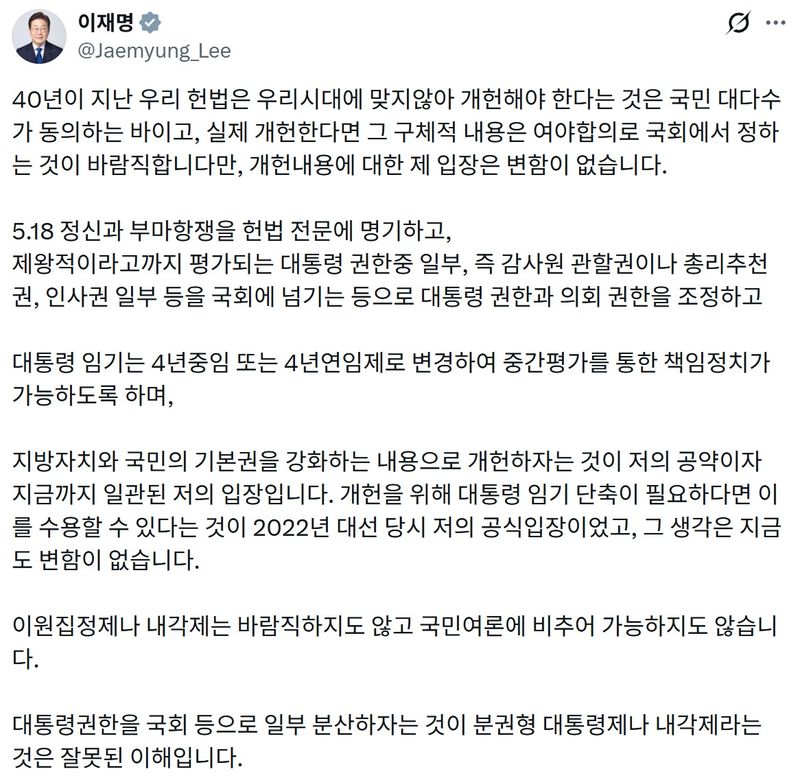
He also explained that the spirit of the May 18 Gwangju Uprising and the Busan–Masan Uprising should be included in the preamble to the Constitution, and that some of the presidential powers often described as imperial, including jurisdiction over the BAI, the right to recommend the prime minister, and some personnel authority, should be transferred to the National Assembly to rebalance presidential and legislative powers.
However, he said, "A dual executive system or a parliamentary system is neither desirable nor feasible in light of public opinion," adding, "It is a mistaken understanding to say that distributing some presidential powers to the National Assembly and other institutions means a decentralized presidential system or a parliamentary system."
Meanwhile, a Cheong Wa Dae official also said that the administration "agrees that there are problems with the imperial presidential system" and that "a four-year, two-term presidential system with strengthened parliamentary powers is, in our view, the most acceptable to the public."
The official met reporters at the Chunchugwan Press Center on the same day and once again reaffirmed President Lee's principled position on constitutional revision.
The official stressed that constitutional revision is an issue that requires the support of more than 200 lawmakers in the National Assembly, so it would be desirable for the legislature to discuss and promote it.
The official added, "The idea is to address the limits of an imperial presidency by moving to a two-term presidential system, so it is not a parliamentary system," and "Nor was any specific decentralized presidential model explicitly named."
The official said, "It has been President Lee's principle that a constitutional amendment should be pursued through agreement, and he has said so many times, so I am reaffirming that principle again."
According to political sources, Lee recently held a series of golf meetings with Kim Tae-ho, a four-term lawmaker from the People Power Party, and other veteran lawmakers from the party. During those meetings, he was said to have remarked, in reference to constitutional revision for a decentralized power structure, that "I think we should amend the Constitution even if it means shortening my term."
[email protected] Choi Jong-geun Reporter