"My child is a high school senior, and I can't sleep because I'm afraid we'll be forced out" ... Parents in school districts worry about landlords' comprehensive real estate tax [Tax War 4]
- Input
- 2026-08-20 05:00:00
- Updated
- 2026-08-20 05:00:00
The Lee Jae-myung administration's Aug. 3 tax reform plan[Real estate-driven tax war]has spread. Older homeowners who have become high-value property owners almost by chance after living in their homes for decades have been hit hard, triggering an unprecedented wave of tax resistance. Financial News will examine the problems in the reform plan in an emergency six-part series.
[Financial News] #. Ms. Yoo decided to move for her child's "better future." She rented out the home she owned and moved to another neighborhood in the same district, allowing her child to enter a prestigious middle school after a difficult process. In other words, Ms. Yoo's move was neither an investment nor a tax-saving strategy. But under the 2026 tax reform plan, she became a "non-resident single-home owner" and now faces a heavier tax burden. That is because the government's exception for unavoidable non-resident cases includes "school enrollment" only for high school and university admission.
Ms. Yoo"I only made this choice hoping my child's future would be a little better, but I cannot understand why the government would call that wrong and impose punitive taxes," she said, asking for the exception to be expanded.Since the government announced the tax reform plan on the 3rd, similar stories have continued to appear in the public comment channel for the legislative notice as of the 19th. But their real concern is not the higher holding tax on their own homesthe comprehensive real estate tax bomb facing landlords. If landlords ask tenants to move out because they want to reduce their tax burden by living there themselves, the tenants have no other way to hold on.
The government's line: 'School enrollment = high school and university'
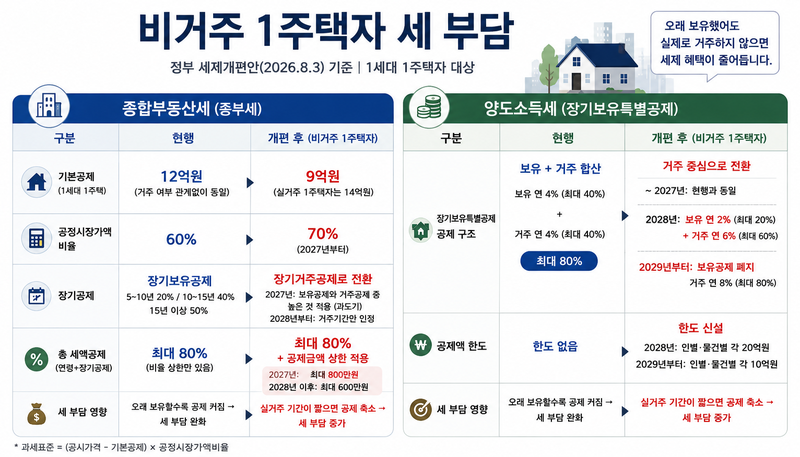
At the center of the controversy is the non-resident single-home provision in the government's tax reform plan. By shifting tax deductions from long-term ownership to actual residence periods, the plan will reduce the benefits under the Comprehensive Real Estate Holding Tax and Capital Gains Tax that had previously been available simply for owning a home for a long time.
First, the basic deduction for the Comprehensive Real Estate Holding Tax will change. At present, single-home households receive a deduction of 1.2 billion won regardless of whether they live in the home, but from 2027 the deduction will rise to 1.4 billion won for actual residents, while it will fall to 900 million won for non-residents.
The tax credit for long-term home ownership will also be converted into a long-term residence deduction. Until 2027, there will be a transition period in which the higher deduction rate between ownership and residence applies, but from 2028 only the residence period will be recognized. Capital gains tax is also changing: the current special deduction for long-term ownership by single-home households is based on both residence and ownership periods, but from 2029 the ownership deduction will be abolished.
Fearing a backlash, the reform plan redesigns the tax system around actual residence while also including exceptions to protect single-home owners who had to leave their homes for unavoidable reasons. These include school enrollment, job changes or transfers, medical treatment or convalescence lasting more than a year, school transfers due to school violence, overseas stays for study or work, and moving to care for parents. The period away from home can be counted as residence for up to three years.
However, those who only moved within the same city, county, or district are excluded. They must also meet a minimum prior residence requirement of one year.
"A school district is wealth, and wealth is pedigree" Why families rent in school districts while keeping their homes

There are concerns that taxing "education migration" could raise the cost of entering a school district even further. Households with the means may absorb the tax and move in, but those without the means could be pushed out, allowing real estate to be passed down as academic pedigree.
The value of the educational environment is already reflected in home prices as a premium. According to Real Estate R114 data compiled in March, apartment prices in seven major school districts nationwide were about 16% higher than the average in those areas. In leading school districts such as Gangnam, Seocho, Yangcheon, and Songpa, prices were 20% to 30% higher than nearby areas, showing a clear gap in home values by school district.
For that reason, in school districts such as Daechi and Mokdong in Seoul, it is not unusual for families to move in on a jeonse lease when their children are about to enter elementary or middle school, then return to their original home once the children enter university. That shows how strongly many parents link their children's future with access to a school district.
In a 2024 report titled 'Social Problems Caused by Overheated Entrance Exam Competition and Response Measures,' the Bank of Korea (BOK) explained that admission rates to top universities were determined more by socioeconomic background such as income and place of residence than by students' potential. The gap was also reflected in the numbers. According to Statistics Korea's 2024 survey on private education spending for elementary, middle, and high school students, households with monthly income of 8 million won or more spent an average of 676,000 won per child per month on private tutoring, while households earning less than 3 million won spent only 205,000 won.
Those left in the blind spots ... school violence and special schools
There are also voices arguing that the exception rules are too limited.
One parent, whose child with autism was assigned to a special school and moved near the school, said, "If special education had been available in our neighborhood, we would have stayed in our original home."
Special schools do not have enough schools or seats, so even getting a placement that matches a child's disability is not easy. Once a child is assigned, they often attend the same school from elementary through high school.
The parent who submitted the comment argued, "This was not a move for convenience or asset management, but a move to ensure the child could receive the education they needed."
They also expressed disappointment with the scope of the exception for students who are victims of school violence. Mr. Choi moved to another region where his maternal relatives live so his child could transfer schools after failing to adapt to school life.
However, the case did not qualify for the non-resident exception. Choi's child decided to transfer because they could not adjust to school life, including failing to build bonds with classmates, but the child was not recognized as a victim of school violence by the school violence countermeasures review committee.
Choi stressed, "Among school violence cases, there are victims recognized by the review committee and there are also victims of bullying and other forms of harm that remain hidden and are never acknowledged. Only transfers based on school violence victims recognized by the committee are counted as residence periods."

"Blocking loopholes" vs. "Protecting real demand" The deepening dilemma
However, experts offered a different view from parents calling for a broader exception.
Yang, Jae-Mo, a professor in the Department of Law and Public Administration at Hanyang Cyber University, said the success of the policy depends on how the boundary is drawn.
He said, "The biggest issue is fairness in deciding how far to recognize unavoidable non-residents. The moment people strongly feel the inequality of 'that person is allowed, but I am not,' the policy purpose the government intended can disappear. We need to make more detailed adjustments based on actual numbers, such as the real rental levels in school districts and the circumstances of redevelopment and reconstruction."
Yoon Ji-hae, head of the Research Lab at Real Estate 114, pointed out that loopholes could emerge.
Yoon said, "Even if special conditions such as hospitalization, childbirth, or employment are listed, it is difficult for the administration to distinguish between actual residence and a registered address change made for tax-saving purposes. There will be people who move only their resident registration to save on taxes but do not actually live there."
She added, "Even now, officetels are counted as homes once resident registration is moved there, and all kinds of loopholes appear. If holding taxes are divided into resident and non-resident categories, the same thing will happen again."
[email protected] Kim Hee-sun Reporter