Labor circles take to the streets ahead of National Liberation Day of Korea... condemn U.S. tariff pressure and call for OPCON transfer
- Input
- 2026-08-14 17:27:59
- Updated
- 2026-08-14 17:27:59
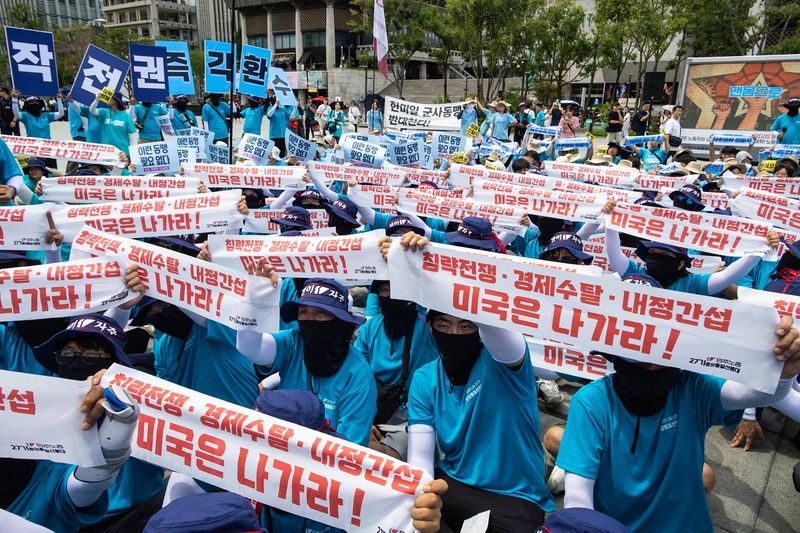
[Financial News] Ahead of National Liberation Day of Korea, labor circles took to the streets in downtown Seoul to condemn the United States government’s tariff pressure and military policies, and to call for the transfer of wartime operational control.
At around 9:30 a.m. on the 14th, the Unification Vanguard from the Federation of Korean Trade Unions (FKTU) and the Korean Confederation of Trade Unions (KCTU) held a joint rally denouncing what they called U.S. economic aggression through tariff threats in front of IFC Mall in Yeouido, Seoul, where the American Chamber of Commerce in Korea (AMCHAM Korea) is located. About 200 people, according to the organizers, took part and chanted slogans such as, "We reject the United States' unjust interference in domestic affairs" and "We urge the swift return of wartime operational control."
In a resolution, the two umbrella unions claimed that massive national wealth was flowing to the United States under the unfair pressure of U.S. President Donald Trump, who was using tariffs as leverage, as a $350 billion investment in the United States and $25 billion worth of U.S. weapons purchases were being pushed forward.
They also said that "factories built up with workers' sweat and tears are being handed over to the United States, and the manufacturing sector that has supported the Korean economy is entering a path of decline and collapse." They added that "the fiscal deterioration and industrial breakdown that will follow will be passed on to workers and ordinary people."
They also called for an end to ROK-U.S. joint military drills and said they opposed the United States government's "Kill Web" concept and the signing of the ROK-Japan Reciprocal Military Logistics Support Agreement.
A delegation from the Unification Vanguard of the two umbrella unions tried to deliver their demands and a protest letter to AMCHAM Korea, but was stopped by security personnel and police.
The Unification Vanguard then moved to the stairs in front of Sejong Center in Jongno District, Seoul, around 11 a.m. and joined a press conference and joint struggle rally hosted by the Independence and Peace Action Group, which called for the immediate return of wartime operational control. The delegation also tried to submit an open letter and a petition signed by more than 10,000 people calling for the return of wartime operational control to the U.S. Embassy in the Republic of Korea, but was blocked by police.
The open letter asked for the embassy's position on several issues, including allegations that it had sided with conspiracy theories about election fraud, whether it planned to expand the role of USFK in countering China, and whether it intended to stop pressuring Korea on domestic economic and labor issues.
Separately, FKTU held the "81st Anniversary of National Liberation Day of Korea Independence and Peace Rally" at the plaza at Yongsan Station in Seoul at around 4:30 p.m. Before the event, FKTU chairperson Kim Dong-myung and members of the Unification Vanguard paid tribute to the forced laborers' statue installed at the plaza.
Kim said, "Peace on the Korean Peninsula is facing new challenges. The strategic flexibility now being pursued and the modernization of the ROK-U.S. Alliance could risk dragging us into a conflict between the United States and China." He added, "The Korean Peninsula is not a tool for great-power strategic competition. Our workers cannot be turned into sacrificial lambs for the revival of the U.S. economy."
He also said that "economic exploitation driven by America First is also serious." He added, "Even after an investment in the United States was agreed upon, they are once again imposing tariffs and trying to uproot the foundations of Korean industry and move them to the United States." He said that "in the end, what remains for us is a threat to peace on the Korean Peninsula, industrial collapse, and fewer jobs."
[email protected] Park Seong-hyeon Reporter