"Are People Really Renting 3 Billion Won Homes?" Will Landlords Move In? Why the Whole Country Is Worried [Tax War 3]
- Input
- 2026-08-19 05:00:00
- Updated
- 2026-08-19 05:00:00
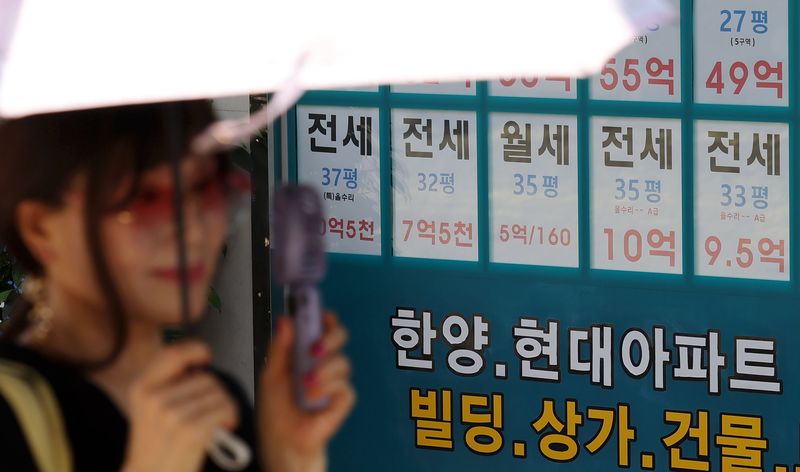
/Photo=Newsis News Agency The 8·3 tax reform plan unveiled by the Lee Jae-myung administration [Real estate-driven tax war] has escalated into a full-blown conflict. Older homeowners who have unexpectedly become high-end property owners after living in their homes for decades are taking the hardest hit, triggering unprecedented tax resistance.
Financial News will examine the problems in the reform plan in six installments. [Financial News] "Should I keep renting, or should I just buy? My head is spinning." That was a post on the real estate board of the anonymous workplace community NOW Talk shortly after the 8·3 tax reform plan was announced. The writer said the jeonse lease on the home they are currently living in expires this year, and that just days after the policy announcement, the landlord, who lives in the provinces, suddenly said they would move in.The problem is that finding another home to move into is not easy. The writer complained, "Setting aside the higher jeonse price, there are almost no listings at all.
/Photo=Newsis News Agency The 8·3 tax reform plan unveiled by the Lee Jae-myung administration [Real estate-driven tax war] has escalated into a full-blown conflict. Older homeowners who have unexpectedly become high-end property owners after living in their homes for decades are taking the hardest hit, triggering unprecedented tax resistance." They added, "I was already looking into buying a place, and if I found a decent listing I was planning to purchase it, but now I have to decide within three months. It's driving me crazy." The comments were full of advice such as, "Listings will shrink for 10 years because of the property tax," and "Jeonse is not the answer. Buy instead." When one commenter suggested asking the landlord for more time, the writer replied, "The landlord is also moving in after renting elsewhere, so there is no room for negotiation. " On the 18th, complaints about jeonse have been pouring in across online communities.
Another poster lamented that their plan to live for two more years and then buy a home had fallen apart after the landlord said they would sell the property because the tax law had changed. Landlords face two paths: move in themselves or raise rent These cases show the most immediate impact the new tax reform is having on the market.
A policy designed to crack down on nonresident single-home owners is creating a 'pass-through effect' that pushes tenants out of the market. That is how the policy is playing out.
The reform, which will take effect for tax liabilities arising on or after January 2027, is built around distinguishing the basic deduction for comprehensive real estate tax on single-home households by whether the owner actually lives in the home. 4 billion won if the owner resides there, but falls to 900 million won if the owner does not.
/Photo=Newsis News Agency The 8·3 tax reform plan unveiled by the Lee Jae-myung administration [Real estate-driven tax war] has escalated into a full-blown conflict. Older homeowners who have unexpectedly become high-end property owners after living in their homes for decades are taking the hardest hit, triggering unprecedented tax resistance.
3%, and the fair market value ratio increases to 70%.
/Photo=Newsis News Agency The 8·3 tax reform plan unveiled by the Lee Jae-myung administration [Real estate-driven tax war] has escalated into a full-blown conflict. Older homeowners who have unexpectedly become high-end property owners after living in their homes for decades are taking the hardest hit, triggering unprecedented tax resistance.The gap in the tax burden is steep.For a nonresident single-home owner aged 60 or older who has held the property for more than 10 years, the comprehensive real estate tax is estimated to rise to about four times the pre-reform level.Faced with higher taxes, landlords are weighing two options: evict tenants and move in themselves to qualify for the resident deduction, or keep renting the property and pass the higher holding tax on to jeonse or monthly rent.
Cheon Kyung-wook, CEO of the tax firm Songwoo, said, "The burden on homeowners from taxation can be passed on to tenants.
" He added, "If taxes go up significantly, rents inevitably rise, so the final destination of tax shifting is tenants.
" Yoon Ji-hae, head of the research lab at Real Estate R114, also pointed out, "From an individual homeowner's perspective, the only realistic tax-saving strategy is to meet the residency requirement, and in that process tenants get pushed out.
" She added, "No matter how much pressure is put on single-home owners, they simply become single-home owners living somewhere else, so the total amount of demand does not change.
The effect on price stability is minimal, and the ones who get lost are tenants without homes of their own.
" In other words, if the increased tax burden is passed on to jeonse, monthly rent, and even new buyers, prices will eventually rise again.
/Photo=Newsis News Agency The 8·3 tax reform plan unveiled by the Lee Jae-myung administration [Real estate-driven tax war] has escalated into a full-blown conflict. Older homeowners who have unexpectedly become high-end property owners after living in their homes for decades are taking the hardest hit, triggering unprecedented tax resistance.
3%.
/Photo=Newsis News Agency The 8·3 tax reform plan unveiled by the Lee Jae-myung administration [Real estate-driven tax war] has escalated into a full-blown conflict. Older homeowners who have unexpectedly become high-end property owners after living in their homes for decades are taking the hardest hit, triggering unprecedented tax resistance.even lease renewal rights cannot stop a landlord's 'move-in declaration' There is also research showing that part of the property tax burden is actually passed on to tenants.3% .A 2023 study by the Korea Research Institute for Human Settlements, titled "The Market Impact of Real Estate Taxation and Future Policy Direction," also concluded that the comprehensive real estate tax can be passed on to tenants, weakening the effect of tax hikes, while higher capital gains tax creates a 'freezing effect' that pushes jeonse prices up.
Since the latest reform also revises the long-term holding special deduction for capital gains tax to focus on residency, there are growing concerns that frozen listings could lead to a jeonse shortage .What makes tenants even more uneasy is that they have little real defense.The Housing Lease Protection Act gives tenants one right to request a lease renewal, but it also allows landlords to refuse renewal if they or their direct lineal relatives plan to live in the home themselves.
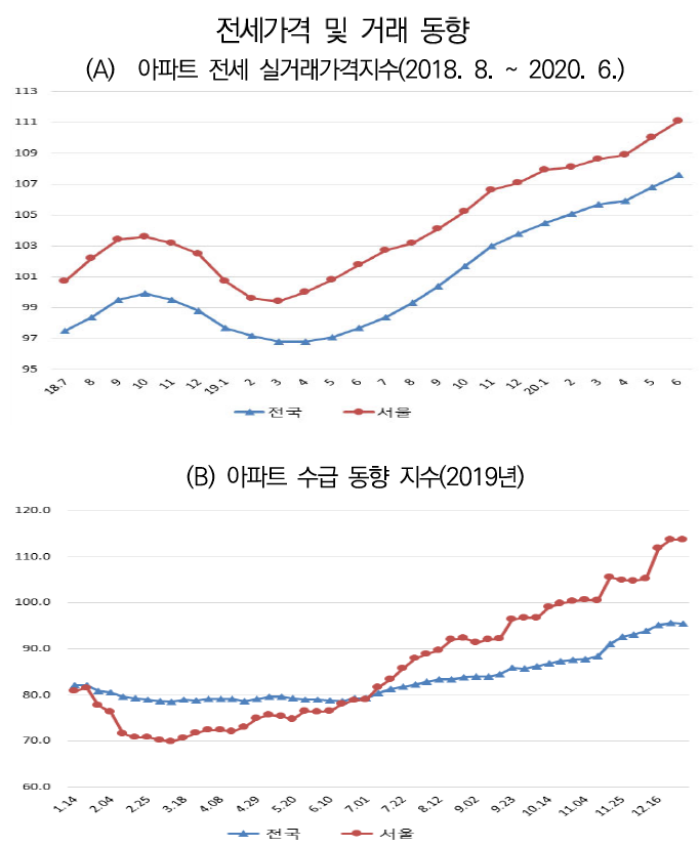
That means once a landlord declares, "I will move in," the tenant has virtually no way to hold out .Trend in apartment jeonse transaction price index (top) and supply-demand index (bottom).A reading above 100 in the supply-demand index means a shortage of supply, or landlord advantage, while a reading below 100 means excess supply, or tenant advantage.
/Photo=Newsis News Agency The 8·3 tax reform plan unveiled by the Lee Jae-myung administration [Real estate-driven tax war] has escalated into a full-blown conflict. Older homeowners who have unexpectedly become high-end property owners after living in their homes for decades are taking the hardest hit, triggering unprecedented tax resistance.
/Photo=Newsis News Agency The 8·3 tax reform plan unveiled by the Lee Jae-myung administration [Real estate-driven tax war] has escalated into a full-blown conflict. Older homeowners who have unexpectedly become high-end property owners after living in their homes for decades are taking the hardest hit, triggering unprecedented tax resistance.
/Source: "The Pass-Through of the Property Tax Burden: Focusing on Jeonse Prices in Seoul," Song Kyung-ho (2026), graphic=Analysis of the Korean Economy (2026) "Pass-through depends on market conditions".
/Photo=Newsis News Agency The 8·3 tax reform plan unveiled by the Lee Jae-myung administration [Real estate-driven tax war] has escalated into a full-blown conflict. Older homeowners who have unexpectedly become high-end property owners after living in their homes for decades are taking the hardest hit, triggering unprecedented tax resistance.caution urged against hasty conclusions That said, it is difficult to say that higher property taxes will immediately lead to higher rents.The pass-through effect can grow or shrink depending on regional and seasonal supply-demand conditions and the elasticity of demand and supply.The paper cited above also noted that "the degree of pass-through was limited because the analysis was conducted in a jeonse market where tenants had the upper hand." In this regard, Yang Jae-mo, professor of law and public administration at Hanyang Cyber University, said, "This tax reform targets high-end homes, so it will not have a major direct impact on most of the rental market.But the public feels as if the ripple effects will spread across the entire market." He added, "At this point, the psychological effect is much greater." There are also structural reasons why the impact feels larger than it really is.
Professor Yang explained, "Even if one landlord takes back a single home, properties in Korea are listed with multiple real estate agencies at the same time, so it looks as if listings are disappearing everywhere.
" He added, "Even if the actual drop in supply is small, the sense of shortage on the ground becomes much stronger." The problem is that the comprehensive real estate tax targets homes in markets where landlords already have relatively strong bargaining power, especially apartments in popular Seoul districts.In other words, the tax burden is concentrated in places where pass-through is easier.
Yoon, the research lab head, warned, "As owner-occupier demand concentrates in prime areas, tenants in preferred neighborhoods may have nowhere to go, while less preferred areas could end up with properties but no buyers or renters, creating a mismatch.
"
[email protected] Kim Hee-sun Reporter