Foreign Investors Are Buying Again, but They Reversed Positions Worth Trillions in a Single Day [Why the Market Moves]
- Input
- 2026-08-15 06:00:00
- Updated
- 2026-08-15 06:00:00
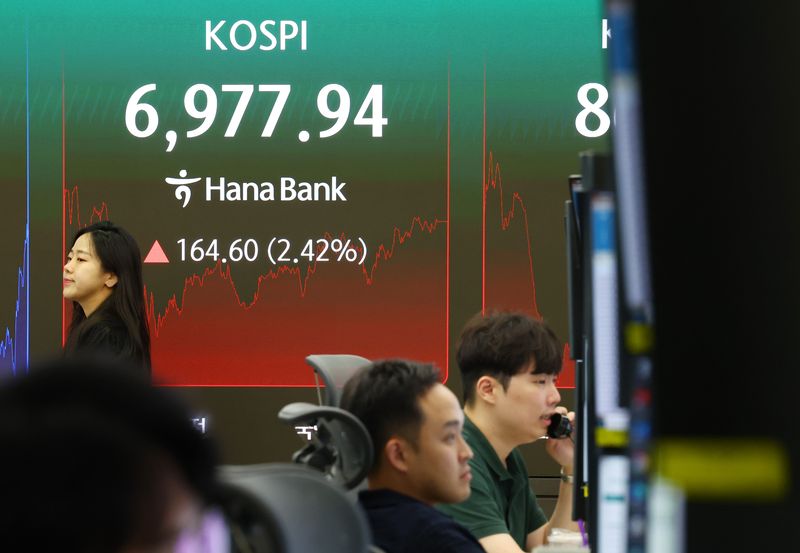
[Financial News] Foreign buying is returning to the domestic stock market. Investors have posted net purchases of more than 8 trillion won in the KOSPI market for four straight trading days, helping drive the rebound. Still, analysts say it is too early to call this a clear trend reversal.
■Net buying for four straight sessions...but no clear trend reversal yetAccording to the Korea Exchange on the 15th, foreign investors bought a net 806.88 billion won in the Korea Exchange Main Board over the past four trading days. They concentrated their buying on large semiconductor stocks, purchasing 330.63 billion won of Samsung Electronics and 285.79 billion won of SK hynix.
However, analysts say it is still too early to conclude that foreigners are making a sustained return. Over the past month, they have repeatedly shifted positions by rapidly alternating between net buying and net selling worth trillions of won in a single day.
Foreign investors sold a net 452.60 billion won on July 28, then expanded net buying to 727.73 billion won on the 31st. On the very next trading day, they again sold a net 283.85 billion won, followed by net buying of 145.13 billion won on the 5th and net selling of 331.14 billion won on the 6th. In a short period, they swung between net buying and net selling worth trillions of won. This pattern was especially pronounced in Samsung Electronics and SK hynix.
A securities industry official said, "The long-term investment case remains intact, supported by improving AI memory conditions, rising demand for HBM, and expectations for shareholder returns. But in the short term, foreign investors are quickly adjusting positions in response to events such as U.S. inflation data, interest rates, exchange rates, and global investor sentiment."
■Foreign trading volume jumps 80%...evolving into 'ultra-short-term' trading since July Foreign investors' average daily buying volume was about 10.4 trillion won from January 2 to May 26 this year. After the listing of leveraged ETFs tied to Samsung Electronics and SK hynix, however, it rose to 18.4 trillion won from May 27 to the end of June, an increase of about 77%. Over the same period, average daily selling volume also rose from 11.4 trillion won to 20.6 trillion won, up about 81%. Combined average daily trading volume increased by about 79%, from 21.8 trillion won to 39.1 trillion won.
Trading volume eased somewhat in July, but it still remained above the level seen before the leveraged ETF listings. From July 1 to the 14th, foreign investors' average daily buying and selling volumes both stood in the 13 trillion won range. Combined average daily trading volume came to 26.4 trillion won, about 21% higher than before the listings.
This means that rather than simply increasing net buying, foreigners have been boosting both purchases and sales, lifting overall trading volume and turnover. The securities market believes the listing of single-stock leveraged ETFs expanded program trading, arbitrage, and futures hedging, and that the sharp market swings in July made foreigners' ultra-short-term trading even more pronounced.
Market watchers say the future direction of the stock market will depend on whether foreign capital returns in a sustained way.
Lee Jae-won, a researcher at Yuanta Securities Korea Co., Ltd., said, "In the short term, I am leaning more toward a step-by-step normalization that raises the market floor rather than a V-shaped rebound." He added, "If weak July employment data are followed by easing inflation pressure, upward pressure on long-term U.S. yields will ease, and whether foreign inflows recover will determine the KOSPI's next leg higher."
He continued, "Most of the KOSPI's strong rallies recently have been accompanied by net foreign buying, and with investor deposits also declining, it will not be easy for retail money alone to recreate a record-setting rally centered on large-cap stocks." He forecast that "the current phase is one in which losses in KOSDAQ and small- and mid-cap stocks are being normalized first, and once inflation stabilizes and shareholder-return policies are confirmed, large semiconductor stocks led by Samsung Electronics and SK hynix will regain leadership in a 'first small- and mid-cap normalization, then a second large semiconductor rally' pattern." He added, "Since valuations are still seen as low, the key issue is a sustained return of net foreign buying."
[email protected] Choi Du-seon Reporter