"I Saved 1 Million Won a Month for Five Straight Years, but Home Prices Rose by 300 Million Won" [Young People Caught Up in the Dream of a Big Break]
- Input
- 2026-08-15 06:00:00
- Updated
- 2026-08-15 06:00:00

Young people who feel that an apartment is out of reach on salary and savings alone are turning to the investment market. The phrase "a big break" is not just about wanting to make a lot of money. It also reflects a bitter sense of resignation in the face of housing prices and widening wealth gaps. In this first installment, we look at why young people who diligently save their salaries still feel that owning a home is far away, and why they have opened stock accounts.
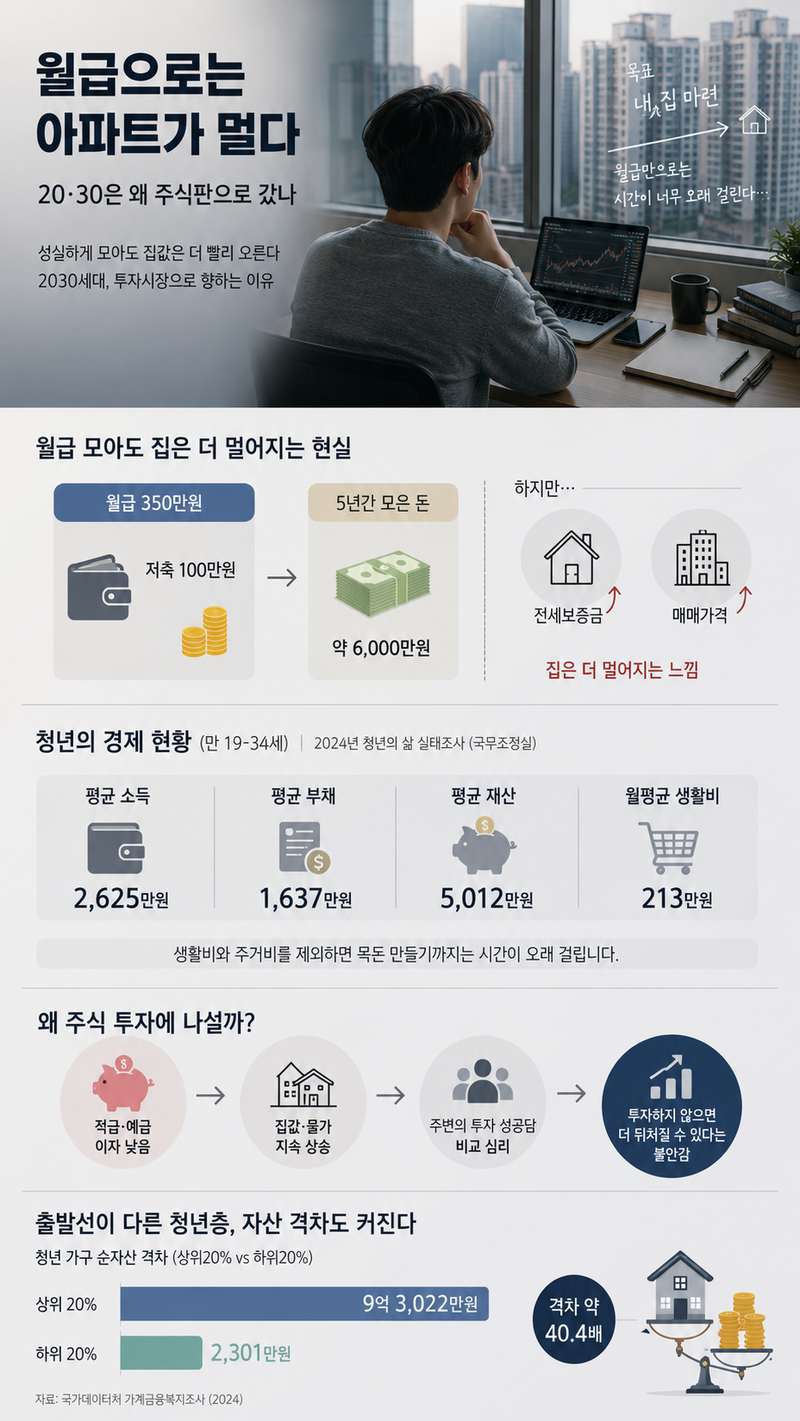
[Financial News]A man in his 30s who works at a mid-sized company in Seoul saved 1 million won every month out of his 3.5 million won salary. Over five years, the money he steadily set aside after graduating from college grew to 65 million won, including interest on the 60 million won principal. During that same period, the price of a small apartment in northern Seoul, not even in a prime district, rose by more than 300 million won.Ahn said, "It felt like I was saving money, but homeownership was getting farther away." At first, he simply waited for each savings product to mature. He reinvested one-year deposits, cut spending, and set aside part of his performance bonus when one was paid. But once he calculated wedding costs, jeonse deposit money, and future home purchase expenses together, it became hard to make a plan based on savings alone.
He opened a stock account after a colleague recommended it. His first investment was 200,000 won a month. He split it between Samsung Electronics and a United States exchange-traded fund (ETF). He was only hoping for returns slightly better than bank interest.
But as he kept hearing stories of people around him making quick profits, he increased his monthly investment to 500,000 won and then 1 million won. Ahn said, "I know losses are scary, but if I do nothing, I feel like I will fall even further behind." He added, "Savings accounts are safe, but they also feel like a safe way to stay poor."
Even if they save diligently, home prices rise faster
The reason people in their 20s and 30s are heading into the stock market is the wealth gap. More and more young people believe that salaries and savings alone cannot keep up with housing prices, jeonse deposits, and wedding costs. Even if a young worker saves a fixed amount every month, it takes a long time to build a lump sum once housing costs, living expenses, and wedding preparations are all taken into account.
Ahn also put savings ahead of investing at first. But every time he heard someone say, "You lose out if you only hold cash these days," he wavered. A coworker said he had made money from U.S. tech stocks, and another friend said he had raised part of his jeonse deposit through crypto. For Ahn, those success stories were not investment tips. They became a benchmark for comparison.
The economic situation of young people is also reflected in related surveys. According to the "2024 Survey on the Lives of Young People," released by the Office for Government Policy Coordination in March 2025, the average personal income of people aged 19 to 34 was 26.25 million won, average debt was 16.37 million won, and average assets were 50.12 million won. The average monthly living expenses for young households were 2.13 million won.
Even looking only at the averages, it takes time to build savings after covering living expenses from a salary. For young people in the Seoul metropolitan area who must pay rent or interest on jeonse loans, it is especially hard to set aside money to invest. By contrast, those with spare cash can enter stocks, funds, and overseas investments earlier. Even within the same generation, the ability to grow assets differs widely.
Young people who opened stock accounts instead of savings accounts
The reason young people are turning to the investment market is not just the promise of high returns. Many are also anxious that the wealth gap will widen further if they do not invest. Deposit interest is stable, but once home prices, inflation, and asset prices seem impossible to catch up with, an investment account starts to look necessary.
Another office worker in his 30s, B, also saved only through deposits for three years after receiving his first paycheck. But as he prepared for marriage and calculated wedding expenses and the jeonse deposit, he opened a stock account. He said, "Even though I was saving my salary, the money I needed was growing faster." He added, "It was not that I wanted to make a fortune in stocks. I just felt that if I did nothing, I would have no way to keep up."
At first, B invested mainly in large-cap stocks. To avoid losses, he checked his account only once a day. But when the market rose, his mindset changed. If people around him sent proof of profits, he increased his buying amount. In a falling market, he considered buying more to recover losses. It did not take long for his reason for investing to shift from building assets to making up for losses.
Young investors are caught between long-term investing and short-term gains. It is hard to reach a target amount quickly through salary alone, but short-term investing carries a high risk of loss. In between, some move into highly volatile products such as leveraged ETFs, theme stocks, overseas shares, and crypto. The phrase "a big break" carries both the hope of rising quickly and the resignation that salary alone is not enough.
Young people start from different lines, and financial asset gaps can widen
Behind young people's move into the investment market are housing costs and wealth gaps. As more people believe that even saving a salary cannot keep up with jeonse and monthly rent deposits or home prices, and that the starting line differs depending on whether parents provide support, stocks, crypto, and leveraged products are increasingly seen as a detour for building assets.
Experts say the wealth gap within the young generation can push people toward high-risk investments. In a column for the monthly magazine "Nara Economy" published by the Economic Information and Education Center of the Korea Development Institute, Professor Kim Yun-tae of Korea University's Graduate School of Public Policy said, "Young people who judge that it is impossible to build assets normally on their own are increasingly being driven to extremes, concentrating on virtual assets and high-risk leveraged investments." Based on microdata from the National Data Office's Survey of Household Finances and Living Conditions, Kim explained that the average net assets of the top 20 percent of young households last year were 930.22 million won, while the bottom 20 percent had 23.01 million won, a gap of about 40.4 times.
Some analysts also say that support focused only on savings-based asset building has limits in reducing the gap within the young generation. In the same column, researcher Kim Minki of the Korea Capital Market Institute said, "A large share of the financial assets of households in their 20s and 30s is tied up in jeonse and monthly rent deposits, while the share invested in financial products such as stocks and funds is low." He added, "Savings incentives alone cannot close this gap."
[email protected] Han Seung-gon Reporter