LNG Carrier Orders Surge as Yards Fill Up... Will Ship Prices Rise Further in the Second Half?
- Input
- 2026-08-17 06:59:00
- Updated
- 2026-08-17 06:59:00
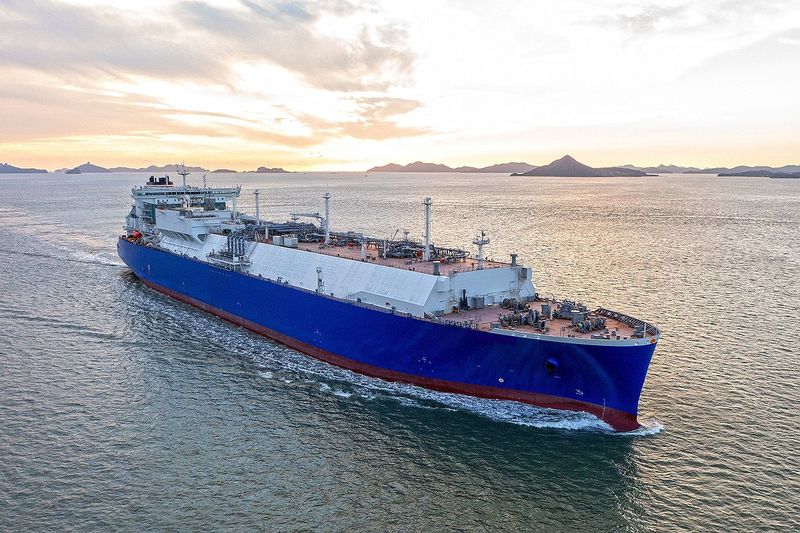
[Financial News] As liquefied natural gas (LNG) production facilities continue to expand across the United States and Qatar, competition to secure LNG carriers is intensifying. With even major Chinese shipyards now filling up quickly after South Korea, the shipbuilding industry has shifted into a market where builders can pick and choose orders. As pricing power moves to suppliers, South Korean shipbuilders, which hold an edge in delivery and quality, are reaping the benefits.
On the 17th, energy consultancy Wood Mackenzie said shipbuilding capacity would become a bottleneck during the global LNG expansion. More than 260 LNG carriers scheduled for delivery after 2027 are already in the pipeline, and most of the construction volume is concentrated in South Korea and China. If ships are not secured on time, the broader gas supply expansion schedule could face major disruptions.
Demand for these vessels is expected to intensify further around 2029. DS Investment & Securities Co., Ltd. estimated that, if global LNG projects expected to reach a Final Investment Decision (FID) this year are reflected, 131 new LNG carriers will be needed in 2029 alone, followed by 101 in 2030.
The scale of U.S. LNG export projects with confirmed FID alone reaches 81.4 MTPA, meaning another 150 to 160 carriers would be needed just to handle that volume. By March, South Korean shipbuilders had only about 60 to 65 remaining slots for 2029, so U.S.-linked projects alone could nearly fill their docks. Adding QatarEnergy's massive fleet expansion plan, which aims to raise production capacity to 142 million tonnes by 2030, is further amplifying the concentration of orders.
A similar shift is visible in China, where builders are also focusing on more profitable ships to make the most of limited dock space. Yangzijiang Shipbuilding, China's largest private shipbuilder, has already used up most of its 2029 delivery slots and said it will prioritize profitability over volume growth. Hudong-Zhonghua Shipbuilding, which has extensive experience building LNG carriers, has also filled about 70% of its 2029 slots.
This change in strategy among Chinese shipyards is a strong positive for South Korea's shipbuilding industry. In the past, when South Korean builders raised prices, shipowners would turn to cheaper Chinese yards. Now, however, dock congestion has sharply reduced price competition.
With slots in both South Korea and China running out, and orders for other vessel types such as container ships also piling up, ship prices are unlikely to ease anytime soon. As of July 7, the newbuild price for a 174,000-cubic-meter LNG carrier remained firm at $248.5 million per vessel.
An industry source said, "China, which used to compete mainly on price, has shifted to selective orders, putting South Korean shipbuilders ahead in the race thanks to their stronger quality and delivery performance." The source added, "Using the remaining dock slots as leverage, the industry is likely to continue focusing on high-value-added vessels."
[email protected] Kim Dong-ho Reporter