Capital gains tax rises from 200 million won to 940 million won... Even after 10 years of actual residence, tax shock sparks a flood of petitions in the National Assembly
- Input
- 2026-08-15 09:00:00
- Updated
- 2026-08-15 09:00:00
[Financial News] If the government's latest tax revision is implemented as originally proposed, the burden of capital gains tax and holding taxes will rise sharply for non-resident one-home owners. The same is true for one-home owners who live in their homes. That is because a cap of 1 billion won on the long-term ownership deduction for actual resident one-home owners is set to be introduced.
According to the industry on the 15th, a petition recently submitted to the National Assembly calling for the withdrawal of the proposed 1 billion won cap on the long-term ownership deduction for actual resident one-home owners has surpassed 30,000 signatures.
The petition was opened to the public on the 11th and had passed 30,000 signatures as of the 14th. If it collects 50,000 signatures within 30 days, it will be referred to the relevant standing committee of the National Assembly.
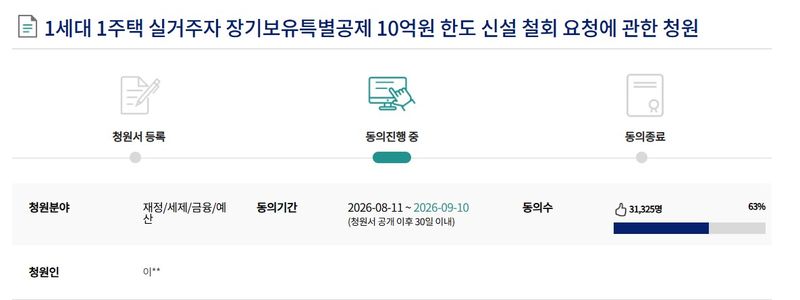
The petitioner stated, "Among the amendments to the Income Tax Act included in the 2026 tax revision plan, we request the withdrawal or reconsideration of the provision that introduces a 1 billion won cap on the long-term ownership deduction for one-home owners."
He added, "The provision would increase the tax burden by up to four times for long-term one-home owners who are not involved in speculation, and it would be applied retroactively to ownership and residence periods that have already passed, violating the principle of protection of trust." He also argued that it taxes inflation gains while freezing supply, which runs counter to the government's policy goals.
More specifically, the petition pointed to several problems with the new 1 billion won deduction cap, including punitive tax increases for long-term actual residents, damage to tax fairness across asset classes such as stocks, the side effect of freezing listings, and a violation of the principle of protection of trust due to what amounts to retroactive application.
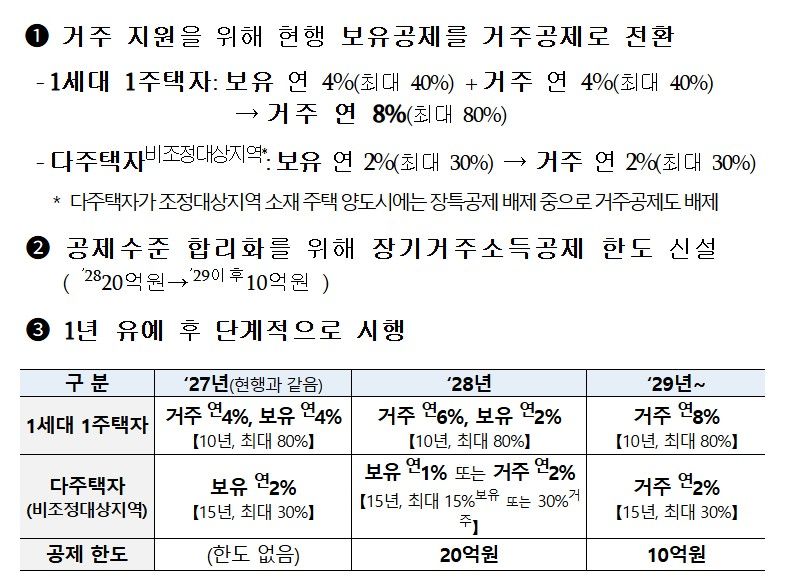
According to the government's tax revision plan, the current long-term ownership deduction for capital gains tax will be gradually replaced by a long-term residence income deduction starting next year. The deduction cap for gains on one-home households will also be reduced to 2 billion won in 2028 and 1 billion won in 2029, effectively setting a new upper limit where none existed before.
Looking at a simulation by Woo Byung-tak, a senior researcher at Shinhan Premier Pathfinder, on the expected capital gains tax under the revised system: if a person buys an 84-square-meter unit at Raemian Firstige in Seocho District for 1.6 billion won, lives there for 10 years, and then sells it for 5.6 billion won, the capital gains tax would rise from 241.85 million won this year to 449.85 million won in 2028, an 86% increase. In 2029, the tax bill would reach 945 million won.
Meanwhile, opposition to the tax revision has been strong since the plan was unveiled. The government says it will finalize the revision after taking public sentiment into account, but the plan is expected to remain largely unchanged.
[email protected] Lee Jong-bae Reporter