Three Years After Liberation, the Lights Went Out. Is South Korea Self-Reliant Now? [Lee You-beom's Eco & Energy]
- Input
- 2026-08-15 06:00:00
- Updated
- 2026-08-15 06:00:00
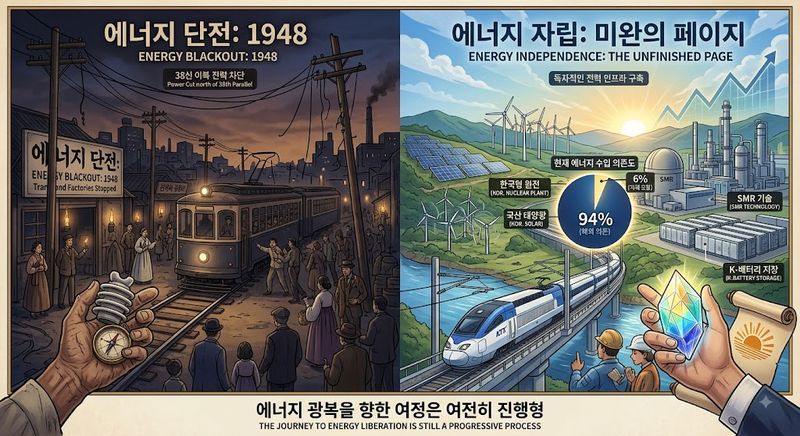
[Financial News] At noon on May 14, 1948, the electricity supply across South Korea was cut off at once. Streetcars running through downtowns came to a halt, and factories stopped operating. Because the blackout coincided with the rice-planting season, the loss of power for irrigation reduced that year's rice harvest by more than 550,000 seok. Since most power facilities were located north of the 38th parallel, South Korea became a country without electricity less than three years after liberation. Seventy-seven years later, power plants are no longer in someone else's hands. But 94% of the energy sources that run those plants still come from beyond the border. South Korea has achieved self-reliance in the power grid, but the final page of liberation — energy self-sufficiency — has yet to be written.
The imbalance left by Japanese colonial rule, and the weakness liberation exposed
This was the so-called May 14 blackout. The People's Committee of North Korea cut off electricity supplied to South Korea, citing a dispute over payment. In reality, the move was widely seen as politically motivated, aimed at disrupting the separate general election held in South Korea on May 10 that year. The reason the incident could deal such a devastating blow to South Korea lies elsewhere. During the colonial period, Japan built a series of large hydroelectric plants in the Paektu Plateau and along the Yalu River, including Bujeon River (200,000 kW), Jangjin River (330,000 kW), Huchon River (350,000 kW), and Suiho (600,000 kW). These were intended to support heavy and chemical industry development in the northern region. As a result, more than 90% of the Korean Peninsula's total power-generation facilities were concentrated north of the 38th parallel at the time of liberation, while South Korea accounted for only 8%, or 79,500 kW. Liberation restored political sovereignty, but electricity was still in someone else's hands. That is why, for a time after liberation, electricity from the north continued to flow south. Even then, however, the two sides remained locked in disputes over how much should be paid and how the charges should be calculated, and South Korea paid only 35% of the billed amount to the North. In the end, after South Korea held its separate general election on May 10, 1948, the north abruptly cut off the transmission at noon on May 14 without warning. With three sides surrounded by sea, South Korea had no way to bring in substitute power from outside. After the blackout, the U.S. military government had to respond with emergency measures, including docking power-generating ships at Incheon Port to supply temporary electricity.
Power infrastructure is 680 times larger than at the time of the blackout
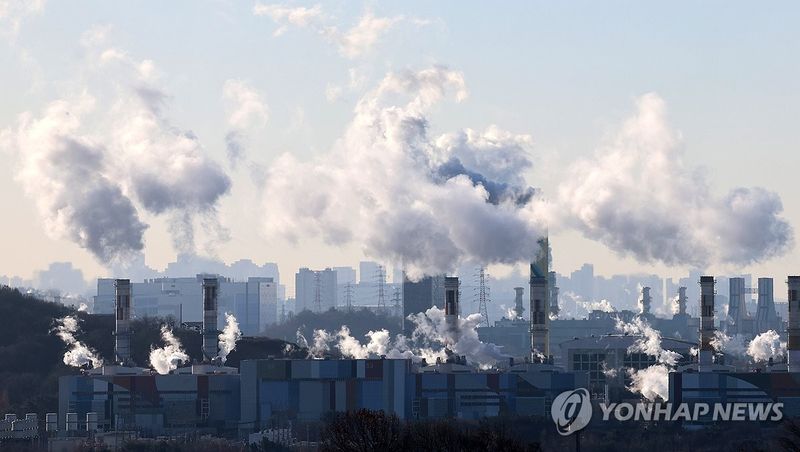
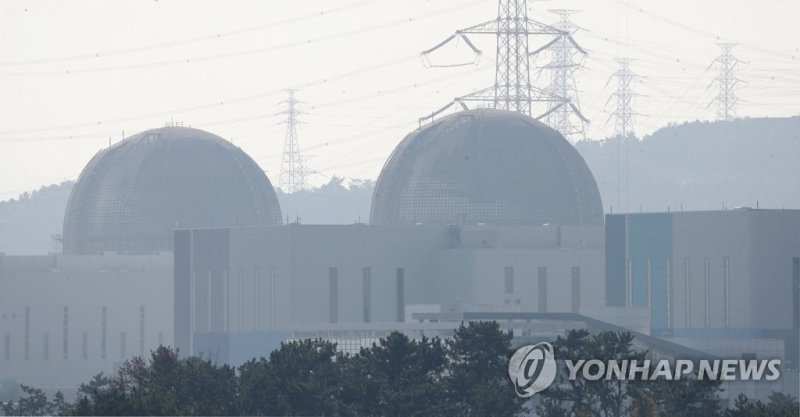
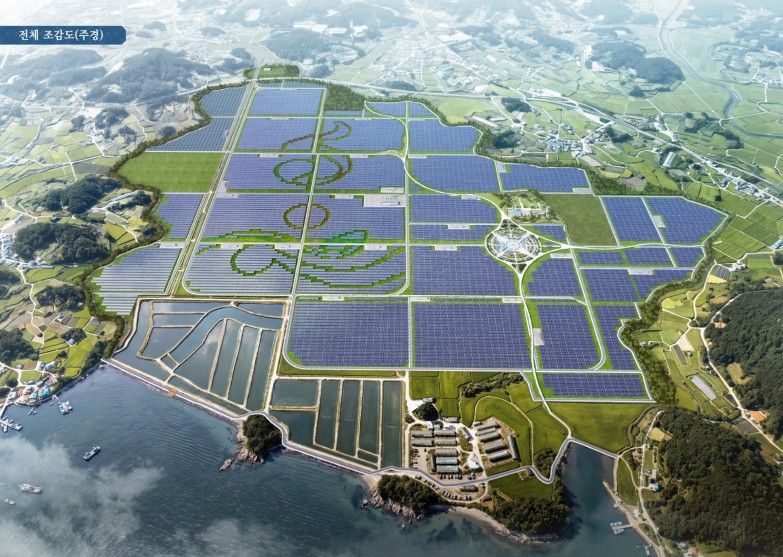
Since then, South Korea has steadily expanded its own thermal, nuclear, and renewable power facilities, achieving full self-reliance in power infrastructure. Thermal power plants were built one after another alongside the economic development plans of the 1960s, and in 1978, Kori Unit 1, the country's first commercial nuclear reactor, began operation. Nuclear power has since played a central role in South Korea's electricity supply for nearly half a century, while renewable facilities such as solar and wind have also expanded rapidly since the 2000s. According to the Electricity Statistics Information System (EPSIS), South Korea has 26 nuclear units with a combined capacity of 26.1 GW, while bituminous coal-fired facilities total 37.7 GW, accounting for 27.7% of all installed generation capacity. Based on that figure, total domestic installed generation capacity is estimated at around 136 GW. That is more than 680 times the less than 0.2 GW of total capacity South Korea had at the time of the May 14 blackout. Solar capacity alone increased by 3.1 GW last year, meaning that in just one year, South Korea added in solar power alone an amount equal to 15 times the country's total installed capacity 77 years ago. With dozens of nuclear reactors, large thermal plants, and solar and wind facilities spread across the country, South Korea has become one of the world's leading nuclear operators and a global production base for power-intensive industries such as semiconductors. The country now worries about excess electricity instead, and recently the policy focus has shifted to how to meet rising power demand from the AI and semiconductor industries. The government's recent vision for an 'electricity nation' is an extension of that confidence. In terms of generation facilities alone, South Korea today is a completely different country from the one where streetcars stopped after the lights went out 77 years ago.
Energy-source liberation is still a work in progress
The problem is the energy sources that run the plants. According to statistics from the Korea Energy Economics Institute, South Korea's energy import dependence reached 94% in 2024. Since the 88.7% recorded in 1990, when the statistics began, the figure has stayed around 90% for more than 30 years, and it even surged to 98% in 2001. Fossil fuels such as oil, coal, and natural gas account for 80.5% of primary energy supply. Oil and gas are effectively imported in full, and even nuclear power, which makes up a large share of electricity generation, is no exception because uranium fuel is also entirely imported. In other words, the power plants are domestic, but the energy sources that run them still come from beyond the border. Crude oil remains heavily dependent on the Middle East, while liquefied natural gas (LNG) relies on long-term contracts with a small number of countries such as Australia, Qatar, and the United States. If the May 14 blackout was a problem of the power grid, today's vulnerability is simply a different form of the same issue: the energy source. Renewable energy is not completely free from dependence either. South Korea is heavily reliant on China for polysilicon and wafers, the key materials for solar panels, as well as rare-earth elements used in wind turbine permanent magnets. In that sense, the shift away from fossil fuels is creating another kind of raw-material dependence. That is why the government's push to expand renewable energy to 100 GW, introduce new nuclear plants and SMRs, and diversify uranium and critical mineral supply chains is not just industrial policy. It is an effort to raise self-reliance in energy sources themselves. From the introduction of nuclear power after the oil shock, to equity investments in overseas oil and gas fields in the 1980s and 1990s, and more recently to the localization of SMRs, South Korea's energy policy has been a series of attempts at self-reliance. Yet the fact that energy import dependence has remained in the 90% range for more than 30 years shows how structural and difficult this problem is. If what was in someone else's hands 77 years ago was the power plant, what is in someone else's hands now is the fuel that fills it.
Climate, the environment, and energy are like two sides of the same coin. Depending on how energy is produced, it can accelerate global warming, or changes in climate and the environment can affect energy demand and supply.[Lee You-beom's Eco & Energy]covers climate, environmental, and energy issues that are inseparable from one another and meets readers every Saturday. If you subscribe to the reporter's page, you can receive it more conveniently.
[email protected] Lee You-beom Reporter