At the Bottom of the Housing Ladder: Government Eases Regulations, Loans and Taxes to Boost Non-Apartment Supply
- Input
- 2026-08-14 10:16:12
- Updated
- 2026-08-14 10:16:12
[Financial News] The government is moving to expand supply of non-apartment housing, such as row houses, multi-family homes and officetels, as the supply crunch in these segments has deepened compared with apartments. It will loosen construction rules so buildings can be larger and taller, expand support for construction financing, and ease loan restrictions for rental operators buying newly built non-apartment homes.
In particular, the special rule that excludes small newly built non-apartment homes from the housing count for acquisition tax, comprehensive real estate tax and capital gains tax will be extended through 2028. The government is overhauling everything from building regulations to supply financing, purchase financing and taxes in an effort to revive the foundation for non-apartment supply.
On the 13th, the Ministry of Land, Infrastructure and Transport announced the "Housing Rapid Supply Plan for Stabilizing the Jeonse, Monthly Rent, and Sales Markets" in a joint briefing with other ministries. Through the measures, the government plans to add more than 230,000 housing units in the Capital Region and support the start of 130,000 general housing units there by 2030.
Kim Deok-rye, head of the housing policy research office at the Housing Industry Research Institute, said, "I could feel that the government put a lot of thought into the supply measures. One clear example is its use of the term 'general housing' for non-apartment homes." She added, "It corrected the very idea of dividing housing into apartments and non-apartments, as if one were superior and the other inferior."
She added, "Cities need apartments and expensive homes, but they also need general housing and affordable homes." She said the policy was designed so people can move up the housing ladder in line with their life stages.
Non-apartment supply has lagged behind apartments for a long time, putting the housing ladder for young people at risk.
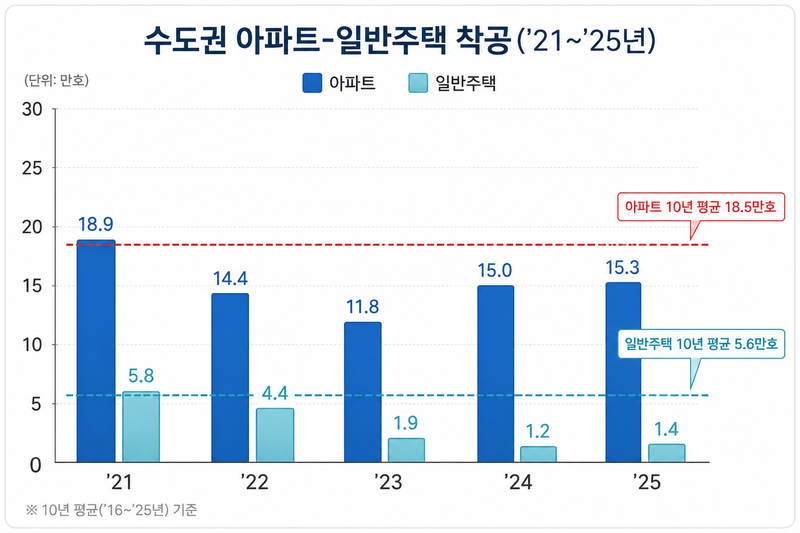
The government decided to separately boost non-apartment supply because, unlike apartments, the shortage of row houses and multi-family homes has persisted for a prolonged period.
According to the ministry, construction starts for general housing in the Capital Region fell from 18,000 units in 2023 to just 14,000 units in both 2024 and 2025. The 2025 figure is only about 25% of the 56,000-unit average over the past decade. By contrast, apartment starts in the Capital Region plunged in 2022 and 2023 before gradually recovering.
The problem is that non-apartment housing remains an important living space for young people and ordinary households. Based on the 2025 population and housing census, 67.9% of households in Seoul headed by people in their 20s and 30s live in general housing, including officetels. The government believes that if the decline in newly built general housing continues, the housing burden on young people and ordinary households could grow further.
Prices are also moving up. The ministry said that the pace of increase in sales, jeonse and monthly rent prices for general housing, including multi-family and row houses, has recently widened, and that the delay in supply recovery is worsening the imbalance between supply and demand.
In response, the government will fully implement from September the general housing supply expansion plan announced on May 26, while adding further deregulation and financial and tax support through this new package.
Woo Byung-tak, an expert at Shinhan Premier Division, said, "Non-apartment supply will not disperse demand as much as apartments do, but it still has its own significance." He added, "If it helps curb jeonse and monthly rent increases in apartments, it could also prevent that from spilling over into broader home price gains."
He also said it could help young newlywed couples with limited funds ease their urgency about buying a home by providing quality non-apartment rental options.
From 660 square meters to 1,000 square meters for villas, and one more floor for multi-family homes
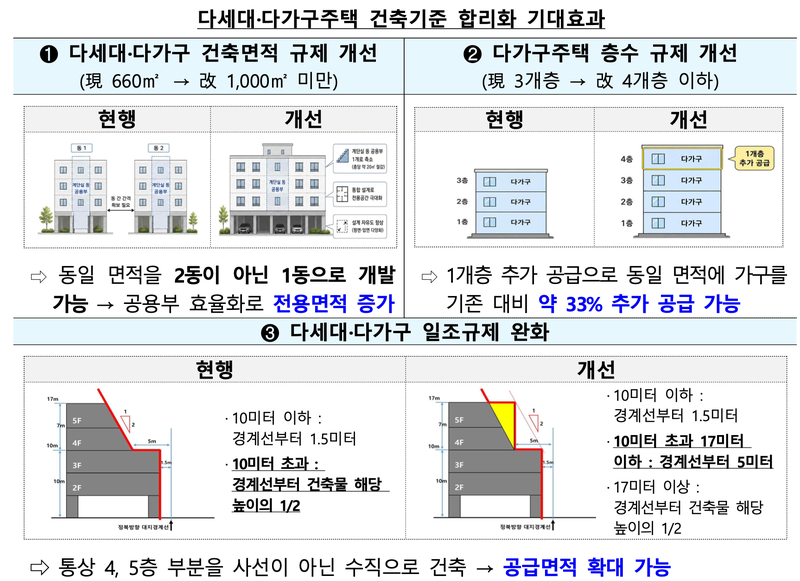
First, the government will allow multi-family and multi-unit homes to be built larger and taller.
The building area limit for multi-family and multi-unit homes will be expanded from the current 660 square meters to less than 1,000 square meters. The aim is to improve efficiency in common areas and increase exclusive floor space by allowing a single building to be developed instead of splitting the same area into multiple buildings.
The floor limit for multi-unit homes will also be eased from the current three floors to four floors or less. The ministry estimated that adding one more floor could increase the number of households supplied on the same site by about 33%.
The Housing Act Enforcement Decree is also being revised so that when multi-family homes are built as urban living housing, the current five-floor limit can be relaxed to as many as six floors if a review by the building committee finds little impact on the surrounding environment.
Sunlight regulations will also be eased. At present, buildings may need to be set back and built in a sloped form depending on their height. Going forward, the upper floors of multi-family and multi-unit homes, typically the fourth and fifth floors, will also be allowed to be built vertically within a certain range.
The government expects this to increase housing supply when aging single-family homes on medium- and large-sized lots are expanded or rebuilt, especially where the current floor area ratio cap is not fully utilized.
It will also ease the floor area ratio calculation for community facilities inside multi-family buildings, in an effort to improve residential conditions.
Kim Deok-rye said, "It is necessary to improve the residential satisfaction of non-apartment housing by expanding public infrastructure such as parking lots." She added, "There is also some disappointment about the floor limit. I wish they had gone a bit higher than four floors."
Construction financing rises from 70 million won to 90 million won, and rental operators' LTV ratio rises to as much as 60%
The government is also loosening the funding tap. The loan cap for construction financing for multi-unit and multi-family homes will be raised from 70 million won to 90 million won, while the interest rate will be cut from 3.5% to 3.2%.
Loan restrictions will also be eased for rental operators buying newly built non-apartment homes.
At present, housing sales and rental operators in the Capital Region and regulated areas are effectively barred from mortgage loans, leaving their loan-to-value ratio at 0%. As a result, they have faced financing difficulties even when buying newly built general housing or purchasing homes slated for demolition in order to build general housing.
Going forward, if a housing sales or rental operator makes an initial purchase of a newly built general housing unit within one year of completion, the loan-to-value ratio will be applied at 30% in regulated areas and 60% in non-regulated areas. If a registered rental operator under the Private Rental Housing Act buys such a home, an LTV ratio of up to 60% will be allowed regardless of whether the area is regulated.
If a home is purchased for demolition in order to build a new general housing unit, the LTV ratio will also be applied up to 60% regardless of whether the area is regulated. However, the home must be demolished within one year of the loan execution date.
The housing-count exclusion will run through 2028, with further extension under review
Tax incentives to support demand for non-apartment purchases will also be extended.
At present, when an individual buys a small newly built home that meets certain requirements, the home is excluded from the housing count when calculating acquisition tax, comprehensive real estate tax and capital gains tax. The government has decided to extend this special rule by one year, through December 2028, instead of ending it at the end of 2027 as originally planned.
The measure applies when a person makes an initial purchase during that period of a newly built home completed between January 2024 and December 2028, with an exclusive floor area of 60 square meters or less and a purchase price of up to 600 million won in the Capital Region or 300 million won in other regions. Regular apartments are excluded, but apartments classified as urban living housing are included.
PF support will also include non-apartment housing alongside apartments. For residential facilities in Seoul and Gyeonggi Province that meet certain requirements and begin construction by 2027, the government will provide fiscal support equivalent to 1 percentage point of PF loan interest. For projects that begin construction in 2028, it will cover 0.5 percentage point. The scope of residential facilities includes not only apartments, but also row houses, multi-family homes, multi-unit homes, officetels and goshiwons.
Shin Bo-yeon, a professor in the Department of Real Estate AI Convergence at Sejong University, advised, "Since non-apartment housing does not rise in price as much as apartments, benefits should be given to suppliers. It is worth considering extending the housing-count exclusion by at least three years."
[email protected] Seo Yoon-kyung Reporter