"Sell Your Home and Move to the Provinces If You Can't Pay Taxes? A Modern-Day Goryeojang" ... Outrage Among the Elderly [Tax War 1]
- Input
- 2026-08-17 06:00:00
- Updated
- 2026-08-17 06:00:00
3 tax reform plan [Real estate-driven tax war] has escalated into a full-blown conflict.
Older adults who became high-value homeowners over the course of a long life have taken the hardest hit, triggering unprecedented tax resistance.In response, Financial News will examine the problems in the tax reform plan in six installments. [Financial News] "I am over 70, and because I cannot pay the taxes, I am being forced out to a place with no ties at all.
3 tax reform plan [Real estate-driven tax war] has escalated into a full-blown conflict.Is it really just and fair for a country to make someone leave the neighborhood where they have lived their whole life because of taxes?" That was the message left on July 12 by a man identified only as Lee on the public legislative proposal center of the Ministry of Government Legislation (MOLEG).He described himself as someone who raised children and repaid loans while living in a single home bought with a bank loan.Now retired and living on a pension, he said the value of his home had surged sharply when it was rebuilt, regardless of his own wishes.
Lee said, "I am stunned that they are asking me to pay more than twice as much in the Comprehensive Real Estate Holding Tax simply because my home value went up.
They say there will be benefits if I sell my house and move outside the Capital Region, but how can someone over 70 move to a place with no ties? " He added, "While listening to the deputy prime minister's announcement, I even felt like I was living in the age of Im Ggeok-jeong.Please stop real estate policies that make it impossible to live, impossible to sell, and impossible to leave " he argued.As of 1 p.m.on the 13th, more than 6,000 comments had been posted on the "Comprehensive Real Estate Holding Tax Act amendment bill" that the Ministry of Economy and Finance announced on the legislative center two days after the government unveiled its tax revision plan on the 3rd.
Among them were many complaints from elderly homeowners with little or no income, similar to Lee's.
Particular anger was directed at the "temporary capital gains tax special rule for elderly single-homeowners" included in the tax reform package.On some online communities, people used harsh expressions such as, "Are they telling us to leave for the provinces if taxes are too burdensome?" and "Is this a modern-day Goryeojang?" If you are over 65, capital gains tax can be reduced by up to 500 million won when you move to the provinces /Photo = Newsis The government's capital gains tax special rule applies when a person has lived in a home in the Capital Region for at least two consecutive years as of the transfer date, and for at least five years in total during the entire ownership period, then sells the home and moves the resident registration of both the owner and spouse to a non-metropolitan area within six months to live there in practice.The eligible group is a one-home household in which the homeowner is at least 65 years old on the transfer date.
3 tax reform plan [Real estate-driven tax war] has escalated into a full-blown conflict.
If the requirements are met and the home is sold in 2027, 50% of the capital gains tax, up to 500 million won, will be reduced.
3 tax reform plan [Real estate-driven tax war] has escalated into a full-blown conflict.3 tax reform plan [Real estate-driven tax war] has escalated into a full-blown conflict.
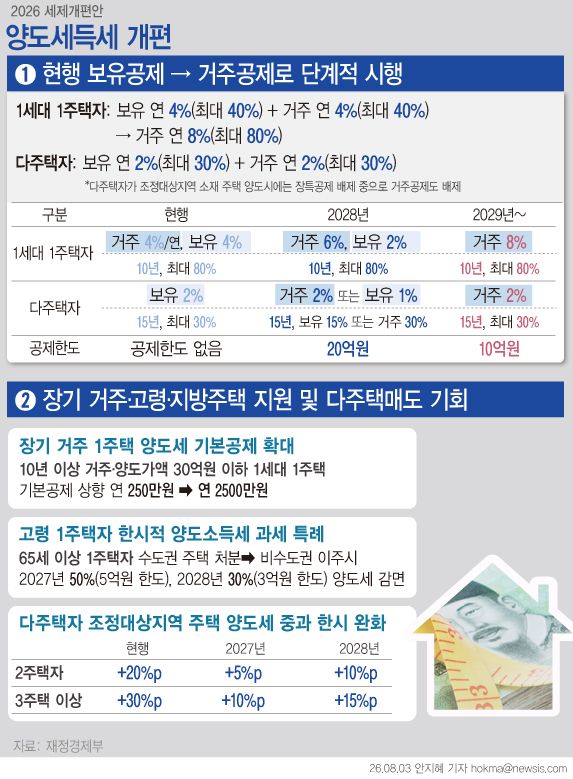
The benefit also comes with strict post-management conditions.If the homeowner buys another home in the Capital Region or returns to the Capital Region within five years after receiving the tax break, the reduced tax amount must be repaid with interest.The controversy grew as it became linked to the overhaul of the Comprehensive Real Estate Holding Tax.The government plan keeps age-based tax credits for one-home households, but it will gradually shift the ownership-based credit to a residence-based system.Tax rates for the Comprehensive Real Estate Holding Tax will also change.
In 2027, rates in some tax brackets will rise, and from 2028, the differentiated rates based on the number of homes will be abolished, with a top rate of 5% applied according to home value.
As the tax burden on expensive homes rises, complaints have concentrated on elderly single-homeowners whose income has fallen but whose home values have soared after decades of living there.
The new special rule was widely interpreted as telling them to sell their homes and move to non-metropolitan areas if taxes become too heavy.5 seniors want to grow old in the home and neighborhood where they live Support measures for older adults' continued residence in their communities, as presented in a 2024 report by the Korea Research Institute for Human Settlements titled "What and How Should We Support Aging in Place?" /Photo = KRIHS Brief Critics also said the policy itself is detached from the actual housing behavior of older adults.In fact, a report released by the Korea Research Institute for Human Settlements in the 2024 KRIHS Brief, titled "Aging in Place: What and How Should We Support It?", also made this point.5% said they wanted to keep living in their current home or neighborhood .2%.
This is known as "Aging in Place (AIP).
3 tax reform plan [Real estate-driven tax war] has escalated into a full-blown conflict.
" AIP means wanting to age not just in a physical home, but while maintaining long-standing neighborhood ties and familiar living conditions such as medical care, transportation, shopping, and caregiving.
3 tax reform plan [Real estate-driven tax war] has escalated into a full-blown conflict.3 tax reform plan [Real estate-driven tax war] has escalated into a full-blown conflict.
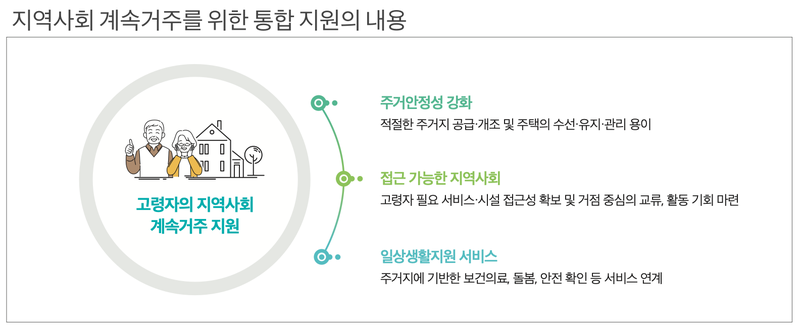
The Korea Research Institute for Human Settlements found that people in their 80s and older showed a stronger desire for AIP, greater reluctance toward institutional living, higher expectations for care from their children, and stronger ties with neighbors.
Living infrastructure such as medical services and transportation also acted as barriers to relocation for older adults.
"If there are hospitals and transportation anyway, would people move to the provinces just because taxes are cut?" Real estate experts also questioned whether the capital gains tax cut would actually lead to moves to the provinces.Kim Hak-ryeol, head of the SmartTube Real Estate Research Institute, said, "Go to Banpo Jugong or Apgujeong-dong.Older people do not easily sell their homes," and added, "There is a senior residence near Konkuk University known as the 'Tower Palace for the elderly.
2 billion won deposit and monthly rent of 5 million won, there are 100 groups on the waiting list.
" He said, "Older adults prefer places where they can receive medical care and where theaters, traditional markets, supermarkets, green spaces, and subway access are all familiar parts of daily life.
3 tax reform plan [Real estate-driven tax war] has escalated into a full-blown conflict.
For people who were already planning to move to non-metropolitan areas, the capital gains tax cut may help.
3 tax reform plan [Real estate-driven tax war] has escalated into a full-blown conflict.But how many people will newly move to the provinces because of this tax benefit? Almost none.
" Yoon Ji-hae, head of the research lab at Real Estate R114, also pointed out, "How likely is it that someone who has lived in the Capital Region for 20 or 30 years would move back to their hometown just because of emotional attachment?" He added, "There are countless people who were born in the Capital Region and have lived there their entire lives.There is even less reason for them to suddenly move to the provinces just because they have become elderly." He also said the regional division in the policy should be designed more precisely.
Yoon explained, "If the core of the home-price problem is Seoul, then one option would be to divide the policy not between the Capital Region and non-metropolitan areas, but between Seoul and areas outside Seoul.
Someone moving from Seoul to Gyeonggi Province or Incheon can still maintain much of their existing living area.
" He added, "Another option would be to design the benefits more clearly, such as fully exempting capital gains tax for moves from Seoul to non-metropolitan areas, or reducing it by 300 million or 500 million won for moves from Seoul to Gyeonggi Province or Incheon.
" he suggested.
[email protected] Reporters Seo Yoon-kyung and Kim Hee-sun Reporter