If You Bought a Home but Never Lived in It, Jeonse Loans Will Be Restricted [Aug. 13 Real Estate Measures]
- Input
- 2026-08-13 18:31:37
- Updated
- 2026-08-13 18:31:37
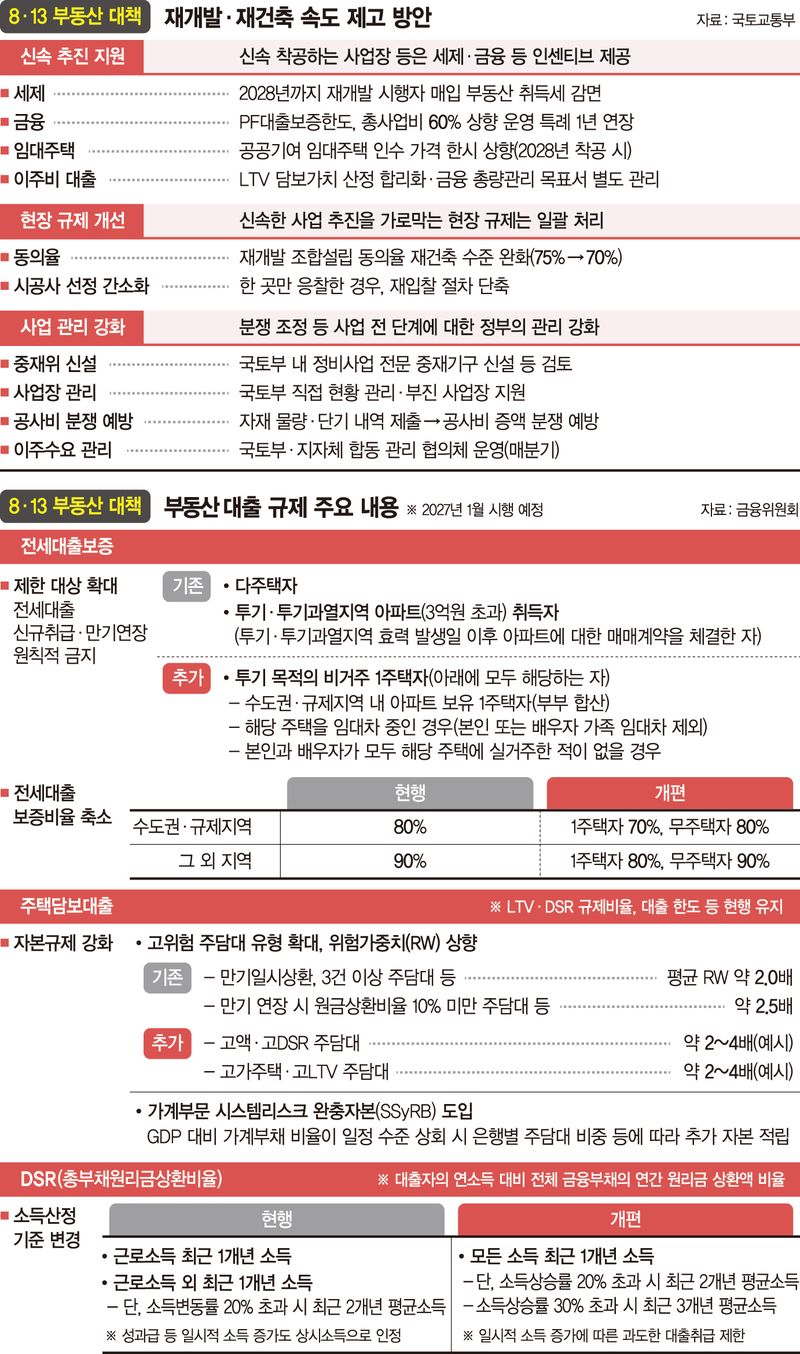
Starting next year, single-home owners in the Seoul metropolitan area and regulated areas who have never lived in their homes will be barred from extending jeonse loans and will also be unable to take out new ones. The move is aimed at blocking so-called gap investment, in which buyers purchase homes with a tenant's jeonse deposit and then seek capital gains. However, the financial authorities did not set a separate standard for the required period of actual residence. As a result, confusion in the market is expected over what counts as genuine occupancy.
Targeting the Seoul metropolitan area and regulated areas... to curb gap investment
According to the Financial Services Commission (FSC), which announced the comprehensive financial measures to stabilize the real estate market on the 13th, jeonse loan guarantees for non-resident single-home owners with speculative intent will be restricted from January next year. Bank jeonse loans are extended on the basis of guarantees from the Korea Housing Finance Corporation (HF), the Korea Housing & Urban Guarantee Corporation (HUG), and Seoul Guarantee Insurance (SGI). If those guarantees are suspended, borrowers will effectively be unable to receive any loan at all.
Until now, jeonse loans have been restricted for multi-home owners and for people who acquired apartments worth more than 300 million won in speculative or overheated zones. The new rule expands that scope to include non-resident single-home owners with speculative intent.
The government views the purchase of an apartment using another person's jeonse deposit without the intention of living there as speculation. However, those are exempt if either the owner or the spouse has lived in the home even once in the past, or if the home was leased to a family member.
For non-resident single-home owners deemed to have speculative intent, both new jeonse loans and extensions at maturity will, in principle, be prohibited. Exceptions will be made only when there is an unavoidable reason, such as a legally required move-in or when the landlord fails to return the deposit, making repayment difficult.
Guarantee ratio for single-home owners' jeonse loans to be reduced
From January next year, the guarantee ratio for single-home owners' jeonse loans will be lowered further, regardless of whether they live in the home. The current ratios of 80% in the Seoul metropolitan area and regulated areas, and 90% in other regions, will each be cut by 10 percentage points to 70% and 80%, respectively.
By broadly widening the definition of end-user demand, the new policy is expected to ease inconvenience for single-home owners who live elsewhere because of work or their children's education. Still, because no separate standard has been set for the required period of residence, market confusion is also expected. The FSC said anyone who has lived in the home for even one day would be regarded as an end user, but such cases cannot avoid risks such as violations of the Resident Registration Act. There are also concerns that people may try to evade the rules through formal address changes.
An FSC official explained, "A person may move their registered address for just one day to qualify for a jeonse loan, but because they would have to bear legal risks for violating the Resident Registration Act, we do not expect many such cases."
Market participants also worry that existing jeonse tenants could be harmed, since jeonse loans for non-resident single-home owners with speculative intent will be completely banned. If borrowers cannot extend their loans and choose to move in themselves, current tenants living in those homes will have to leave. According to the FSC, there are about 60,000 jeonse loans, worth 9.3 trillion won, for single-home owners who hold apartments in the Seoul metropolitan area and regulated areas.
[email protected] Lee Jumi, Park Sohyun Reporter