Next Year's PF Guarantees to Reach 33 Trillion Won; Move-in Loan LTV Standards Eased to Apply to New Homes [Aug. 13 Real Estate Measures]
- Input
- 2026-08-13 18:31:23
- Updated
- 2026-08-13 18:31:23

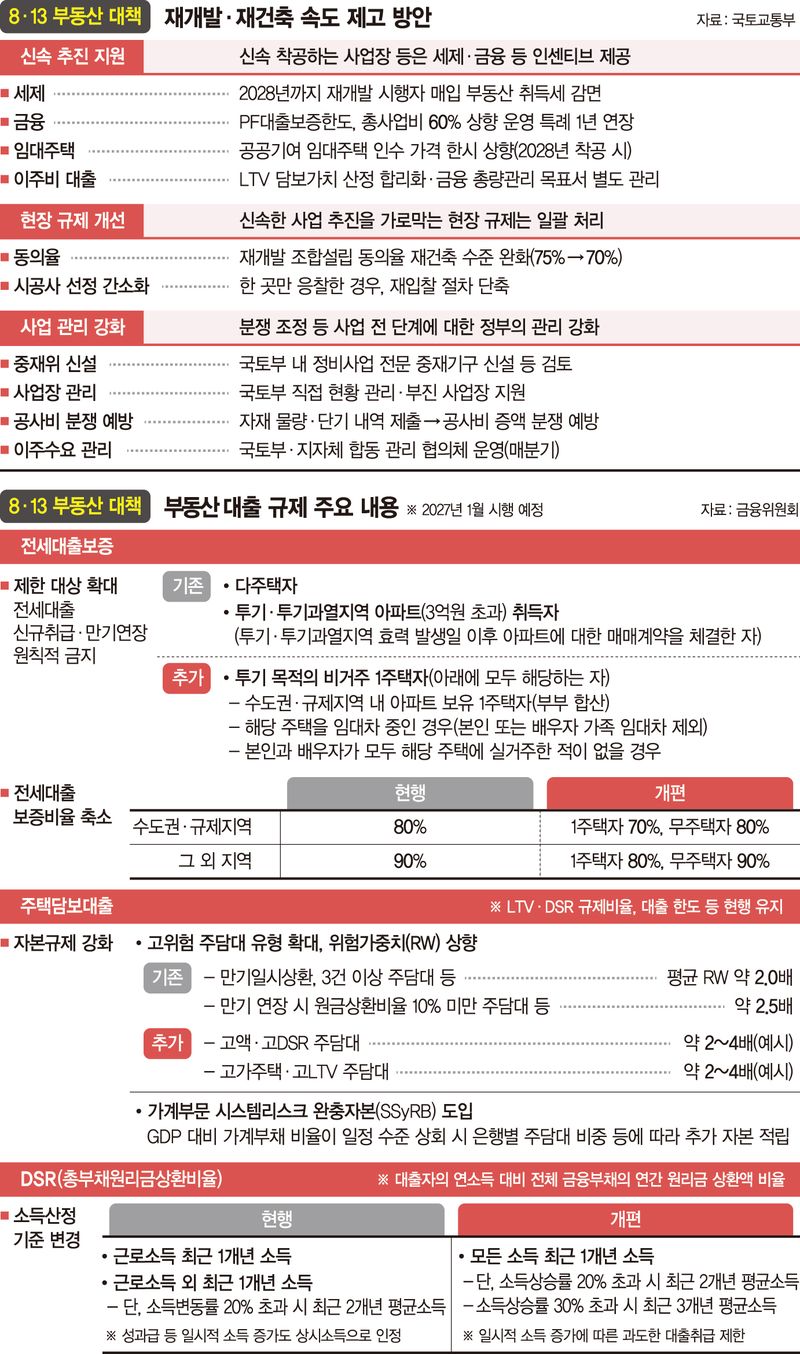
■ PF and move-in loan rules eased, financial supply doubled
The Financial Services Commission (FSC) announced the comprehensive financial package for stabilizing the real estate market on the 13th.
First, the introduction of the PF equity ratio rule for developers, which the industry had strongly demanded be delayed, will be pushed back from next year to 2029, two years later. However, because the rule was introduced to prevent a repeat of PF-driven crises such as the Legoland case, the temporary delay will apply only to residential projects, not all sites. Detailed measures will be announced within the year after consultations with industry groups and associations.
Rules on move-in loans will also be eased. The 40 percent Loan-to-Value Ratio (LTV) cap will remain in place, but the assessment standard will change from the value of the land and buildings currently held by union members before the completion of a redevelopment project to the estimated value of the new homes after completion. The new rule is set to take effect on the 31st and is expected to ease relocation difficulties at many redevelopment sites in Gangbuk. For cases where move-in loans alone are not enough, the Korea Housing Finance Corporation will also launch a new guarantee product for additional move-in loans. The goal is to begin in January next year, with guarantee limits calculated based on expected relocation demand at each site.
Housing supply-related financial support will expand from the current 26.3 trillion won to 47.8 trillion won plus alpha. Over the next three years, public guarantees from the Korea Housing Finance Corporation and HUG will increase from an average of 13.1 trillion won to 28.7 trillion won, or about 2.2 times the current level. In 2027, when the volume of projects scheduled to break ground is the smallest, 33 trillion won will be concentrated to support faster starts. KAMCO will also create a new PF normalization support fund worth 3 trillion won plus alpha to help revive troubled projects. If the fund is expanded to 3 trillion won, it is expected to support the supply of at least 18,000 homes. Syndicated loans jointly arranged by banks and insurers will also be expanded from 1 trillion won to 5 trillion won to speed up normalization. If the amount rises to 5 trillion won, it is estimated that at least 20,000 homes could be supplied. In addition, private-sector funds in the financial industry will be increased from 7.3 trillion won to 10 trillion won.
■ Industry says the measures will ease housing supply bottlenecks
The housing and development industries are welcoming the two-year deferral of the PF capital rule, saying the measures should help ease bottlenecks in housing supply. They also believe the package could help restore a development ecosystem that has been under severe strain.
According to the industry, the current supply ecosystem is on the verge of collapse, with little progress not only in bridge loans at the land acquisition stage but also in the transition to main PF financing. Above all, developers and builders view it positively that the financial authorities have recognized the severity of the housing supply problem.
A senior official at a development company said, "We had repeatedly raised issues such as PF regulations and move-in loans with the financial authorities, but they were not accepted." The official added, "This package shows that the financial authorities now seriously recognize the collapse of the supply ecosystem." Park Won-gap, chief real estate expert commissioner at KB Kookmin Bank, said, "A significant portion of the industry's requests, including move-in loans for redevelopment projects, have been reflected." He added, "It is meaningful that the government, including MOLIT, has recognized the importance of revitalizing the private sector."
[email protected] Lee Jong-bae, Park So-hyun Reporter