23 Million Homes Plus Alpha in the Capital Region, Loan Cap to Be Doubled [August 13 Real Estate Measures]
- Input
- 2026-08-13 18:30:21
- Updated
- 2026-08-13 18:30:21
The government held a joint briefing at the Government Complex Seoul on the 13th and announced the "Rapid Housing Supply Plan for Stabilizing the Jeonse, Monthly Rent, and Sales Markets" and the "Comprehensive Financial Measures for Stabilizing the Real Estate Market."
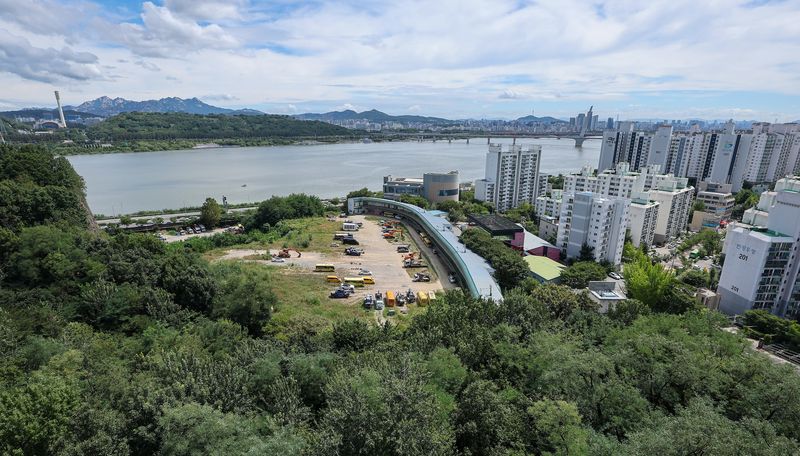
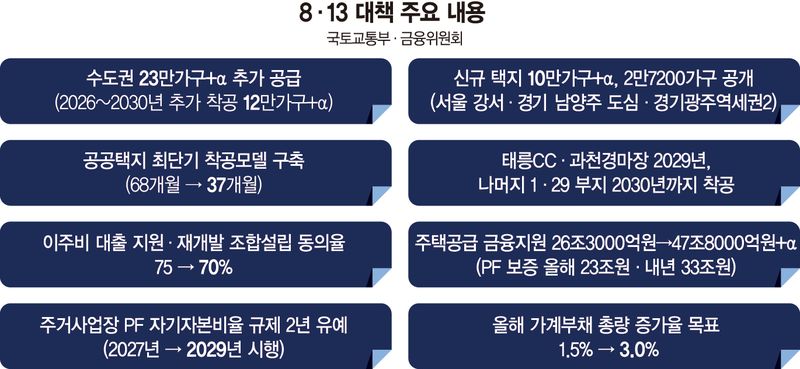
Among the new land sites, the Namyangju Downtown District will build 21,700 homes on 2.28 million square meters in Wabu-eup, near Dosim station on the Gyeongui–Jungang Line. Using the green belt around Korea University’s Deokso Farm, the government will prepare wider transportation measures and develop an agri-bio cluster. Gyeonggi Gwangju Station Area District 2 will provide 4,500 homes on 480,000 square meters in Jangji-dong, near Gyeonggi Gwangju station. The Gangseo District, Seoul, will build 1,000 homes on 51,000 square meters of the long-abandoned Yeomchang Park site.
Construction in Gangseo District, Seoul, is targeted to begin in 2029, while the Namyangju Downtown District and Gyeonggi Gwangju Station Area District 2 are scheduled to break ground in the first half of 2030. The government will disclose the locations of the remaining new land sites, totaling 73,000 homes plus alpha, within the year. Until then, all green belt areas in Seoul and green belt areas in the capital region adjacent to Seoul will be temporarily designated as land transaction permit zones.
Not all of the 230,000 homes plus alpha announced by the government will begin construction by 2030. Compared with the September 7 Real Estate Supply Plan and the January 29 Supply Plan, the additional amount scheduled to break ground from 2026 to 2030 is 120,000 homes plus alpha. For new land sites, the construction volume is calculated at the time the district is designated.
For new public land sites, the government will carry out approvals, compensation, and site preparation in parallel, cutting the time from candidate-site announcement to groundbreaking from 68 months to 37 months. Groundbreaking for 89,000 homes at existing public land sites, including Third New Towns and Seoripul, will also be brought forward by one to two years.
For redevelopment projects, the required consent rate to establish a union will be lowered from 75% to 70%, and support for relocation loans, tax measures, and Project Financing (PF) will be expanded. Housing supply financial support will increase from 26.3 trillion won to 47.8 trillion won plus alpha. The government will also secure supply through conversions of non-residential land, easing restrictions in military protection zones, and small-scale redevelopment projects.
Financial authorities decided to double the household loan growth target from the current 1.5% to 3%. If the target is raised to 3%, total household lending in the second half alone will increase by about 30 trillion won. That figure includes relocation loans, interim payment loans, balance-payment loans, and policy-backed loans. However, the authorities said relocation, interim payment, and balance-payment loans will be managed separately from the total after consultation with banks. The specific method will be finalized after discussions with the financial sector.
[email protected] Jang In-seo Reporter