"Semiconductors Defy the Falling Won"... Export Prices Resume Their Rise After a Pause
- Input
- 2026-08-14 06:00:00
- Updated
- 2026-08-14 06:00:00

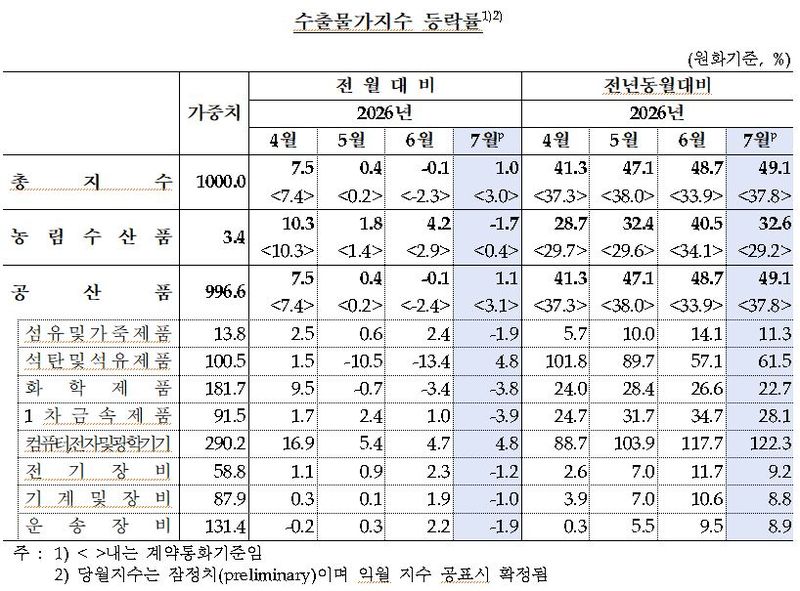
According to the "July 2026 Export and Import Price Indexes and Trade Index" released by the Bank of Korea on the 14th, the won-denominated export price index rose 1.0% in July from the previous month. That was the highest increase since April, when it rose 7.5%.
After rising for 11 straight months from July last year through May this year, the index was unchanged in June. It then turned upward again just one month later.
Compared with the same month a year earlier, the index jumped 49.1%. It has been rising for 11 consecutive months since September last year, surpassing the previous month's increase of 48.7%.
Industrial products rose 1.1% from the previous month. Computer, electronic and optical devices, which include semiconductors, gained 4.8%, and coal and petroleum products also rose 4.8%. By contrast, primary metal products fell 3.9%, chemical products dropped 3.8%, petroleum and leather products declined 1.9%, and transport equipment slipped 1.9%.
Looking specifically at semiconductors, DRAM rose 6.6% from the previous month, while computer memory devices climbed 17.6%. Compared with a year earlier, DRAM and flash memory surged 270.3% and 248.1%, respectively.
Agricultural, forestry and fishery products fell 1.7% from the previous month, reversing the 4.2% increase seen in June.
In contract-currency terms, which exclude exchange-rate effects, export prices rose 3.0% in July from the previous month. They were up 37.8% from a year earlier.
The drop in international oil prices was the main factor. The monthly average price of Dubai crude fell 3.4% from $79.45 per barrel in June to $76.75 in July.
Raw materials rose 0.8%, supported by a 0.9% increase in mining products such as crude oil. Intermediate goods fell 2.2%, led by coal and petroleum products (-3.9%), primary metal products (-3.8%), and computer, electronic and optical devices (-2.2%). Capital goods and consumer goods fell 1.8% and 0.1%, respectively.
In contract-currency terms, import prices rose 0.9% from the previous month.
Lee Heung-hoo, head of the Price Statistics Team at the Economic Statistics Department 1 of the Bank of Korea, said, "The upward trend in export prices widened slightly, while the rise in import prices narrowed as international oil prices and the exchange rate fell, improving the terms of trade." He added, "This reflects both higher export prices for items such as semiconductors and increased shipment volumes, which means our economy's external purchasing power has strengthened."
In July, the export volume index rose 20.0% from a year earlier, driven by gains in computer, electronic and optical devices (25.2%), machinery and equipment (10.5%), and primary metal products (5.2%). The export value index climbed 64.2% over the same period.
The import volume index also rose 14.7% from a year earlier, as computer, electronic and optical devices (31.4%) and machinery and equipment (30.7%) increased, even though coal and petroleum products fell 23.3%. The import value index gained 25.8%.
The net barter terms of trade index, which measures how much imported goods can be purchased with one unit of exports, rose 24.7% from a year earlier as export prices increased much more sharply than import prices, up 36.8% and 9.7%, respectively. On a monthly basis, it fell 6.9%.
The income terms of trade index rose 49.7% from a year earlier, as both the net barter terms of trade index and the export volume index increased over the same period. The income terms of trade index measures the ability to expand imports using export earnings. When the index rises, it means the amount of imports that can be purchased with total export revenue has improved.
[email protected] Kim Tae-il Reporter