Records of 'firsts' built on faithfulness... Hair transplant specialist Dr. Hwang Sung-joo says, "I want to give hope to humanity" [Interview with 100 Hair Loss Experts]
- Input
- 2026-08-14 10:14:27
- Updated
- 2026-08-14 10:14:27
When something that should normally be there is absent, it brings loss. Hair loss, which has emerged as a major issue of our time, is an absence that causes us deep and heavy grief. To face it head-on and overcome it, we are meeting 100 hair loss experts, starting with a medical doctor who pioneered first-generation hair loss treatment. Please look forward to the new stories that will unfold beyond the two syllables of "hair loss." [Editor's note]
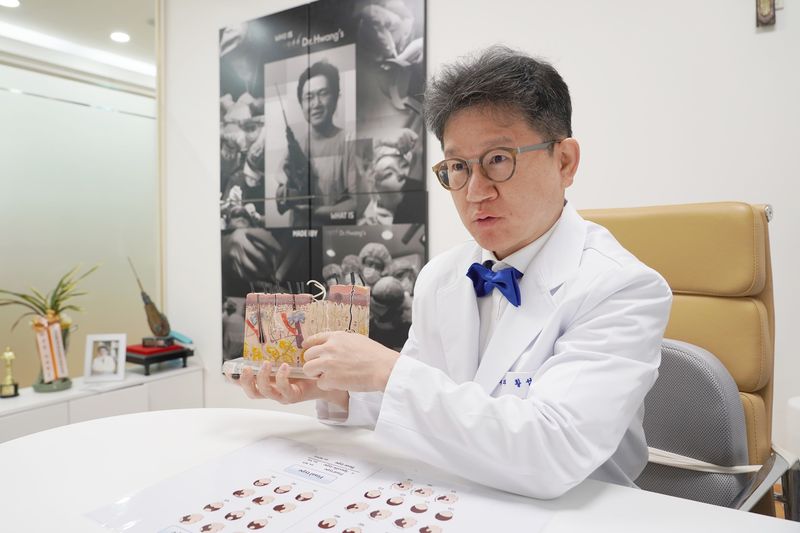
[Financial News] He approached every new challenge with sincerity. He did so when he began hair transplantation as a dermatologist, when he learned that a long-held global theory was wrong, when he performed surgeries no one in Korea had attempted, and when he came to lead world-renowned scholars. Before long, he found himself standing in the role of a pioneer.
Over the past 30 years, Hwang Sung-joo, head of the Hair Transplant Center at Myongji Hospital, has devoted himself to the field and accumulated a series of "firsts," including proving the world's first recipient-site influence theory, performing Korea's first hair transplant between family members, and becoming the first Korean president of the International Society of Hair Restoration Surgery (ISHRS). When we met him on the 13th, he modestly described his past as simply "fate" and "good luck." But by carefully and precisely solving problems in his own way, he has helped advance the entire hair transplantation field.

Hair transplanted directly to the leg... the world's first doctor to prove the recipient-site influence theory
― You studied under Professor Kim Jeong-cheol, who pioneered hair transplant surgery in Korea, and now serve as head of the Hair Transplant Center at Myongji Hospital. Have you worked only in hair transplantation all along?▲ It is true that I was assigned as a resident when Professor Kim Jeong-cheol launched the hair transplant center in the dermatology department at KNUH in 1996. But after that, I worked as a dermatologist at Gyeongsangbuk-do Andong Medical Center and treated a wide range of skin conditions. The more patients I saw, however, the more I felt I needed to focus on one field. So around 2000, I decided to devote myself to hair transplantation, returned to KNUH, and spent two years there as a fellow in the field. I have been doing hair transplants ever since. It has now been 30 years.― The paper you wrote right after starting hair transplantation at KNUH was selected as the best paper by the Korean Dermatological Association.▲ At the time, hair transplantation was based on the so-called donor-site influence theory. It held that even after a follicle is transplanted, it retains the same characteristics it had before the move. But through research, I proved the recipient-site influence theory, which showed that follicles are affected by the site where they are transplanted. That study won the Best Paper Award from the Korean Dermatological Association and the Platinum Follicle Award from the International Society of Hair Restoration Surgery.― You challenged an established theory. Did you begin the research because you were convinced the donor-site theory was wrong?▲ No, not at all. The experiment began by transplanting hair to the leg. I wanted to reassure patients who doubted the effectiveness of hair transplantation by showing them that "hair grows well even on the leg, so of course it will grow well on the scalp."But three years after transplanting hair to the leg, it seemed to grow more slowly than hair on the scalp. I performed a second transplant to confirm it, and it was slow again. Suspecting that the recipient site was affecting the result, I transplanted the hair from the leg back to the scalp for a third round. This time, it grew quickly. That proved the follicles were influenced by the recipient site. Even so, opinions in the academic community remained divided. Finally, I transplanted chest hair to the scalp. Naturally, the chest hair also grew quickly, just like scalp hair. Only then did the recipient-site influence theory become accepted as the standard view.― So you used your own body for experiments over several years. That is remarkable. Then what causes the recipient site to have an effect?▲ The scalp has good blood circulation and thick skin. It is the ideal environment for hair growth. The palm, by contrast, has good circulation but thin skin, making it difficult for hair to take root. The back has thick, firm skin, but blood circulation is poor, so it is hard to supply hair with oxygen and nutrients. In other words, the blood circulation and skin thickness of the recipient site play a major role.― After the recipient-site theory was established, did the field of hair transplantation change, such as by transplanting follicles from other body parts to the head?▲ In theory, transplanting follicles from other body parts to the scalp is possible. But every donor site where follicles are harvested is left with a scar. You cannot leave scars elsewhere just to increase hair density. Also, although follicles moved to the scalp can produce hair that grows quickly and long, they do not grow as long as naturally growing scalp hair. The best material for hair transplantation is unquestionably hair itself.
Hair root lengths range from 3 mm to 6 mm... developed a hair transplant method that takes root length into account
― You also developed new surgical methods and tools to address side effects experienced by patients.▲ Among hair transplant patients, some develop scattered wide and deep holes at the transplant site, as if the pores had enlarged, or they experience inflammation. These are side effects that occur when follicles are implanted too deeply. Once I first learned about the side effect and its cause, I devoted great care to avoiding deep implantation. But no matter how hard I tried, the side effects never disappeared completely. It was frustrating.Then one day, I wanted to measure the length of the follicle roots. I separated each harvested follicle one by one and measured them, and the root lengths varied from 3 mm to 6 mm. I realized that simply implanting them shallowly was not enough; a customized procedure was needed.― So you created a device that could adjust the implantation depth according to root length?▲ Yes. I wanted to perform hair transplantation according to each root length, so nurses separated the harvested hair one by one and measured the root lengths. But because follicles are also human tissue, they often dried out and were damaged when placed on graph paper for measurement.
So I came up with a medical board marked with a scale. It is made of polymethyl methacrylate, a material similar to glass, so the follicles do not dry out during the procedure. It also has spaces for separating follicles by root length, such as 3 mm, 5 mm, and 6 mm, which helps shorten surgery time. I also developed an implantation device along with the board. The device allows needle-length adjustment and includes a stopping function.
"You can take all of my hair"... the first family hair transplant after bone marrow transplantation in Korea
― I have heard that because follicles are also organs, it is difficult to transplant another person's follicles. Yet you successfully performed a family hair transplant in Korea, and I heard you carried out the surgery yourself.▲ That is right. A pair of sisters came to see me 20 years ago. The younger sister had lost hair growth after chemotherapy for leukemia, and the older sister said she wanted to give her own hair to her younger sister. At first, I waved it off and said it would not work because of immune rejection. But then I learned they had undergone bone marrow transplantation. If that was the case, it meant the donor's blood was flowing in the recipient's body. So I conducted an experiment. I transplanted hair crosswise between the sisters and observed the response.― Interesting. What were the results?▲ The younger sister's hair did not grow on the older sister, but the older sister's hair grew well on the younger sister. The older sister's immune cells accepted her own tissue inside the younger sister's body. On the other hand, the older sister's immune cells rejected the younger sister's DNA remaining in the scalp. In addition to the sisters, in 2025 a mother also gave her daughter a hair transplant. She, too, had undergone a bone marrow transplant. I performed both the sister case and the mother-daughter case. These are the only two family hair transplant cases in Korea involving bone marrow transplantation.― Does transplanting another person's hair always require a bone marrow transplant?▲ There are exceptions. Identical twins can undergo hair transplantation without a bone marrow transplant. In fact, when identical twins who visited my clinic had their hair transplanted crosswise, I confirmed that it grew well. I believe that experiment was probably the first of its kind in the world. Otherwise, unless a bone marrow transplant has been performed, a person would have to take immunosuppressants for life in order to receive another person's hair. Accepting another person's tissue is not easy.A ceremony that made Hollywood buzz... recognized by colleagues as a "Faithful" leader
― You proved the recipient-site influence theory, developed a surgical method based on root length, and performed family hair transplants... all of them were firsts. But there is still more. You were the first Korean to serve as president of the International Society of Hair Restoration Surgery. What does the president usually do?▲ To become president of the International Society of Hair Restoration Surgery, one must first serve three years as an executive director, three years as secretary-general, and one year as vice president. Fortunately, thanks to recommendations from my colleagues, I was able to go through every step and eventually become president. As president, you are constantly in meetings and constantly making decisions (laughs). That means working through video conferences with members around the world to promote the society's development and decide on various matters. The time zones are different, and even when people speak the same language, the accents vary from country to country, so there were difficult moments. Still, I tried to carry out my duties faithfully.― You were in a position to lead scholars from around the world. Is there a memory that stands out?▲ Beyond academic or technical matters, I would like to share something that was personally enjoyable. During my term as president, the International Society of Hair Restoration Surgery marked its 25th anniversary. In the West, a 25th anniversary is called a Silver Jubilee and is celebrated on a grand scale. While thinking about how to hold the 25th anniversary event, the venue was chosen to be the same place in Hollywood where the Academy Awards are held. So I suggested naming the gala dinner the "ISHRS Fun Academy Awards" and creating meaningful awards to present.― When you say awards from the society, do you mean something like a "Researcher of the Year" award?▲ That would not have been very fun, would it? Since it was a Silver Jubilee, I wanted to honor the people who had contributed to the society over the years. We selected people who had donated generously, performed many charity surgeries, or devoted themselves to service. We announced the winners by drawing names from envelopes, just like a real awards ceremony, and presented trophies similar to those used at the Academy Awards. Every recipient was visibly moved. We also selected a Best Dresser for the accompanying family members. I wanted to give all members and their families an enjoyable time, and I was glad it turned out that way.― The society must have recognized that sincerity as well. I heard the society gave you an award in return.▲ After the event, while everyone was enjoying the festive atmosphere, my name was called. The executives selected me as the most faithful leader among those who had led the society over the past 25 years, naming me the Faithful Leader. I was deeply moved, and memories of the past flashed before my eyes. After the event, a welcome reception for the president was held in a hotel suite, and I stayed in the same suite. I am not an actor, but I think I may have been the most warmly welcomed person in Hollywood that day. It is a glorious memory.― As a fellow Korean, I find that moving as well. Then, as head of the Hair Transplant Center at Myongji Hospital, what do you hope to achieve? Do you still want to continue your challenges and discoveries as a first mover?▲ First of all, I want to be a support for younger colleagues who are growing. And I want to give hope to those who need help, like the morning star. Those in need may be patients, children in countries that need humanitarian aid, or friends with physical disabilities. Even now, I am educating 100 children in Africa, and on weekends I continue volunteering at church. We will all go to heaven someday, won't we? I want to make each day valuable and rewarding so that I will have no regrets about the time I spent when that day comes.And I want to create good moments at Myongji Hospital. While serving as head of the Hair Transplant Center, I also serve as head of public relations. I want not only to produce research results and run the Hair Transplant Center well, but also to do many good things for the hospital. Last November, I arranged for the principal oboist and principal violist of the Berlin Philharmonic to hold a special concert for Myongji Hospital. They are people I came to know through hair transplantation, and they kindly made the trip for our patients. Going forward, I plan to use my abilities to the fullest to create meaningful work.
[email protected] Kim Hyun-sun Reporter