"It’s 8 p.m. and the bars are empty"... Young people who don’t drink these days are all here
- Input
- 2026-08-13 19:00:00
- Updated
- 2026-08-13 19:00:00
[Financial News] The after-work habits of people in their 20s and 30s are shifting away from bars and toward gacha shops and character stores, changing the look of neighborhood commercial districts. As young consumers move from drinking to taste-driven spending, the landscape for small businesses is being reshaped.
Spending on hobbies instead of drinking... Gacha shops and character stores spread
According to the National Tax Service's status report on the country's top 100 everyday business categories released on the 12th, the number of toy stores nationwide stood at 3,996 at the end of June, up 673, or 20.3%, from a year earlier. That was also 67, or 1.7%, more than a month earlier. On average, more than two toy stores opened every day. The National Tax Service attributed the increase to the rapid spread of figure shops and gacha stores.
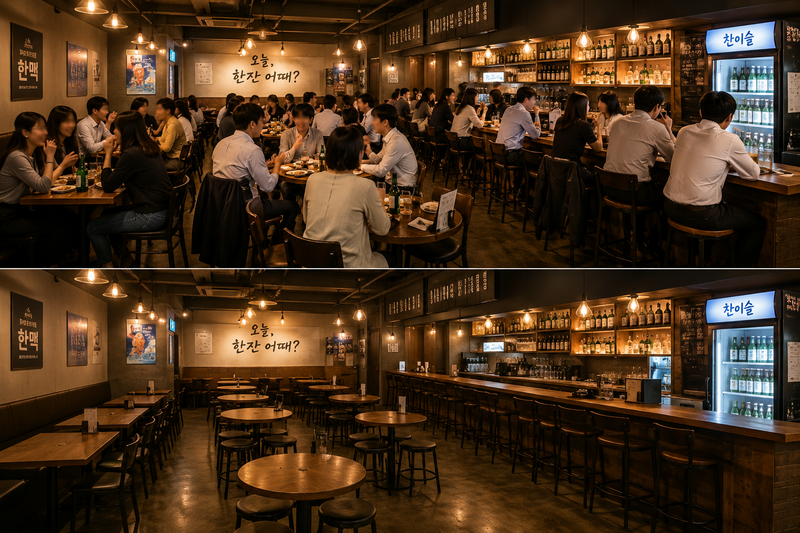
By contrast, bars that once drew steady traffic from people in their 20s and 30s are disappearing quickly. Over the same period, the number of pub-style bars nationwide fell to 19,730, down 1,975, or 9.1%, from a year earlier. Casual drinking establishments, including traditional taverns, also declined from 8,648 to 7,853, a drop of 795, or 9.2%.
The change is especially visible in major Seoul commercial districts. In Mapo District, where Hongdae is located, the number of toy stores jumped from 49 last year to 70 this year, up 42.9%. Over the same period, pub-style bars fell from 271 to 252, down 7.0%, and casual drinking establishments dropped from 212 to 187, down 11.8%. Stores aimed at young consumers' taste-driven spending are filling the space left by bars.
Toy market sees surge in consumers in their 20s and 30s
In particular, the toy market itself has seen a shift in its customer base. Adults have poured into a market that was once mainly for children.
Figure and character merchandise, once considered the domain of a small group of enthusiasts, has become a way to express personal identity. Analysts say the appeal of getting immediate satisfaction at relatively low cost also fits the spending habits of people in their 20s and 30s.
The shift in consumption is also visible in drinking indicators. According to the Korea Disease Control and Prevention Agency (KDCA)'s 2025 Community Health Survey, the high-risk drinking rate among men in their 20s fell from 17.8% in 2016 to 10.4% in 2025, a drop of 7.4 percentage points over the past 10 years. In relative terms, that was a 41.6% decline, the largest among all age groups.
Alcohol makers post weak results... HiteJinro operating profit plunges 17%
As a result, the liquor industry also posted weak results. According to the Financial Supervisory Service's Data Analysis, Retrieval and Transfer System (DART), Lotte Chilsung's operating profit last year came to 167.2 billion won, down 9.6% from a year earlier. HiteJinro also saw operating profit fall 17.2%, from 208.1 billion won to 172.3 billion won.
The imported liquor market is also shrinking. According to the Korea Customs Service (KCS), whisky imports by weight in January and February this year totaled 2,880 tons, down 28.2% from 4,012 tons in the same period last year. Wine imports by weight also fell 2% over the same period. Last year's total liquor imports were worth $1.27374 billion, down 13.5% from $1.47196 billion two years earlier.
Experts say worsening youth employment conditions, combined with rising dining-out and housing costs, are pushing people toward smaller discretionary purchases instead of big spending.
[email protected] Ahn Ga-eul Reporter