Japan attracts 5.3 trillion won in foreign investment for semiconductor revival; TSMC and Micron also invest
- Input
- 2026-08-12 18:26:17
- Updated
- 2026-08-12 18:26:17
The Ministry of Trade, Industry and Energy holds a meeting with executives from semiconductor companies.
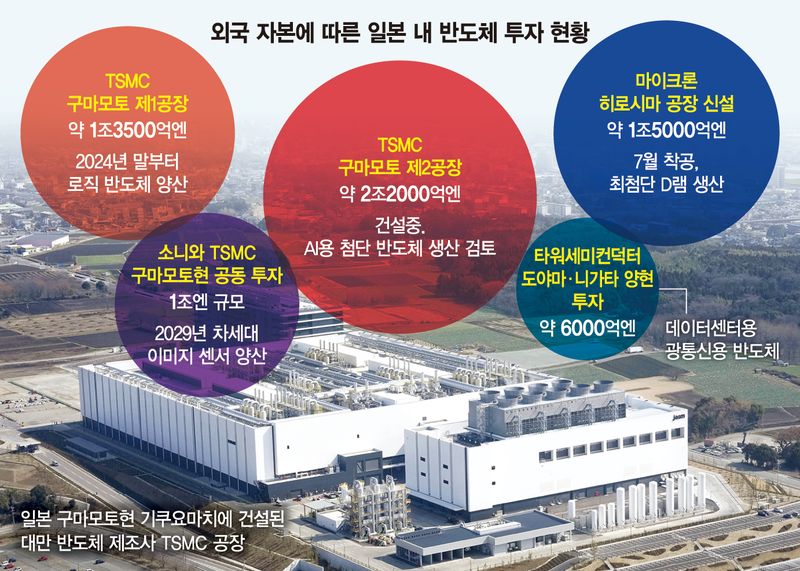
According to The Nikkei on the 12th, the total value of major semiconductor investments in Japan involving foreign companies reached 6 trillion yen after Sony Group and TSMC officially announced the previous day that they would establish a joint venture for next-generation image sensors.
Ahn Duk-geun's outreach
Minister of Trade, Industry and Energy Ahn Duk-geun speaks with executives from semiconductor companies.
Sony will invest 465 billion yen, or about 412.92 billion won, in the joint venture, while TSMC will contribute 282 billion yen, or about 250.42 billion won. Including government subsidies, the total investment will amount to about 1 trillion yen, or 8.88 trillion won. The company will build a production line in Kōshi City, Kumamoto Prefecture, and begin mass production of next-generation image sensors in 2029.
Investment is continuing even after the powerful earthquake that struck on the 28th of last month, with a maximum intensity of 7. TSMC restored production to pre-quake levels by the 3rd of this month, and Sony resumed operations on the 4th. Kumamoto Prefecture Governor Takashi Kimura called the investment "a catalyst for Kumamoto's economic revival."
■ Rebuilding the production network with foreign capital as market share declines
The Japanese government has designated semiconductors as a strategic material and has used large subsidies to attract production facilities from global companies.
TSMC, the largest investor, is putting more than 3 trillion yen, or about 26.64 trillion won, into its Kumamoto plants No. 1 and No. 2. Micron is investing 1.5 trillion yen, or about 13.32 trillion won, to build a cutting-edge DRAM production facility in Hiroshima for AI data centers, while Israel's Tower Semiconductor is investing 600 billion yen, or about 5.328 trillion won, in Toyama Prefecture and other locations.
Japanese companies are joining as well. KIOXIA is expanding its NAND flash facilities, and Rapidus aims to begin mass production of cutting-edge 2-nanometer semiconductors in Hokkaido from the second half of next year. The strategy is to combine foreign and domestic companies to build a production network spanning logic chips, DRAM, NAND flash, and image sensors.
Japan once accounted for more than 50% of the global semiconductor manufacturing market in the late 1980s, but after the collapse of the bubble economy, it fell behind in the investment race and its market share dropped to around 10% in the 2010s. Its production base for advanced semiconductors used in AI data centers remains relatively weak.
Compared with the global investment race, 6 trillion yen is still seen as modest. Samsung Electronics and SK hynix announced in June that they would invest a combined 800 trillion won to build four new semiconductor plants in South Korea. TSMC's investment in the United States amounts to $265 billion, or about 375.187 trillion won, roughly nine times Japan's level, while Samsung Electronics is also investing about $40 billion, or about 56.632 trillion won, in the United States. ■ The next challenge after factories: companies that can buy semiconductors Japan's next task is to nurture companies that can design semiconductors and purchase them on a large scale. In the United States, the huge semiconductor demand from Alphabet, Microsoft, and Amazon acts as a magnet that draws investment from global companies. TSMC's investment in the United States is nine times larger than in Japan largely because of that demand base. By contrast, Japan's semiconductor revival strategy has focused on expanding manufacturing facilities. The Nikkei noted that for sustained industrial clustering, Japan must nurture not only manufacturers but also design firms and demand-side companies.
[email protected] Reporter Seo Hye-jin Reporter