Kim Dong-kwan's 55 Trillion Won Investment in the Yeongnam Region... Talent Development and KAI Acquisition Run on a Two-Track Strategy
- Input
- 2026-08-12 18:22:13
- Updated
- 2026-08-12 18:22:13
■ Green light for KAI privatization through KEXIM consulting
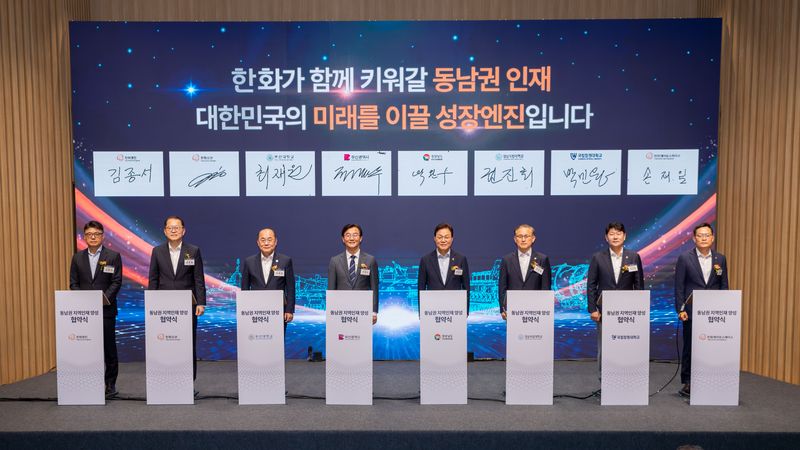
Hanwha Aerospace, Hanwha Ocean, and Hanwha Engine signed a 'Southeast Region Talent Development Agreement' with Gyeongsang National University, Pusan National University, and Changwon National University at Changwon Plant 3 on the 12th.
The agreement is part of Kim Dong-kwan's plan, announced last month, to invest 55 trillion won in AI and aerospace in the Yeongnam Region. At the time, Kim said, "A virtuous cycle in which local talent learns locally, local companies challenge the global market, and local industries lead the future of Korea is the true industrial ecosystem Hanwha envisions."
Under its plan to build a 'Korean SpaceX,' Hanwha Group recently acquired a 15.89% stake in Korea Aerospace Industries (KAI), becoming the company's second-largest shareholder. As Hanwha has acquired more than 15% of the listed company's shares, it plans to file for a merger review with the KFTC.
Industry watchers said the biggest obstacle would be whether KEXIM, which holds a 26.41% stake as the largest shareholder, and the government would support privatization. But sentiment shifted after KEXIM's Investment Banking Division ordered a consulting service on strengthening the competitiveness of the space and aviation industries. An industry source said, "Given that the project is worth about 1.8 billion won over three months, it is effectively being viewed as part of the KAI privatization process."
As a result, Hanwha is seen as having built a complete integrated defense value chain spanning land, sea, air, and space, giving it a strong platform to emerge as a global anchor company and a 'Korean Lockheed Martin.' In fact, Hanwha already has a strong foothold in ground systems, represented by Hanwha Aerospace's K9 self-propelled howitzer and REDBACK armored vehicle, while Hanwha Ocean has successfully absorbed naval defense capabilities such as submarines and surface ships. If the acquisition of KAI, the country's only complete aircraft manufacturer, is completed, Hanwha would not only gain synergy with its existing aircraft engine business but also build a dominant portfolio covering the aerospace and space sectors without gaps.
■ Strong appeal to the government on regional talent development
In particular, Hanwha kicked off its AI and aerospace investment drive by signing the talent development agreement on the day. The move signaled to the government its strong commitment to cultivating future talent in space and investing in infrastructure. Through the agreement, Hanwha will accelerate the creation of an advanced industrial ecosystem in the southeast by focusing on three pillars: regional talent development, upgrading the technology of partner companies, and shared growth with startups.
The key is practical, employment-linked education. Hanwha will establish a contract-based department at Pusan National University, tentatively named the Advanced Mechanical Systems Engineering Department, and significantly expand cooperation in research and development (R&D). At Gyeongsang National University and Changwon National University, it will introduce master's programs under a contract enrollment system to train the next generation of AI specialists.
Selected students will receive full tuition and living stipends throughout their studies, along with internship opportunities to build hands-on experience. After completing the program, outstanding graduates will go through a separate process and then be immediately assigned to Hanwha Aerospace, Hanwha Ocean, and Hanwha Engine. In addition, the three universities will conduct joint research and technology exchanges, while also identifying local government support projects together to further strengthen industry-academia cooperation.
Hee-Chul Kim, CEO of Hanwha Ocean, emphasized, "This cooperation, built through the combined efforts of the government, local governments, and universities, will serve as a solid foundation for shared growth between the region and companies."
[email protected] Kim Dong-ho Reporter