Korean Crypto Assets Estimated to Move Overseas Reaches 700 Trillion Won... 168 Trillion Last Year, 5 Trillion in Fees [Crypto Briefing]
- Input
- 2026-08-12 16:05:36
- Updated
- 2026-08-12 16:05:36
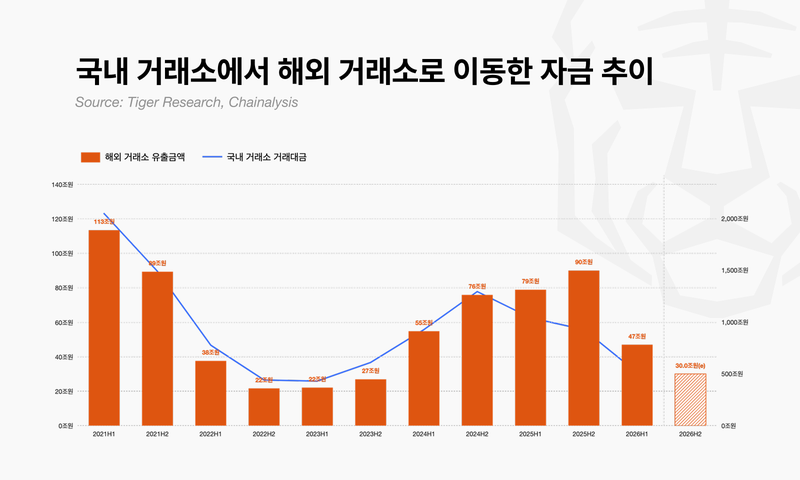
[Financial News] The amount of crypto assets moved from domestic exchanges to overseas exchanges between 2021 and 2026 is projected to reach about 700 trillion won, according to a new analysis. Last year alone, about 168 trillion won moved overseas, and transaction fees paid by Korean investors to overseas exchanges were estimated at about 5 trillion won. Some of the capital that moved overseas was also used for derivatives and prediction markets on decentralized exchanges (DEXs), expanding its use beyond simple trading.
On the 12th, web3 specialist Tiger Research and Chainalysis said that, based on an analysis of about 5 million address records linked to domestic and overseas exchanges and about 120,000 wallets believed to belong to Korean investors, crypto assets moved from domestic exchanges to overseas exchanges from 2021 through 2026 are estimated at about 700 trillion won. That includes this year's projected annual total of about 77 trillion won. The amount moved last year was about 168 trillion won. The firms noted that this figure reflects only identifiable routes and is not a sample representative of all Korean crypto investors.
Although the amount moving overseas has recently declined, the ratio of capital outflow compared with domestic trading volume has increased. Tiger Research said its analysis showed a rise in the 'net outflow intensity,' calculated by dividing net outflows to overseas exchanges by spot trading volume on Korea's three largest exchanges: Upbit, Bithumb, and Coinone. This means that while domestic spot trading volume has fallen, the decline in net outflows to overseas exchanges has been relatively smaller.
Fees generated by the use of overseas exchanges were also estimated to be substantial. Using its own methodology, Tiger Research estimated that Korean investors paid about 5 trillion won in trading fees on overseas exchanges last year. Fees for the first half of this year were also estimated at about 140 billion won.
Investor demand that moved overseas has expanded beyond centralized exchanges (CEX) into on-chain services. From January 2024 through July this year, the cumulative amount deposited by wallets believed to belong to Korean investors into three DEXs, including Hyperliquid and Lighter, reached about 240 billion won. In July alone, the notional trading volume of about 1,200 such wallets using Hyperliquid was estimated at 740 billion won. Because of the nature of leveraged trading, notional volume can be much larger than the actual capital deployed.
Trading activity has also expanded from crypto assets to traditional assets. From January through July this year, major instruments traded by wallets believed to belong to Korean investors included perpetual futures based on SK hynix, Samsung Electronics, and crude oil. One wallet was analyzed to have opened a 10x leveraged short position in SK hynix-based perpetual futures last month, using about 100 million won as margin.
Use by Korean investors was also confirmed in prediction markets. From January 2024 through July this year, about 3,700 wallets believed to belong to Korean investors used Polymarket, with cumulative trading volume of about 636 billion won.
Use of crypto cards, which connect crypto assets such as stablecoins to payments, is also rising. As of the end of last month, cumulative downloads in Korea of crypto card applications such as RedotPay, Kast, and ether.fi were estimated at about 38,000. From July last year through July this year, the cumulative amount deposited into crypto cards from wallets believed to belong to Korean users was about 41.1 billion won. Tiger Research also found cases in which funds moved from domestic exchanges to personal wallets were then used for crypto card payments via Hyperliquid and Polymarket.
Tiger Research interpreted the trend as a process in which demand that is difficult to meet in Korea is being satisfied overseas, rather than a simple decline in domestic investor demand. It estimated that if only 25% of the 5 trillion won in trading fees believed to have been generated overseas last year were instead generated by domestic firms, that could translate into about 125 billion won in revenue.
Senior researcher Jo Yoon-sung of Tiger Research said, "Capital outflows do not mean there is a lack of demand in Korea. They show that the market not yet satisfied domestically is still very large." He added, "It is time to change the structure in which demand created in Korea ends up only as revenue and competitiveness for overseas companies."
[email protected] Kim Mi-hee Reporter