Jung Chung-rae: "If I am elected, Lee's approval rating will rise by 10 percentage points"
- Input
- 2026-08-12 10:16:17
- Updated
- 2026-08-12 10:16:17
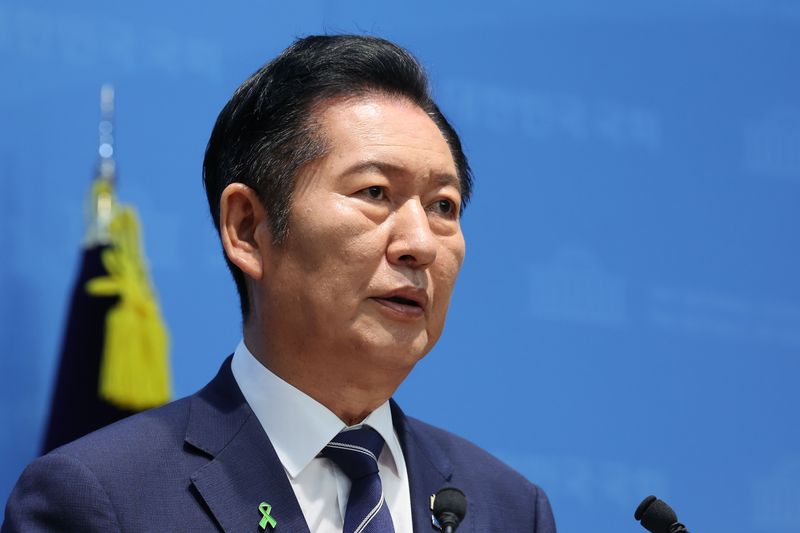
[Financial News] Jung Chung-rae, a candidate for DPK leader, said that the recent decline in President Lee Jae-myung's approval rating was due to the so-called "core supporters" turning away. He added that he expects the rating to rise as soon as he is elected leader of the ruling party.
At a press conference at the National Assembly Communication Center on the 12th, Jung said the president's "concrete support base" had shown signs of shrinking after the June 3 local elections. "I believe Jung Chung-rae has the backing of the traditional support base, and my election will immediately lead to a rise in the president's approval rating," he said. "It will go up by about 5 percentage points right after I am elected, and by about 10 percentage points within a short time as I serve as party leader."
He said the drop in Lee's approval rating was caused by the cooling sentiment of the traditional support base. "If he restores the spirit of people's sovereignty, trusts the people and stays with them, they will respond with high approval ratings at any time," he said. "To lift the president's approval rating, Jung Chung-rae is needed. I will reignite the hearts of the traditional core support base."
He also presented pledges aimed at boosting Lee's approval rating. These include strengthening party-government cooperation, as urged by rival pro-Lee candidates Kim Min-seok and Song Young-gil, speeding up legislation for key state tasks, ending factional politics within the party, and building a foundation for victory in the general and presidential elections through broader pro-government unity.
He also said he would begin his first schedule after winning with policy visits. "If I am elected, my first stop will be Gwangju, where I will inspect progress to ensure the success of the Southwest Semiconductor Cluster," Jung said. "I will immediately begin policy consultations among the party, government, and presidential office to address issues such as Seoul's housing policy and the polarization in the stock market caused by single-stock leveraged ETFs." He added, "I will meet with Choo Mi-ae, Governor of Gyeonggi Province, to discuss the province's fiscal condition."
Major pressure points against the Lee administration include the three mega-projects, including semiconductor investment in Honam; housing issues in the Seoul metropolitan area; the Samsung Electronics and SK hynix leveraged ETF, nicknamed "Samjeonnix"; and Gyeonggi Province's weak finances. His remarks suggest that if elected, he intends to resolve the problems that have put the government in a difficult position.
Specifically, he proposed expanding employment instead of exempting the 52-hour workweek system, which is a key point of contention in the Special Act on Mega Regulatory Free Zones; expanding public housing by normalizing LH; punishing those responsible, including Kim Min-seok, who was prime minister when the Samjeonnix ETF was introduced, and suspending trading; and actively using additional tax revenue generated by the semiconductor boom.
[email protected] Kim Yun-ho Reporter