[Editorial] Opposing Public Institution Relocation for No Reason Is Organizational Self-Interest
- Input
- 2026-08-11 18:26:41
- Updated
- 2026-08-11 18:26:41
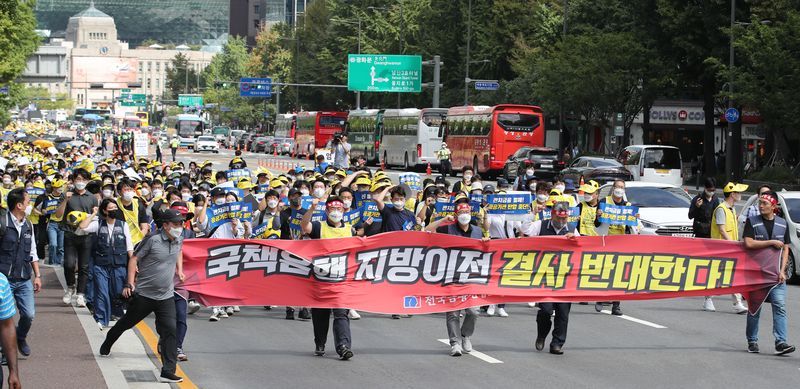
As is well known, the purpose of relocating public institutions is to ease concentration in the Seoul metropolitan area and revitalize regional economies. Unions are opposing the plan, citing the loss of key personnel, weaker competitiveness in new hiring, organizational instability, and a decline in expertise in corporate finance. The first round of public institution relocation was completed in 2019, and 105 public institutions were moved to Innovation Cities, Sejong Special Self-Governing City, and other areas.
According to the National Assembly Budget Office (NABO), the first relocation can be seen as only a partial success. Population increased in six of the 10 locations, but declined in four. A report released on the 9th by the Korea Institute for Industrial Economics and Trade, titled "The Ripple Effects of Public Institution Relocation and the Direction for Building Innovation City Hubs," reached a similar conclusion. It said the share of the population in the Seoul metropolitan area rose even further after the move, and the concentration of young people in the capital region became even more pronounced.
The Korea Institute for Industrial Economics and Trade suggested linking public institution relocation with the development of hub cities nationwide. Rather than distributing institutions evenly across regions, it said they should be concentrated in areas with strong growth potential, large populations, and easy access to metropolitan infrastructure such as major cities. The first relocation of public institutions failed to produce the desired results because it spread them across the country in a piecemeal, share-the-pie manner. Some institutions also complained that moving out of Seoul reduced operational efficiency.
The relocation of state-owned banks, which is drawing the strongest backlash, should also be decided with these issues in mind. The goal is to ease concentration in the Seoul metropolitan area while minimizing any decline in operational efficiency. Even if relocation goes ahead, it is worth carefully reviewing whether, as the Korea Institute for Industrial Economics and Trade suggested, moving multiple institutions to areas with growth potential would be the better option. Please also consider that uniform dispersal does not help regional revitalization and can reduce efficiency.
No one can oppose the purpose and intent of relocating public institutions. If the distorted overconcentration of the Seoul metropolitan area is not changed, national development will suffer. It is only natural that making fuller use of the country's limited land would also support growth.
Moving a single institution on its own will have no real effect. An ecosystem must be built in which institutions, companies, and organizations related to that institution's work gather together and move in an integrated way. The case of the National Pension Service is worth noting. After relocating to Jeonju, North Jeolla Province, the NPS, which had faced criticism over efficiency, has recently achieved results by attracting asset management firms through incentives.
Unions should not simply oppose everything. That can come across as organizational self-interest. The government should decide on relocation with a long-term perspective and, if it does proceed, make the best choice for building an ecosystem and securing efficiency. There will inevitably be growing pains before public institutions settle successfully and contribute to regional development. The side effects seen in government agencies that moved to Sejong should be carefully examined first, and a thorough plan should be drawn up.
To ease the concentration in the Seoul metropolitan area, which is only worsening despite various policies, stronger measures are needed. Building industrial complexes and relocating them to revive local economies is more important than public institutions. The government must make the "Five Mega-Regions and Three Special Self-Governing Provinces Strategy" a success and breathe new life into the regions.