As barriers to single-stock products rise, investors head overseas... Regulation creates a balloon effect [Leverage Regulation: Pros and Cons]
- Input
- 2026-08-11 18:24:14
- Updated
- 2026-08-11 18:24:14
After regulations on Single-Stock Leveraged Exchange-Traded Funds reduced trading and rebalancing demand for related products, some of the supply-and-demand pressures that had been driving stock market volatility appear to have eased. Retail investors are also shifting away from net-selling single-stock leveraged products and buying ETFs that track major domestic and overseas indices or are managed based on them. However, the recent decline in volatility cannot be attributed solely to the regulations, and a 'balloon effect,' in which leverage demand moves into other products, is also seen as a key variable.
■ Selling leverage, buying index ETFs
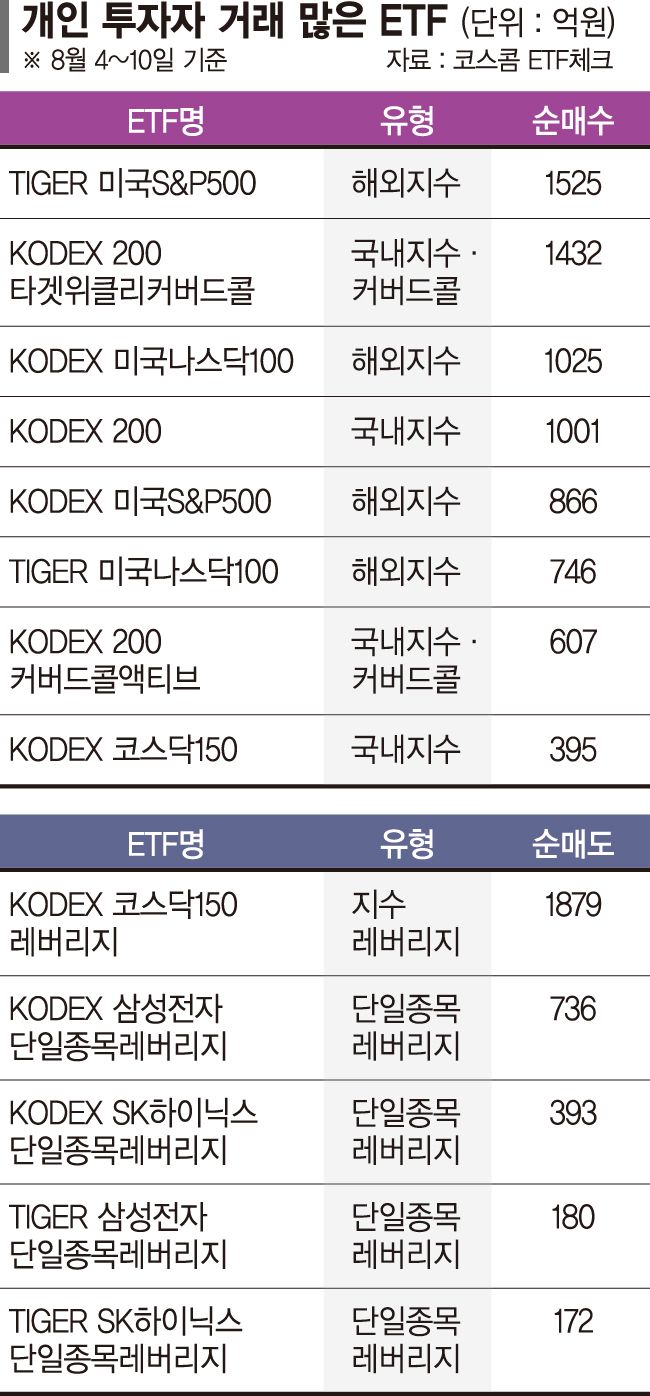
According to Koscom Corporation's ETF Check on the 11th, eight of the top 10 ETFs bought net by retail investors over the past week, from the 4th to the 10th, were index-type or covered-call ETFs that track major domestic and overseas benchmarks or are managed based on them.
During the period, retail investors bought 152.5 billion won of TIGER U.S. S&P 500 on a net basis. They also purchased Samsung KODEX 200 Target Weekly Covered Call ETF worth 143.2 billion won, KODEX NASDAQ 100 worth 102.5 billion won, and Samsung KODEX 200 ETF worth 100.1 billion won.
By contrast, leveraged ETFs dominated the list of top net sellers. KODEX KOSDAQ 150 Leverage ETF saw 187.9 billion won in net selling, while Samsung Electronics Single-Stock Leveraged ETF and KODEX SK Hynix Single Stock Leverage ETF were also sold, with net selling of 73.6 billion won and 39.3 billion won, respectively. Over the week, retail net selling of 14 single-stock leveraged ETFs based on Samsung Electronics and SK hynix reached 1.2598 trillion won.
Brokerage firms say retail demand for high-leverage investing fell quickly as last month's market plunge coincided with tighter basic deposit requirements. As the circuit breaker mechanism was triggered on the KOSPI for two straight days on June 28 and 29, the asset size of single-stock leveraged ETFs and rebalancing trades also shrank.
Lee Sang-heon, a researcher at iM Securities, explained that "some of the money appears to have moved into products that diversify across the broader market, such as the S&P500, KOSPI, and KOSDAQ."
■ Easing supply-demand concentration... but the 'balloon effect' remains a variable
The contraction in the single-stock leveraged market is viewed positively because it reduces excessive concentration in supply and demand. Leveraged ETFs rebalance by buying more when the underlying asset rises and selling when it falls in order to maintain their target leverage ratio. In sharp swings, this structure can amplify volatility because it triggers trades in the same direction as price movements.
Expected market volatility has also declined. The KOSPI 200 Volatility Index (V-KOSPI) fell to 75.05 this month from monthly averages of 84.82 in June and 84.73 in July. The index, which had climbed to 97.99 on June 29, dropped to 69.55 on the 10th.
Still, brokerage analysts say it is difficult to see this as a direct effect of the higher deposit requirement alone. The market rebound, the easing of the sharp selloff in semiconductor stocks, and global market trends all played a role. They also argue that the effectiveness of the regulation should be judged less by the direction of stock prices and more by how much it has reduced concentration in leveraged products and the factors that amplify volatility.
There is also a possibility that investment demand will shift into other leveraged products to avoid the regulation. Korea Investment & Securities noted that as trading in single-stock leveraged products declined, activity increased in semiconductor sector leveraged ETFs with heavy exposure to Samsung Electronics and SK hynix. This suggests that even if domestic regulations tighten, leverage demand could move into sector-based or overseas-listed products.
Jung Hyun-jong, a researcher at Korea Investment & Securities, said that if the scale of overseas leveraged and inverse ETFs expands, the rebalancing demand from those products could affect volatility in the domestic market through foreign momentum-driven trading. He added that although trading in single-stock leveraged products has fallen quickly, leverage demand itself has not disappeared, so the market-stabilizing effect of the regulation and the extent of demand shifting still need to be examined further.
[email protected] Lim Sang-hyeok Reporter