Apple Boosts China’s Advanced Industries, Using Its Supply Chain to Push Back Against South Korea
- Input
- 2026-08-11 18:20:16
- Updated
- 2026-08-11 18:20:16
■ Apple gives CXMT a fast lane
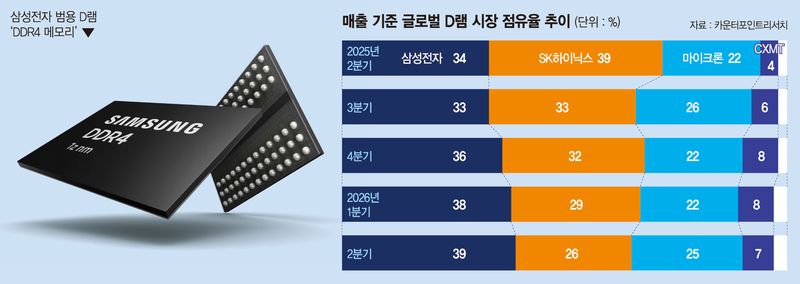
On the 11th, South Korea’s semiconductor industry was closely watching whether CXMT would enter Apple’s supply chain. The technology gap is still clear for now, but if CXMT can supply large volumes to a big tech company like Apple, it could secure a foothold in the commodity memory market earlier than expected. Industry observers say this would not only improve CXMT’s technology and production capacity, but also boost market confidence in Chinese-made memory chips. In the market, if CXMT’s DRAM wafer input capacity rises to around 350,000 wafers per month by the end of this year, it could come close to Micron, the world’s third-largest memory maker, which has a monthly capacity of 375,000 wafers. CXMT has already secured supply deals with major PC makers such as HP and ASUS. Analysts say Apple is now giving CXMT an even faster lane after the company recently raised about 14 trillion won through its IPO to fund investment. Lee Jong-hwan, a professor in the Department of System Semiconductor Engineering at Sangmyung University, said, "CXMT is growing at a very fast pace," adding, "If it is added to Apple’s supply chain, its growth could accelerate even further." What Apple seeks by bringing in CXMT is pricing power over the memory “big three” — Samsung Electronics, SK hynix, and Micron.
Cook has recently voiced strong public dissatisfaction with rising memory prices. During Apple’s earnings announcement on the 30th of last month, he described the surge in memory prices as "a once-in-a-century flood-like situation." Ahn Ki-hyun, executive director of the Korea Semiconductor Industry Association, said of CXMT’s DRAM competitiveness, "For commodity products used in smartphones and similar devices, it is hard to say there is a major performance gap between CXMT and domestic companies," adding, "If Apple secures an additional supplier like CXMT, it will inevitably gain more leverage in price negotiations with existing memory makers." Lee also explained, "With memory supply from Samsung Electronics and SK hynix currently not smooth and prices still high, Apple, which uses a large amount of memory, needs to secure volume in advance. Even if some performance is lower, it can be seen as trying to secure supply by using Chinese products as well."
■ The dual-sourcing strategy deserves attention
Industry watchers say that if CXMT actually enters Apple’s supply chain, it could become a turning point that accelerates the expansion of China’s memory industry into overseas markets. A semiconductor industry source in South Korea said, "Supplying Apple is not just about securing volume. It also means having product quality and stability recognized in the global market." The source added, "If CXMT really enters Apple’s supply chain, other global customers may also begin to view Chinese memory differently, and that could become an important turning point for the overseas expansion of China’s memory industry."
South Korea’s industrial sector says Apple appears to be following a pattern similar to the one it used when it included BOE in its OLED supply chain. Many believe Apple strategically nurtured BOE to check the dominant competitiveness of Samsung Display and LG Display. An industry source in the display sector said, "Apple has strategically expanded its Chinese supply chain to secure pricing power," adding, "Even so, BOE has still not entered the lineup for flagship models." The pattern appears to be repeating: core components are sourced from South Korea and Taiwan, while commodity parts are sourced from China under a dual-sourcing strategy.
The key issue is whether the Trump administration in the United States will approve the move. With CXMT already closing in on Micron, some question whether Washington would readily side with Apple. The Trump administration has tightened controls on exports of advanced semiconductor technologies and equipment in response to China’s rise in the chip industry.
[email protected] Jo Eun-hyo, Im Su-bin, Jeong Won-il Reporter